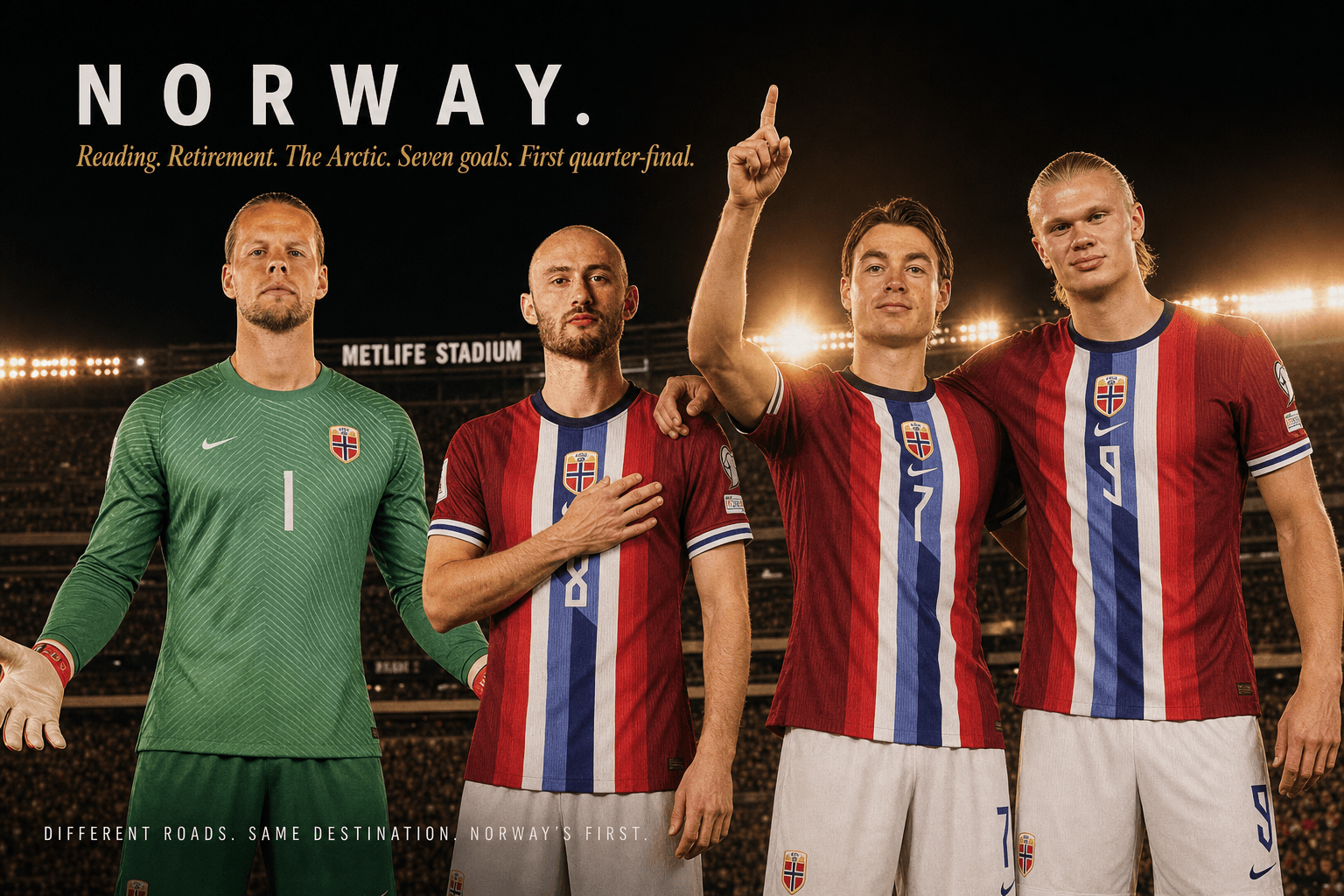
At some point this week, a Norwegian journalist will ask Ørjan Nyland how it feels to be the goalkeeper who saved Bruno Guimarães's penalty and kept out Vinicius Junior's low drive and somehow touched an Ajer back-pass onto the post to prevent Brazil scoring, all within the space of one round-of-16 match at a World Cup that Norway had not attended in 28 years. And Nyland — who spent part of his career at Reading in the English Championship, who this season played four league games for Sevilla as their third-choice option, who is 35 years old and will turn 36 in September — will give an honest, measured answer about being ready when his opportunity came. The specific journey that produced that readiness is one of football's better stories from this World Cup. It is also a story about what happens when a manager builds a team around a culture rather than around names — and what happens when that culture, on the right day, beats a squad with 2.73 expected goals.
Orjan Nyland: From Reading to Brazil's Penalty Spot
The career of Ørjan Nyland is a map of professional football's less-photographed corners. Born in 1990 in Volda, Norway, he began at Hødd — a club from his local municipality — before joining Molde, where Ole Gunnar Solskjær handed him his professional breakthrough. Bundesliga club Ingolstadt bought him in 2015. Aston Villa signed him in August 2018, where he helped them win promotion to the Premier League through the 2019 play-off final. He played seven Premier League matches before Villa terminated his contract in 2020.
Then followed the period that defines the specific quality of what he produced against Brazil. Norwich City, where he barely played senior minutes. Bournemouth in the Championship. Reading in the Championship. RB Leipzig on a short-term emergency contract — two Bundesliga appearances, part of the squad that won the DFB-Pokal. Then Sevilla in 2023, joining as backup. In 2025-26, he played four LaLiga matches. Yahoo Sports confirmed this was his 75th senior Norway cap and, by far, the biggest game of his career. Since 2023 he has just 59 total appearances at Sevilla across three seasons — rarely a full-time starter.
In the 14th minute at MetLife Stadium, Bruno Guimarães — a midfielder who had never taken a senior Brazil penalty — stuttered in his run-up. Nyland saved it. He then denied Vinicius Junior. He got a touch on Martinelli's drive. He stuck out a leg to thwart Rayan. He somehow touched an Ajer back-pass onto the post. He jawned with Neymar before and after the stoppage-time penalty. And when the final whistle confirmed Norway 2-1 Brazil, the 35-year-old goalkeeper who plays four league games a season had been the best player on the pitch. He was named Man of the Match. Reading to Man of the Match in a World Cup round of 16. The journey is not linear. The destination is real.
Fredrik Aursnes: The Man Who Retired and Changed His Mind
In March 2024, Fredrik Aursnes told the Norwegian Football Federation he was done with international football. He was 28. He had 20 caps. He wanted time and freedom to prioritise other things. Norway were still years away from a World Cup. The retirement was quiet and understandable. Then Norway qualified for the 2026 World Cup. On February 3, 2026 — four months before the tournament began — Aursnes reversed his retirement. As his country entered the World Cup finals for the first time in 28 years, the midfielder who plays for Benfica decided he wanted to be part of it.
The specific arc of Aursnes's career is the broader Norwegian football story in one player. He won the Norwegian Cup at 16 with Hødd — the youngest ever winner. He joined Molde, won the Eliteserien. He moved to Feyenoord in the Eredivisie, reached the 2022 Conference League final against Roma. He signed for Benfica for 13 million euros in 2022, has won the Liga Portugal title and the Portuguese League Cup. He is a Champions League regular at a club that has competed with the continent's best. He retired from Norway at 28. He changed his mind because the World Cup was too large to miss. His comeback adds a specific quality — versatility across five positions, the technical understanding of a player who has operated at the highest European club level for three consecutive seasons — that Solbakken could not have replaced from within the remaining pool. The World Cup is his first. He is 30. He is here.
Patrick Berg and the Bodø/Glimt Blueprint
Patrick Berg is the captain of Bodø/Glimt — a club from Bodø, a city of 50,000 people inside the Arctic Circle in northern Norway, where the sun does not set in summer and the winters are dark for months at a time. He is also the captain of the Norway national team in this World Cup. Berg told UEFA after Bodø/Glimt's stunning run through the 2025-26 Champions League: "As players, we almost feel like we're living in a dream. It's something we'll look back on in many years and probably think it was a bit surreal that it happened." In the same Champions League campaign, Bodø/Glimt beat Manchester City at home in the league phase, won 2-1 away at Atlético de Madrid, drew 2-2 with Borussia Dortmund, and then beat the previous year's Champions League runners-up Inter Milan 5-2 on aggregate in the knockout play-offs. The club from the Arctic Circle, without the budgets, the stadiums, or the global brands of the teams they were beating, reached the Champions League Round of 16 by outcompeting elite opponents on pure tactical intelligence and collective belief.
That specific experience — of Berg and Jens Petter Hauge and Fredrik André Bjørkan winning in Rome, in Madrid, in Milan, in Manchester — is the preparation for what Norway are doing at this World Cup. When you have beaten Man City on your own pitch, the MetLife Stadium crowd cheering for Brazil is loud but not unprecedented. When you have kept your shape against Inter for 180 minutes across two legs, keeping your shape against Vinicius Junior in the second half of a World Cup knockout match is demanding but familiar. The Bodø/Glimt blueprint — small club, elite mentality, collective over individual — is the Norway national team blueprint. Berg brings it directly from club to country.
Sander Berge: Fulham, the Premier League, and the Right Amount of Elite
Not every player in this Norway squad represents an impossible journey. Sander Berge plays for Fulham in the Premier League. He is an established top-flight midfielder — not Bellingham, not Pedri, not Rodri — but a technically reliable, physically imposing central midfielder who does the job his system requires without drawing attention away from the player who does draw attention. Berge controls the defensive phase when Haaland's movement pulls the opposition's defensive attention. He recycles possession when Odegaard's passing range is being monitored. He is the player whose name does not appear in headlines but whose absence would change how the system functions. In the lineup against Brazil — confirmed by NBC Sports: Nyland; Ryerson, Ajer, Heggem, Moller Wolfe; Odegaard, Berge, Berg; Sorloth, Haaland, Nusa — he sits beside Berg in the double pivot, the specific pair that keeps the ball moving and provides the defensive cover when Norway transition. Fulham in the Premier League. Exactly the right amount of elite for this specific role.
Reading in the Championship. Benfica from retirement. The Arctic Circle captain who beat Man City and Inter Milan. Fulham. And Erling Haaland with seven goals. Norway have reached their first-ever World Cup quarter-final with a goalkeeper who barely plays club football, a midfielder who retired and changed his mind, a club captain from a city of 50,000 people inside the Arctic Circle, and the world's most lethal striker. This is not an accident. This is what Ståle Solbakken built.
The Viking Culture and What This World Cup Means for Norway
There is a specific quality in Norwegian football culture that the 2026 World Cup has made visible to a global audience: the collective over the individual, the group over the name, the belief that preparation and organisation can overcome the resource gap that separates Norwegian clubs from the Champions League's wealthiest members. Norway is a nation shaped by its geography — the fjords, the Arctic winters, the sea routes that define a country where collective effort in challenging conditions is not a sporting philosophy but a historical survival mechanism. The Viking tradition that outside observers reference is not mythological decoration. It is the specific cultural inheritance of a society that solved its collective challenges through cooperation and navigation rather than through hierarchy and deference. Solbakken's Norway plays that way. Not everyone is Haaland. The ones who are not Haaland matter as much as the one who is.
Whatever happens against England in Miami on July 11, this World Cup is permanent for Norway. As we explored in our piece on Norway's 28-year absence from the World Cup and what the return means, an entire generation of Norwegian players grew up, had careers, and retired without experiencing this tournament. Nyland is 35. He joined Molde in 2013. He has waited thirteen years for his 75th Norway cap to be played in front of a sold-out stadium in a World Cup knockout match. The Reading years, the Bournemouth months, the four LaLiga appearances this season — all of that was the path to the one save that ended Brazil's campaign. The quarter-final is the reward for the entire arc. And it is Norway's first.
What Winning This Tournament Would Mean for Norwegian Football
Norway have not won a major international trophy. They have not reached a World Cup semi-final. But the 2026 tournament has already changed Norwegian football's reference point permanently. The generation of players who grew up without ever seeing Norway at a World Cup — the coaches, the young academy players, the children watching Nyland save penalties and Haaland score twice in the final eleven minutes — have their reference point now. As we noted in our piece on why Norway were always the tournament's most dangerous dark horse, the argument for their quality was always structural: they had the world's best striker, an Arsenal captain in midfield, a Champions League-experienced goalkeeping setup, and a manager who understood how to organise a team around Haaland's specific movement without making the entire system dependent on his involvement. Against Brazil, that argument became a scoreline. The scoreline is now history. And Nyland, Aursnes, Berg, and Berge are the names attached to it.
Nyland, Aursnes, Berg, Berge — the squad that eliminated Brazil and reached Norway's first World Cup quarter-final. Which player's story do you find most extraordinary — and do you think Norway can beat England and reach the semi-finals? Tell us below.