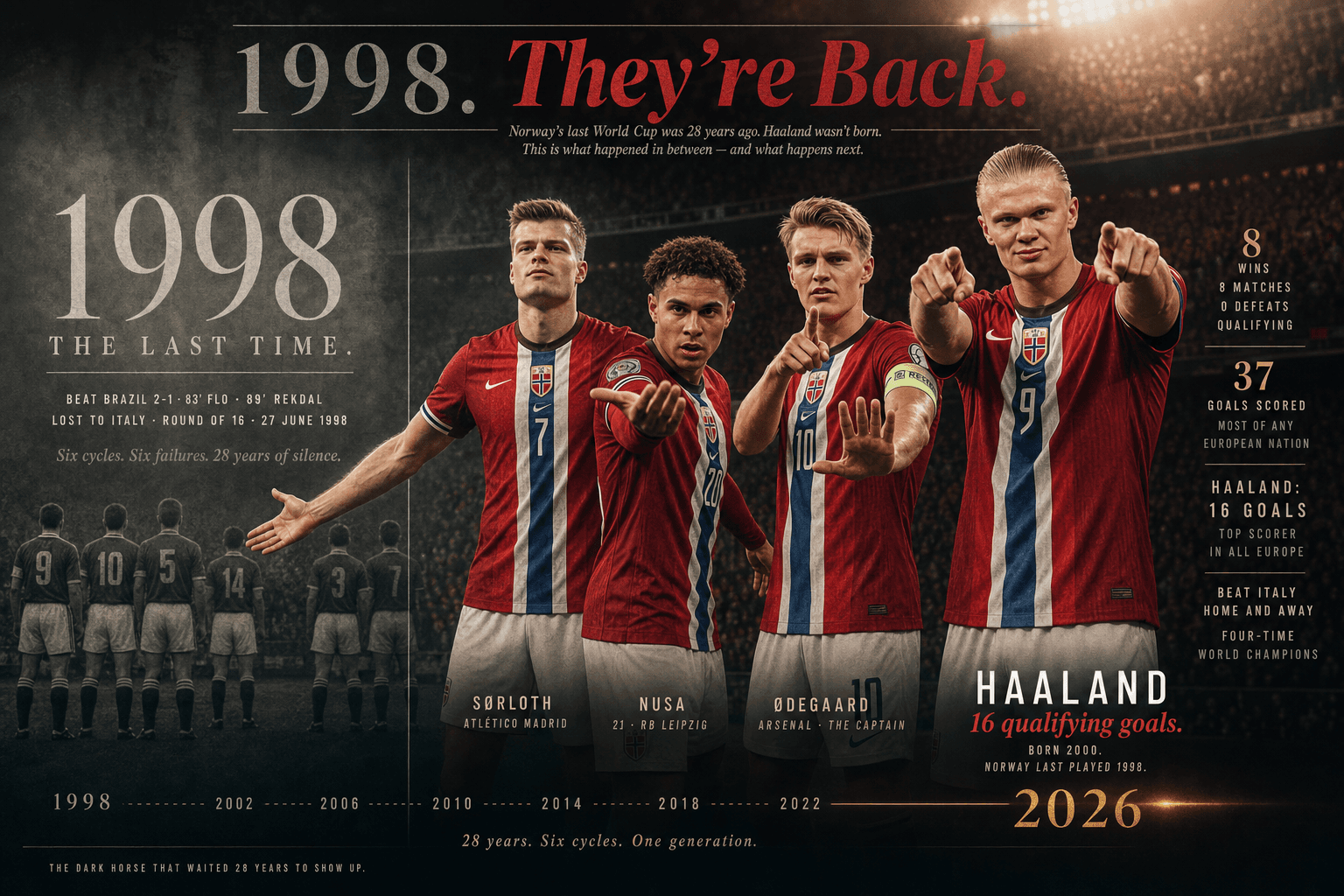
Norway's last World Cup appearance was in 1998, in France. Their final match was a 1-0 defeat to Italy in the Round of 16 on 27 June 1998 at the Stade Vélodrome in Marseille. The stadium emptied. The squad flew home. Nobody who was watching that day would have predicted that Norway would not be back at a World Cup for another 28 years. That is how long the gap turned out to be. The 2026 World Cup in North America is Norway's first appearance at football's biggest stage since June 1998 — and Erling Haaland, the striker leading the line, was born two years after Norway's last World Cup game was played.
When Did Norway Last Appear at a World Cup?
Norway last appeared at the World Cup in 1998, in France. Their qualifying group that year contained Brazil — the tournament favourites — and they produced one of the most famous giant-killing results in World Cup history. On 23 June 1998 in Marseille, Norway beat Brazil 2-1. They were 1-0 down to Bebeto's goal with eleven minutes remaining. Tore André Flo equalised in the 83rd minute. Then Kjetil Rekdal converted a penalty in the 89th minute. The game ended 2-1 to Norway. They had beaten the tournament favourites, in the group stage, coming from behind in the final twelve minutes.
That same group stage also contained Morocco and Scotland. Norway finished second, qualified for the Round of 16, and met Italy in Marseille. A single Marco Delvecchio goal ended Norway's tournament. The squad flew home having beaten Brazil, eliminated them from the group stage, and reached the knockout rounds. It was, by any measure, Norway's best tournament performance in the modern era. They have not been to a World Cup since.
Norway's full World Cup history: 1938 (group stage), 1994 (group stage, their first-ever World Cup point in a 0-0 draw with South Korea), 1998 (Round of 16, beat Brazil 2-1 in group). Three appearances total. Their best performance: 1998. The 2026 tournament in North America is their fourth.
Why Did Norway Miss Six Consecutive World Cups?
The 28-year absence between 1998 and 2026 was not a single failure. It was six consecutive qualifying campaigns, across six different cycles, where Norway fell short at the decisive moment. The generation of Tore André Flo, Kjetil Rekdal, and Ole Gunnar Solskjær faded. The quality that produced the Brazil result did not translate into a successor generation with the same competitive level. Norwegian club football developed, but the domestic system was not producing the consistent stream of top-European-level professionals that international qualification requires.
The most painful near-miss was the 2022 qualifying cycle. Norway were placed in a group with the Netherlands and Turkey — two teams with significant international pedigree and substantial depth. Critically, Erling Haaland missed key qualifying matches through injury. Without their most dangerous goalscorer in multiple decisive games, Norway finished third and missed Qatar entirely. The group, in hindsight, was winnable with a fit Haaland. Instead, the 2022 World Cup happened without Norway, and Haaland watched it happen knowing exactly what his absence had cost.
The 2026 qualification was the correction. Norway won all eight qualifying matches. They scored 37 goals — the most of any European nation. Haaland scored 16 of them. The cycle that followed 28 years of failure produced the cleanest, most dominant qualifying campaign any Norwegian team has ever run.
Is Erling Haaland the Main Reason Norway Are Considered a Dark Horse at the 2026 World Cup?
Yes — but not for the reason most previews suggest. Haaland is not Norway's dark horse status because of his name recognition or his trophy count or his goal record at club level. He is the reason because of a specific, irreducible threat: a team built around a striker who produces something in the 73rd minute that no defensive plan can fully account for is, by definition, dangerous in tournament football. You can plan for a system. You cannot fully plan for a player who scored 16 qualifying goals and whose country has not been to a World Cup in 28 years.
But the case for Norway as a dark horse extends beyond Haaland specifically. As we documented in our full Norway dark horse analysis, the squad contains Martin Ødegaard — Arsenal's Premier League-winning captain — Alexander Sørloth of Atlético Madrid, Antonio Nusa of RB Leipzig, and Sander Berge of Fulham. Three centre-forwards who start for clubs in Europe's major leagues. A defensive and midfield structure built by Ståle Solbakken over five years of deliberate preparation. If you focus on Haaland as the single reason, you miss the system that makes Haaland possible and the squad that gives opponents a second problem when they double-mark him.
The more precise answer is: Haaland is the reason Norway's dark horse status has teeth. Without Haaland, Norway with Ødegaard and Sørloth and Nusa is a competitive side capable of reaching the knockout rounds. With Haaland, Norway is a team that can eliminate anyone in the bracket on a single night.
Haaland was born in July 2000 — two years after Norway's last World Cup game was played. He has spent his entire life watching a national team that kept falling short. The 2026 World Cup is not just his first tournament. It is his generation's first tournament. That is a different kind of motivation from a player who has won five Champions Leagues by proxy from his armchair.
Norway's 2026 World Cup Qualifying Record: The Numbers That Back the Dark Horse Tag
The dark horse label requires evidence, not just narrative. Norway's qualifying record provides it. Eight matches played. Eight wins. Zero defeats. Zero draws. Thirty-seven goals scored — the highest total of any European nation in the qualification phase. Haaland's 16 goals made him the top scorer across the entirety of European qualifying, double the next highest individual. They beat Italy — four-time world champions — home and away. Italy, who then had to navigate the play-offs just to reach the tournament.
A perfect qualifying record against European competition, including home and away wins over a four-time world champion, is not the typical profile of a team that should be dismissed in the tournament's early rounds. The gap between Norway's qualifying performance and their perceived status as a group-stage curiosity is the specific arbitrage that makes them the dark horse rather than simply an interesting team.
Norway's Group I: France, Senegal, Iraq — What the Dark Horse Needs
Norway were drawn in Group I alongside France, Senegal, and Iraq. The path to the knockout rounds is clear: beat Iraq, which should be achievable, and take something from Senegal. A draw against Senegal combined with a win over Iraq puts Norway through. If France have already qualified, the final group game becomes an opportunity rather than a pressure point.
The threat Norway represent in the knockouts is what makes the dark horse label genuinely applicable rather than aspirational. In the Round of 16, Norway could face England, Portugal, the Netherlands, or Germany. All four of those games are winnable on a night when Haaland produces one decisive moment from a platform built by Ødegaard, Nusa, Berge, and Solbakken's defensive system. Norway are not going to win the World Cup. But the team that beat Brazil with 11 minutes remaining in 1998 — with Tore André Flo and Kjetil Rekdal — has a very specific history of doing things in knockout-adjacent moments that nobody expected.
This time they have Haaland. And Haaland, as explained in the story of why Manchester City threatened legal action when a Real Madrid candidate tried to sign him before his first World Cup, is going nowhere. He is at his first World Cup, with a squad built around him, playing for a nation that waited 28 years for this. The last time Norway beat the tournament favourites in a World Cup group stage, nobody was talking about them before the game either.
What the 1998 Result Against Brazil Tells You About 2026
The most important piece of historical context for understanding Norway in 2026 is not their record or their qualifying numbers. It is the specific nature of the 1998 result against Brazil. Norway were losing with eleven minutes remaining against the tournament favourites — a team containing Ronaldo, Bebeto, Rivaldo, and Roberto Carlos. The most talented forward line in the world. Norway were going out. They scored twice in six minutes and won. That is not a team that happens to be good. That is a team that produces decisive moments in decisive moments, against the best opponents available, in the least expected way.
The 2026 squad does not have Tore André Flo. It has Erling Haaland, who is several magnitudes more dangerous than Flo was in 1998. It does not have Kjetil Rekdal. It has Martin Ødegaard, the Premier League champion who captains Arsenal, and Antonio Nusa, the 21-year-old Leipzig winger who terrorised Bundesliga defences all season. The 1998 squad had one player of genuine European-elite quality. The 2026 squad has five or six. The dark horse label, for Norway, is not flattery. It is historical precedent.
Solbakken, Norway's manager, has been building this specific squad for five years. When you read about Manchester City's decision to lock Haaland down until 2034, understand that the guarantee of Haaland's availability for the next eight years of World Cup cycles is the guarantee of Norway's relevance across the same period. This is not their only chance. But it is their first. And the 1998 team, with far less talent, beat Brazil on the biggest stage. What Norway do with this generation in 2026 is, on any reasonable reading of the evidence, the most interesting open question in the tournament.
Norway last appeared at a World Cup 28 years ago. Haaland wasn't born when they last played. Is this the World Cup that changes the story — and do you think Norway can beat one of the big nations in the knockout rounds? 👇