Six of the eight teams left in this World Cup are European. One is South American. One is African. No team from Asia, North America or Oceania survived the Round of 16. It is the clearest statement yet of a shift that has been building for a decade: European club football, and specifically the Champions League ecosystem behind it, now produces the players who decide World Cups, regardless of which flag they play under. This isn't a one-off quirk of a single bracket — it is the continuation of a trend that has been visible in every recent edition of this tournament, just never quite this pronounced.
The Quarter-Final Lineup, By Confederation
France, England, Norway, Spain, Belgium and Switzerland represent UEFA in the last eight. Morocco is CAF's sole survivor. Argentina is the only team left from CONMEBOL. Every team from CONCACAF, including all three co-hosts Canada, Mexico and the United States, is out, a detail BackPage FC covered in depth in our piece on the USA's elimination and Pochettino's uncertain future. The AFC and OFC are absent entirely, with every Asian representative and Oceania's lone qualifier failing to survive the group stage or Round of 32. Whichever way the bracket is sliced, this is one of the most Europe-heavy quarter-final fields in the tournament's history, surpassing even the 2018 and 2022 editions, both of which still had at least two non-European teams reach the last eight, underlining just how sharply this tournament's knockout rounds have tilted toward a single continent.
The explanation isn't really about nationality at all. It's about where these players actually learn the game. Of the 16 knockout-round teams eliminated so far, the vast majority fielded starting elevens drawn overwhelmingly from the Premier League, La Liga, Bundesliga, Serie A and Ligue 1 — including Morocco and Argentina, the two survivors from outside Europe. Morocco's own squad is built on players who came through French, Belgian, Dutch and Spanish academies, a pattern BackPage FC examined closely in our piece on the diaspora pipeline behind France and Morocco's squads. Argentina's spine, from Emiliano Martínez to Lionel Messi's supporting cast, is built almost entirely around players plying their trade across Europe's top five leagues, even though the country itself sits outside the confederation entirely, a detail that complicates any simple story about geography deciding this tournament.
Two Late Collapses That Prove the Point
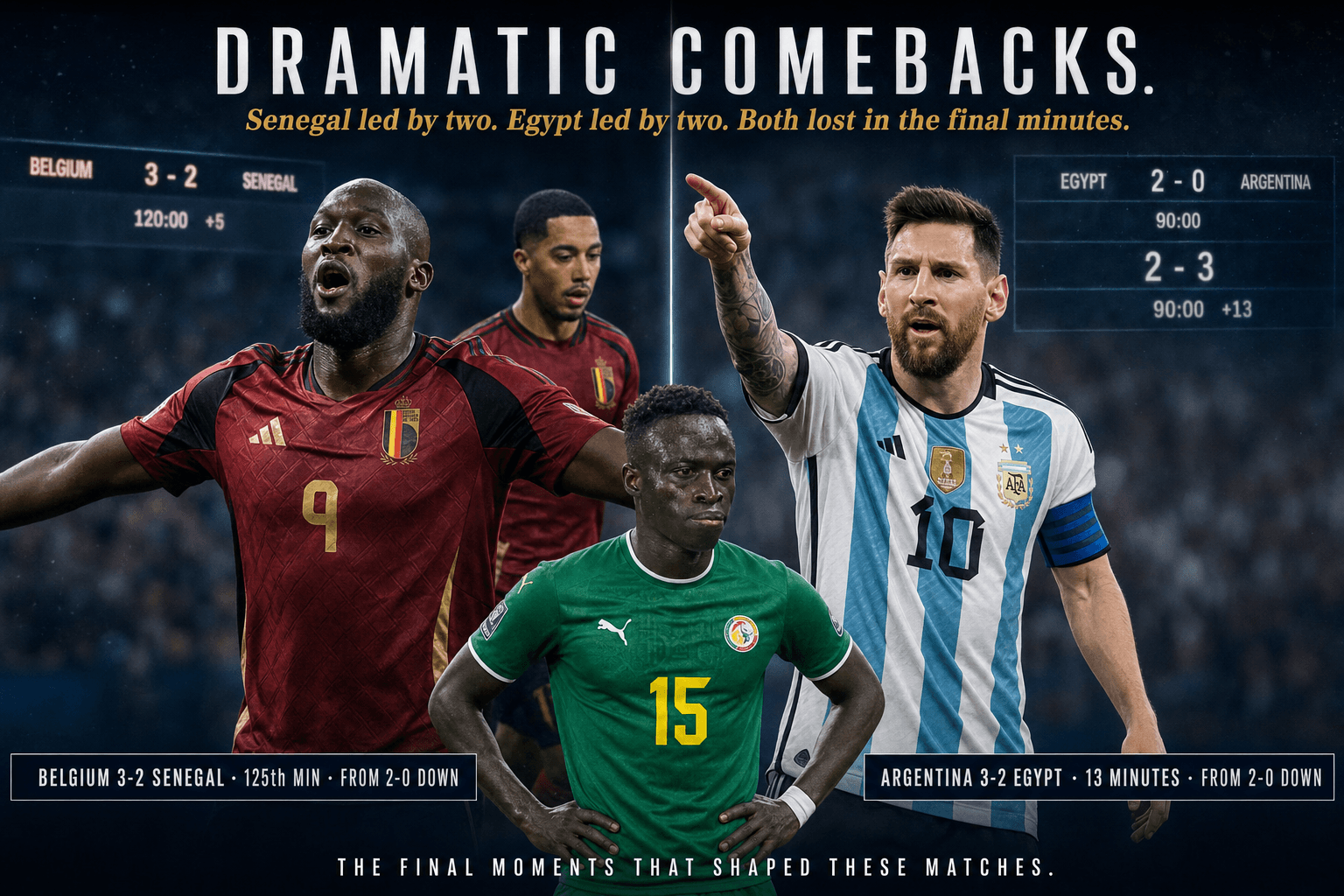
Nothing illustrates the gap better than how Senegal and Egypt were eliminated, in two knockout matches played on different continents' worth of expectation but united by an almost identical script. Senegal led Belgium 2-0 with five minutes of normal time remaining in their Round of 32 tie in Seattle, only for Romelu Lukaku and Youri Tielemans to score twice in three minutes to force extra time, before Tielemans converted a controversial 125th-minute penalty to complete a 3-2 comeback — the latest goal in World Cup history and only the second time in the last 11 editions that a team has come back from two or more goals down in the knockout rounds to win. Egypt led Argentina 2-0 with roughly 13 minutes to go in their Round of 16 tie in Atlanta, only for Cristian Romero, Messi and Enzo Fernández to score three times in the closing stages to win 3-2, a match BackPage FC broke down in full in our piece on the controversy surrounding that result.
Both African teams did the hard part. Both built two-goal leads against European and South American opposition through organisation, discipline and moments of real quality — Habib Diarra and Ismaila Sarr's finishes for Senegal, Yasser Ibrahim and Mostafa Ziko's for Egypt. And both lost their nerve, their legs, or their tactical shape in the final ten to fifteen minutes, against opponents whose reserves of match-fitness, squad depth and knockout-game composure came directly from playing at the highest club level in Europe week after week, season after season. Senegal defender Krépin Diatta put it bluntly afterwards, saying his team simply had to defend its box better in those closing minutes and take responsibility for failing to see the game out, rather than looking for excuses in Belgium's quality alone.
Senegal led Belgium 2-0 with five minutes left. Egypt led Argentina 2-0 with thirteen minutes left. Both lost.
The symmetry between those two results is almost too neat to be coincidence. Both African sides were clearly the better team for large stretches of their respective matches. Both built commanding leads through genuine attacking quality rather than fortune or good luck, and both were undone not by a single moment of misfortune or bad luck, but by a cumulative inability to see out a knockout match against opponents who simply had more quality left in the tank when it mattered most — physically, tactically and psychologically.
Why the Champions League Keeps Winning This Argument
This is precisely why the Champions League, rather than any individual domestic league, has become the dominant global product in football. It is the competition where the players who go on to decide World Cups spend nine months a year competing against each other at the highest possible intensity, week in and week out, refining exactly the kind of composure that both Senegal and Egypt were missing in their closing minutes. Belgium's Lukaku, Tielemans and Kevin De Bruyne, Argentina's Messi, Julián Álvarez and Enzo Fernández, and France's entire front line all built their game inside that same competitive environment before ever wearing their national shirts in a World Cup knockout match. a theme also explored in our list of managers who have won both the Champions League and the World Cup. It is no coincidence that the four semi-finalists from the 2025-26 Champions League — drawn from England, Spain, France and Germany's top clubs — map almost exactly onto the nations now dominating this World Cup's quarter-final field.
The knock-on effect is that a talented squad built outside that ecosystem, however well-coached and organised, is being asked to match fitness levels, squad depth and big-game nerve against players who have already been tested at that intensity for the better part of a decade. Morocco's own presence in the last eight — covered in our quarter-final field breakdown — and Senegal's near-miss before it, suggests African football's route into this conversation increasingly runs through the same European academies and leagues that develop everyone else, rather than through isolated domestic development. Even Egypt's own attacking spine, built around Mohamed Salah's decade in the Premier League and Omar Marmoush's move to Manchester City, reflects the same underlying truth: the closer an African federation's best players get to European club football's top level, the more competitive that federation becomes on the World Cup stage, right up until the moment a genuinely elite opponent finds its extra gear in the final ten minutes.
Morocco's Achievement Looks Even Bigger in This Context
All of this makes Morocco's own place in the quarter-finals more impressive, not less. They are only the fifth African nation ever to reach this stage, following Cameroon in 1990, Senegal in 2002, Ghana in 2010 and their own run in 2022, and they are now doing it in back-to-back tournaments — the first African side ever to manage that feat. Morocco's own squad construction, leaning heavily on players developed inside European academies while retaining a core of domestically developed talent, may end up being the clearest template for how the rest of the continent closes the gap, precisely because it does not require waiting a generation for infrastructure to catch up. It simply requires identifying, recruiting and integrating diaspora talent faster and more effectively than African federations have managed historically, a lesson that CAF's other member federations would do well to study closely over the next four-year cycle rather than treating Morocco's success as an isolated exception.
What Other Continents Can Actually Learn From This
There are really only two paths on offer, and most federations outside Europe are already choosing one of them. The first, exemplified by Morocco and by Cape Verde's diaspora-built squad, which BackPage FC examined in detail in our piece on how European academies are shaping African football, is to actively recruit players developed in Europe who retain eligibility through family heritage, effectively importing the European development advantage through dual nationality rather than trying to replicate it domestically. It is not a perfect solution — it depends on European clubs continuing to develop African-heritage talent in the first place — but it has already produced Morocco's run to a second consecutive World Cup quarter-final and came within ten minutes of doing the same for Senegal. It is not a perfect solution either — it can create exactly the kind of identity tensions that followed Ayyoub Bouaddi's switch from France's youth setup to Morocco's senior team — but the results on the pitch speak for themselves.
The second path, considerably harder and slower, is to build the same environment domestically: academies with the coaching quality, competitive intensity and financial backing to replicate what a Premier League or La Liga club offers a 16-year-old prospect. No confederation outside Europe has managed this at scale yet, which is exactly why the diaspora-recruitment path has become the more common shortcut. CONCACAF's failure this tournament, with all three co-hosts eliminated before the quarter-finals despite home advantage and record investment in the sport across Canada, Mexico and the United States, suggests that money and infrastructure alone are not enough without the deep, multi-generational competitive culture that Europe's top leagues have built over more than a century. The United States in particular poured enormous resources into its domestic pathway over the last four years, hiring a manager with genuine elite pedigree in Mauricio Pochettino, and still finished with a fourth Round of 16 exit in five World Cups — clear evidence that infrastructure spending alone cannot manufacture the knockout-stage composure that only comes from sustained exposure to Europe's best competitions.
The uncomfortable truth for federations in Africa, Asia, North America and Oceania is that there is no shortcut that fully closes the gap in the short term. Diaspora recruitment can produce a Morocco or a near-miss Senegal. Genuine domestic development, of the kind that would let a nation compete on both fronts simultaneously, appears to be at least a generation away for any confederation outside Europe and South America's traditional powers. Until that changes, tournaments like this one, where six of the last eight come from a single continent, are likely to keep repeating rather than being a one-off anomaly. The lesson from Senegal and Egypt's late collapses isn't that their players lacked quality or heart — it's that ninety minutes of matching Europe's best is not the same thing as matching them for the final ten, and that gap is exactly where Europe's structural advantage still shows up most clearly.
Should African, Asian and North American football federations prioritize diaspora recruitment or long-term domestic academy investment as the faster route to closing the gap with Europe?