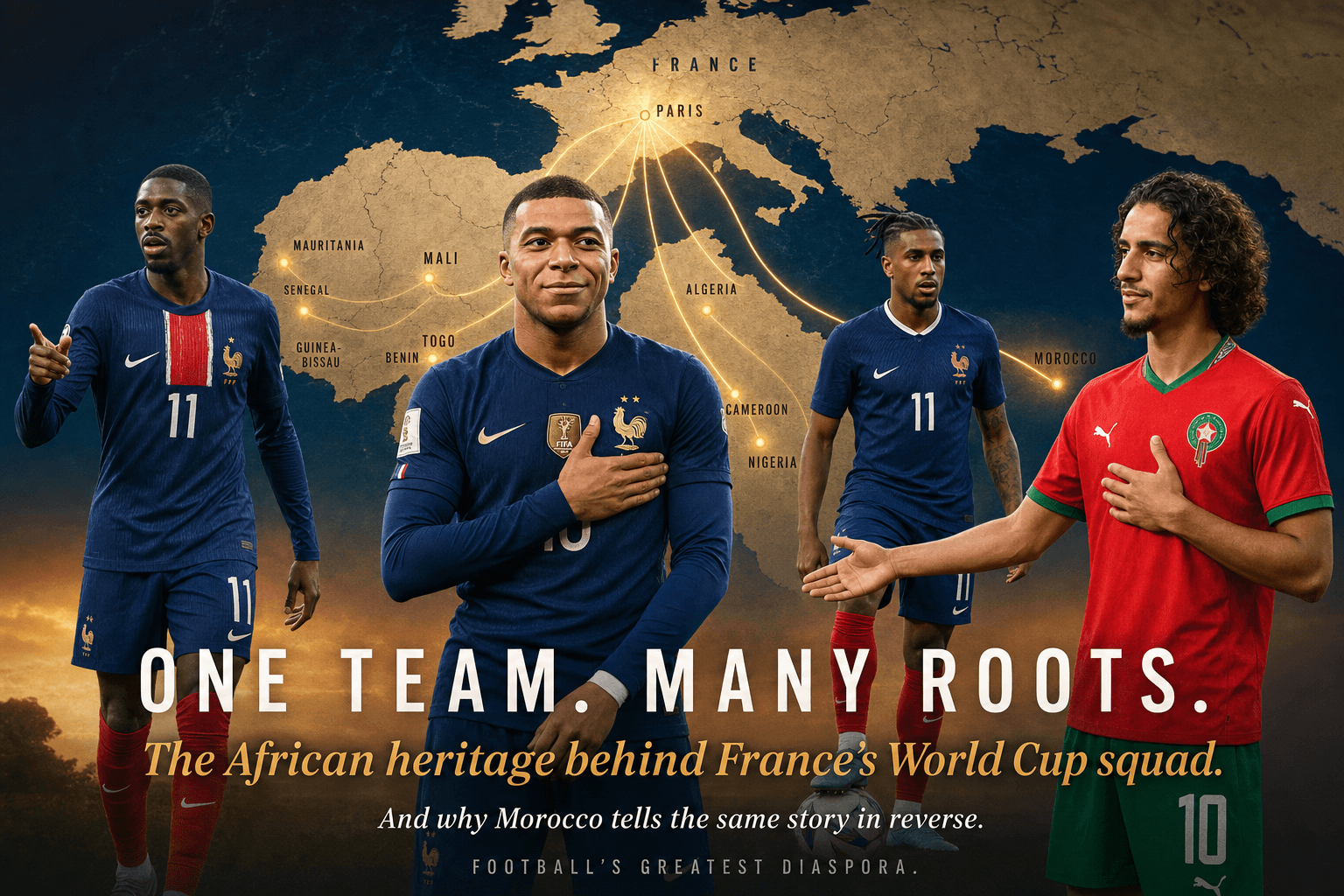
France's World Cup squad is ranked number one in the world, stacked with Ballon d'Or winners and title favourites — and built, in large part, on the children of African immigrants. From Kylian Mbappé's Cameroonian and Algerian roots to Ousmane Dembélé's Malian and Mauritanian-Senegalese heritage, this is one of the most African France squads in World Cup history, and it faces Morocco in the quarter-final carrying that history directly into the game.
Where France's Stars Actually Come From
France's federation does not publish an official heritage breakdown of its squads, but independent tracking of major tournament rosters over the last decade has consistently put the number of players with African family backgrounds somewhere between a third and half of any given 23 or 26-man selection — a proportion no other major footballing nation comes close to matching.
Start with the captain. Kylian Mbappé was born in Paris to a Cameroonian father, Wilfried, and an Algerian mother, Fayza Lamari, and grew up in Bondy, one of the Paris banlieues that have become a talent pipeline for French football. Mbappé has said publicly that he feels more connection to Cameroon than Algeria, and Cameroon's own national team staff have joked in the past that his father would have loved to see him in the Indomitable Lions shirt.
Ousmane Dembélé, the reigning Ballon d'Or winner, was born in Vernon, France, to a Malian father and a mother of Mauritanian and Senegalese descent. He has quietly supported his family's heritage off the pitch, financing the construction of a mosque in Mauritania and donating to his family's ancestral hometown, even if he rarely speaks about it publicly. N'Golo Kanté, still involved in this squad at 35, was born in Paris to Malian parents. Ibrahima Konaté also traces his family roots to Mali.
Further back, Jules Koundé has spoken about his family's Beninese heritage, while William Saliba and Aurélien Tchouaméni both have Cameroonian family backgrounds. Dayot Upamecano's family has roots in Guinea-Bissau, and Bradley Barcola's family background traces to Togo. Michael Olise, born and developed in England before choosing to represent France, has a Nigerian father — making him one of several current France squad members who could technically have represented an African nation at senior level and chose Les Bleus instead.
A Pattern That Goes Back Decades
It is worth being precise about how this heritage shows up on the pitch, too. It is not simply a matter of surnames or skin tone; players like Mbappé and Dembélé have both spoken, in different ways and to different degrees, about the influence their family's countries of origin have had on how they see their own identity, even while playing exclusively for France since their youth careers began. That dual identity, rather than being a source of internal conflict for most of these players, has generally been framed by them as additive — French by nationality and upbringing, with a second layer of connection to Cameroon, Mali, Senegal, Benin or Nigeria that shapes family life away from the pitch.
None of this is new for France. The 1998 World Cup-winning squad, built around Zinedine Zidane, Patrick Vieira and Marcel Desailly, was already being described as "Black-Blanc-Beur" — Black, White, Arab — a phrase meant to celebrate the multicultural nature of a title-winning team, though it also drew ugly commentary from the French far right at the time. The 2018 World Cup-winning squad under Didier Deschamps carried a similarly deep well of African heritage, with players like Paul Pogba, whose parents are from Guinea, and Samuel Umtiti, who was born in Cameroon before moving to France as a child.
What makes the current squad notable is the sheer concentration of attacking talent it produces from that same pipeline. Mbappé, Dembélé, Olise, Barcola and Rayan Cherki make up an attacking line that is arguably the most talented in the tournament, and almost all of it traces back to immigrant families who arrived in France in the postwar decades, often from former French colonies in West and North Africa, to work in construction, cleaning and manufacturing jobs the domestic labour market did not want. Their children, and now grandchildren, built the modern French national team.
Nearly a quarter of the players at this World Cup represent a country different from the one they were born in — and no nation has benefited from that pattern more than France.
The Morocco Quarter-Final Adds Another Layer
That backdrop makes France's quarter-final against Morocco even more charged than a normal knockout tie. Morocco's own squad includes players developed in the French system, and the most striking storyline of all belongs to Ayyoub Bouaddi, an 18-year-old Lille midfielder who was born in France, developed through the French youth system, and captained France's under-21 side before switching his international allegiance to Morocco in May 2026. Bouaddi's performance against Brazil, where he dominated the ball and left Casemiro chasing shadows, has made him one of the breakout stars of the tournament — and a symbol of the same dual-nationality pipeline that built France's own squad, only running in the opposite direction.
Morocco's route to this quarter-final has been built on precisely the kind of diaspora talent identification that has powered France for three decades. The comparison is not lost on either federation: France recruits the children of African immigrants who grew up in French suburbs, while Morocco, Cape Verde, Senegal and other African federations are increasingly recruiting back players who grew up in Europe but retain family ties to the continent. Bouaddi represents the sharpest version of that trend — a player good enough to captain France at youth level, who ultimately chose his family's country instead.
The Wider Diaspora Story at This World Cup
France is not an isolated case. Nearly a quarter of the 1,248 players competing at this World Cup represent a country different from the one they were born in, a figure driven heavily by the same postcolonial migration patterns that shaped France's squad. Cape Verde's entire World Cup story, which BackPage FC covered in depth in our piece on Cape Verde's diaspora-built squad, is built on exactly this principle in miniature: a tiny island nation fielding a squad drawn overwhelmingly from players born and developed in the Netherlands, Portugal and France. Morocco itself has followed the same playbook for years, recruiting players raised in France, Belgium, the Netherlands and Spain to complement its domestically developed core.
The financial and developmental asymmetry behind this pattern is well documented. African federations have long argued that they are effectively subsidising European football, developing young players only to lose them permanently once a European academy or, in cases like Mbappé's Bondy or Dembélé's Vernon, simply raising them from birth in France in the first place. Cameroon's own coaching staff have joked in the past that Mbappé's father would have preferred to see his son in the Indomitable Lions' colours, only half in jest — a reminder of just how much attacking talent has passed through countries like Cameroon, Mali, Senegal and Nigeria's diaspora networks without ever wearing those national jerseys competitively.
Why the Concentration of Talent Matters Tactically
Beyond the politics and the identity questions, there is a simpler football explanation for why this pattern keeps producing winners. Youth academies in the Paris banlieues, and similar working-class immigrant neighbourhoods around Lyon and Marseille, have become the most productive football nurseries in Europe, mixing technical development from a young age with a physical, streetball-honed competitiveness that translates directly to the elite level. Mbappé's rise from Bondy, alongside past graduates of the same banlieue system like Karim Benzema and Franck Ribéry, is the clearest advertisement for why France keeps producing more elite attacking talent than any other footballing nation, even compared to countries with far larger populations.
That density of talent is precisely why Deschamps can afford to leave players like Eduardo Camavinga and Randal Kolo Muani — both established internationals with African family backgrounds of their own — out of his final 26-man squad altogether. Competition for places at this level of the France squad is arguably tougher than for almost any other national team in the tournament, and the diaspora pipeline is the single biggest reason why.
Playing Through the Politics
The heritage of France's squad has also made it a target for exactly the kind of rhetoric that followed the win over Paraguay, where a senator's racist remarks about Mbappé's background dominated headlines more than the result itself. It is not the first time. Argentina fans were filmed singing a racist chant about the France squad's African backgrounds after their Copa América win, and the far-right politics that Mbappé has publicly criticised in France itself have repeatedly targeted the same multicultural identity that makes this squad so effective on the pitch. Aurélien Tchouaméni and Kingsley Coman faced similar scrutiny after missing penalties in the 2022 World Cup final shootout, with their nationality questioned online in a way white teammates who missed chances rarely experience.
Deschamps, in his final tournament in charge before handing over to Zinedine Zidane, has generally kept his squad's focus on football rather than the noise around it, and the numbers back up how well that has worked: four wins from four, three or more goals scored in five consecutive World Cup matches — a tournament record — and a squad ranked first in FIFA's world rankings heading into the knockout stages. Whatever happens against Morocco, the story of how this France squad was built will keep following it all the way to the final, because it is inseparable from why the team is this good in the first place.
What Morocco Represents in This Story
For Morocco, Thursday's quarter-final in Foxborough is a chance to write a different version of the same story. Where France has spent decades absorbing the children of African immigrants into a European superpower, Morocco's run to the semi-finals in Qatar in 2022 and back into the quarter-finals now is built on doing the reverse: reclaiming players raised and developed in Europe, and building a genuinely competitive African footballing power out of a diaspora network that would otherwise have kept feeding teams like France, Belgium, Spain and the Netherlands indefinitely.
Bouaddi's choice to represent Morocco over France, at just 18 and after already captaining the French under-21 side, is the most visible recent example of that shift working in the opposite direction from the historical norm. If more players raised in Europe start making the same calculation Bouaddi did, the balance of power behind matches like France vs Morocco could look very different a decade from now — and a France squad that has spent thirty years benefiting from African talent may increasingly find itself competing against it instead.
Do you think diaspora recruitment like Morocco's approach with Bouaddi will keep reshaping which countries produce World Cup winners?