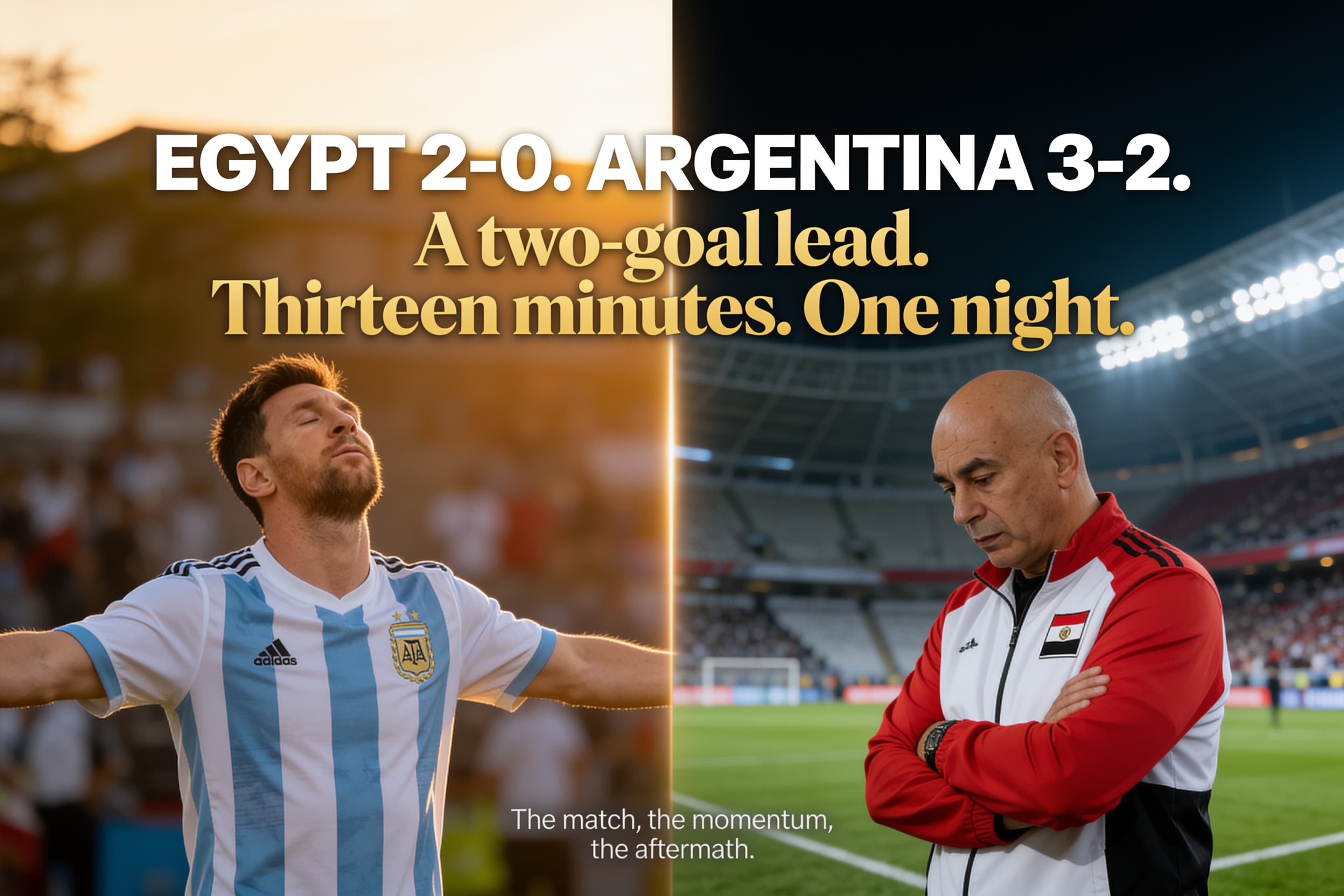
Argentina are in the World Cup quarter-finals after coming back from two goals down to beat Egypt 3-2 in Atlanta, one of the great comebacks in the tournament's history. But Egypt head coach Hossam Hassan left the pitch accusing referee officialdom of favouring Lionel Messi and the defending champions, and once you line up the key decisions from the match, it is not hard to see why he feels that way — even if the full picture is more complicated than pure bias.
The Match That Sparked the Row
Egypt led 1-0 through Yasser Ibrahim inside 15 minutes, an unmarked header from a Marwan Attia cross that caught Argentina badly out of position early on. Messi missed a penalty to level it soon after, easily saved by goalkeeper Mostafa Shobeir, the fourth of eight spot-kicks he has now failed to convert across his World Cup career — a statistic that would have made him a punchline in almost any other tournament story. Mostafa Ziko then doubled Egypt's lead in the 67th minute with a brilliant counter-attacking finish — except the goal was ruled out after a VAR review found Marwan Attia had fouled Lisandro Martínez in the build-up, holding his shirt and standing on his foot simultaneously as Egypt won back possession roughly 100 yards from Argentina's goal. Egypt still went 2-0 up moments earlier through that same counter-attacking approach, only for Argentina to score three times in the final 13 minutes: Cristian Romero headed in from a Messi assist in the 79th minute, Messi himself levelled with a half-volley in the 83rd, and Enzo Fernández headed home the winner in the third minute of stoppage time, sending the Argentina end of Mercedes-Benz Stadium into delirium and leaving Egypt's players surrounding the referee in disbelief.
Egypt's disallowed goal has genuine backing from neutral analysts. Former Premier League referee Graham Scott told The Athletic that Attia's challenge on Martínez was "normal contact" rather than a foul, and described the VAR intervention as a "massive overreach" of a system meant to correct only clear and obvious errors, given the incident occurred nearly 100 yards from Argentina's goal in a passage of play that had already run on for several seconds. Egypt were also denied a stoppage-time penalty shout when Alexis Mac Allister appeared to pull down Hamdy Fathy earlier in the move that led to Fernández's winner, an incident VAR chose not to review at all.
"We have been treated unfairly today. We have suffered injustice." — Egypt head coach Hossam Hassan
Hassan's Bigger Accusation
Hassan didn't stop at complaining about individual decisions. In his post-match comments, he suggested the result had been shaped by forces beyond the two teams on the pitch. "We looked better than the reigning champions — better in everything — but the result was influenced by internal factors on the pitch and external factors off it," Hassan said. "Perhaps they wanted to keep the world champion in the competition." The Egyptian Football Association followed up with a formal statement saying it "cannot remain silent" about the officiating, citing "serious concerns" about the consistency of decisions that "directly influenced the course of the game." A red card was shown to Egypt's goalkeeping coach, who had to be physically restrained from confronting French referee François Letexier, while Hassan himself was cautioned along with goalkeeper Mostafa Shobeir.
Hassan didn't stop at the referee, either. He also took aim at the scheduling of the match itself, complaining that kickoff had been set for noon local time in the height of an Atlanta summer. "Whoever schedules these matches is someone who has never played football," he said. "You never schedule a football match at 12 noon." It was a smaller complaint compared to the officiating row, but it added to the sense of a manager who felt every element of the occasion, not just the decisions on the pitch, had been stacked against his team.
This is the same argument BackPage FC has already tracked in this tournament's Balogun saga, where a presidential phone call got a USMNT suspension lifted mid-tournament, and where FIFA had already shown similar leniency toward Cristiano Ronaldo months before a ball was kicked. The pattern Hassan is pointing to isn't new: officiating controversies at this World Cup have disproportionately worked in favour of the sport's most famous names, whether or not any individual decision was actually wrong on its own merits. It is also worth noting that Egypt would have become only the fifth African nation ever to reach a World Cup quarter-final, after Cameroon in 1990, Senegal in 2002, Ghana in 2010 and Morocco in 2022 and again this year, which only sharpened the disappointment among Egyptian fans and media watching the collapse unfold in real time.
The Messi-Balogun Comparison Everyone Is Making
The clearest example predates the Egypt match entirely. In Argentina's opening group game, Messi tackled Algeria captain Aïssa Mandi from behind, raking his studs down the back of the Algerian's calf and Achilles. Referee Szymon Marciniak blew for a foul but showed no card, and VAR declined to recommend a review. Weeks later, Folarin Balogun was sent off for the USA in a challenge that multiple pundits considered less severe. ESPN's own VAR review panel called Messi "fortunate that the outcome was not a red card," writing that "once there is contact with studs on the calf with a level of force, it endangers the safety of an opponent and should be a red card," regardless of intent. The Algerian Football Federation has since filed a formal complaint with FIFA over Marciniak's performance in that match, alleging the referee also mishandled two other challenges during the game.
Former Select Group referee Andy Davies, writing for ESPN, was careful to note that the two incidents are not directly comparable in their detail and dynamics — Balogun's challenge involved a serious foul on an opponent's ankle in a different kind of tackle, while Messi's was a studs-first, back-of-the-leg connection during an aerial contest for the ball. But Davies still concluded that, taken on its own, "once there is contact with studs on the calf with a level of force, it endangers the safety of an opponent and should be a red card" — meaning the technical assessment of Messi's tackle in isolation still points toward a sanction that never came. Fans and pundits noticing the discrepancy is not simply about two plays looking similar on a highlight reel; it is about a growing sense that the world's biggest stars are being officiated by a different standard than everyone else at this tournament.
None of this proves officials were consciously protecting Messi. Different referees, different matches, and genuinely different incidents make clean comparisons difficult, and FIFA's own VAR review of the Egypt match defended the disallowed goal as "the right outcome" given Attia's foul had a "direct impact" on Argentina's ability to defend. But the accumulation of decisions, across an entire tournament, all breaking the same direction toward the same handful of superstars, is exactly the kind of pattern that fuels suspicion even when individual reviewers insist each call was correct in isolation.
What Egypt Got Wrong in Their Own Analysis
Here is the part of Hassan's complaint that deserves more scrutiny than it has received: Egypt were still 2-0 up with under 15 minutes to play, against the reigning World Cup holders, in front of a stadium dominated by Argentina supporters. They did not lose because of the disallowed goal. They lost because of what happened tactically in the final quarter of the match. Argentina's turning point wasn't a refereeing decision — it was a substitution. When Lautaro Martínez replaced Rodrigo De Paul, Messi was freed from a congested central role and pushed into the right channel, occupying the kind of space Ángel Di María used to exploit for Argentina in tournaments past. Sky Sports' own match report noted that Messi had looked "claustrophobic in the middle of the pitch" for most of the game, and that shifting him out wide let him "find breathing space" for the first time all match. His touch map for the second half shows a clear cluster of activity in the right channel that simply was not there before the substitution, a detail that tactical analysts have pointed to as the real story of Argentina's comeback rather than any single officiating call.
That repositioning directly produced Argentina's comeback: Messi's cross set up Romero's headed goal in the 79th minute, his mazy run from the right nearly created a second chance moments later, and he eventually scored the equaliser himself from inside the box after cutting infield from that same right-sided starting position. Egypt's defensive block, set up to control central areas and pressure Salah's opposite number, simply did not adjust to Messi operating from a wide starting position with 11 minutes still to play, and neither full-back nor the deeper midfield pairing shifted to track his new role in time. That is a coaching and in-game management failure, not a conspiracy — and it is the more uncomfortable explanation for Egypt's exit than blaming referees, even if the disallowed goal genuinely was a poor VAR intervention that deserves the criticism it has received. Hassan's own substitutions in the closing stages, bringing on fresh legs to protect a two-goal lead rather than reinforcing the space Messi had begun to exploit, may end up looking like the bigger tactical miscalculation once the dust settles on this result.
A Result That Will Follow Both Teams to the Quarter-Finals
For Argentina, the win sets up a quarter-final against Switzerland, a side that reached the last eight for the first time since 1954 by beating Colombia on penalties, a story BackPage FC covered in full in our piece on Switzerland's historic run. Scaloni's side have now come from behind twice in the knockout rounds already, first against Cape Verde and now against Egypt, a pattern that speaks to genuine resilience even as it raises questions about how sustainable that kind of late drama is against increasingly better opposition the deeper the tournament goes.
For Egypt, the exit ends a tournament that had genuinely threatened to make history, with a place among Africa's five all-time World Cup quarter-finalists — a group BackPage FC examined in our piece on the diaspora pipeline reshaping African football at this World Cup — agonisingly close before the final 13 minutes unravelled. Hassan's complaints about officiating fit a wider pattern BackPage FC unpacked in our piece on why six of the eight remaining teams are European, and will likely fade from the news cycle within days, replaced by the next controversy this tournament inevitably produces. What should not fade, for Egyptian football specifically, is the tactical lesson buried underneath the outrage: a two-goal lead against the best player of his generation is never actually safe until the final whistle, and reacting to his opponent's biggest tactical adjustment of the match with more time-wasting rather than defensive reorganisation is a decision that deserves at least as much scrutiny as anything François Letexier did with his whistle.
Do you think Egypt's collapse was more about the referee's decisions or their failure to adjust to Messi's late change of position?