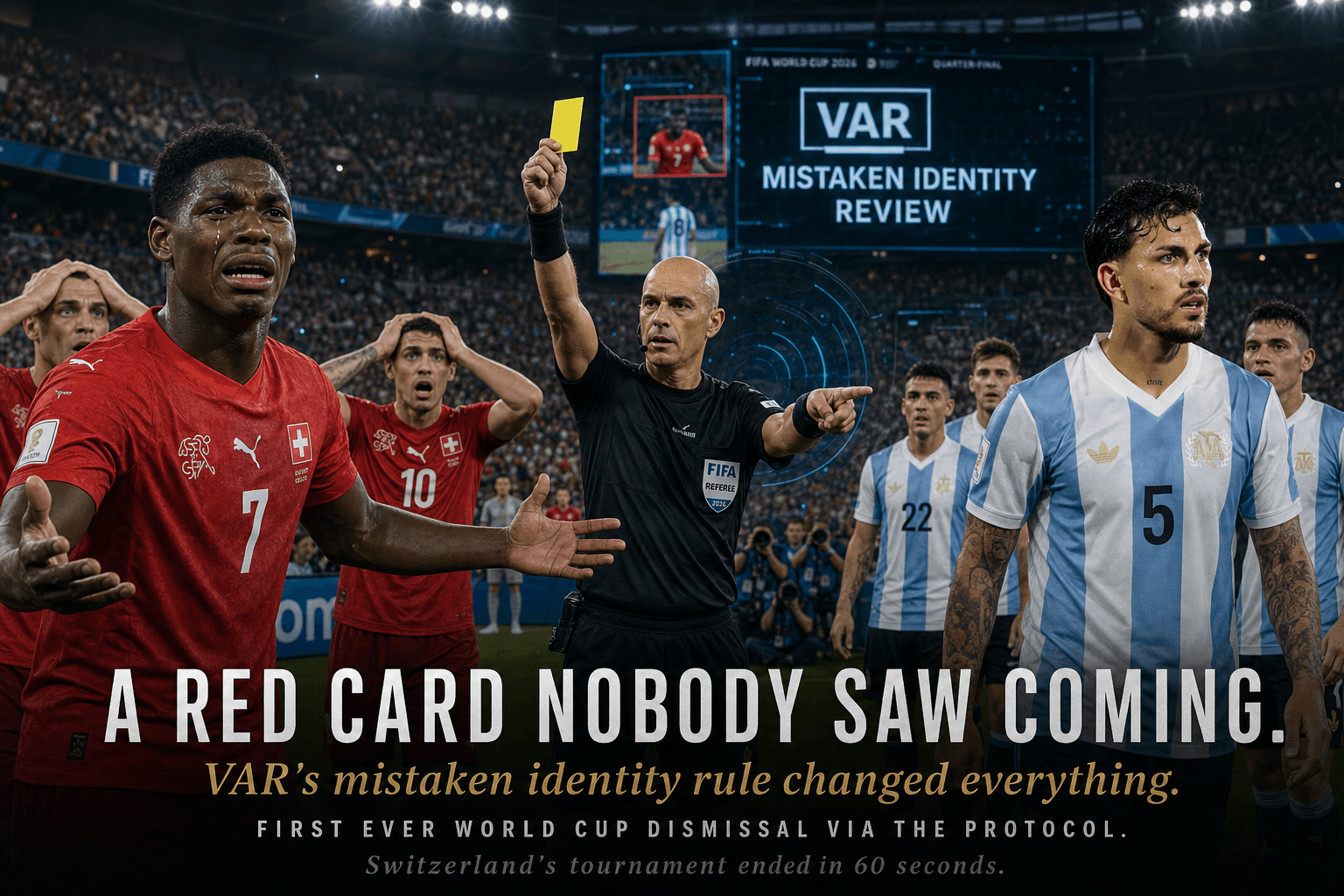
Breel Embolo was on the losing side of a football match before the football itself decided it. In the 71st minute of Argentina's World Cup quarter-final against Switzerland in Kansas City, with the score locked at 1-1 after Dan Ndoye's equaliser, referee João Pedro Silva Pinheiro showed Leandro Paredes a yellow card for a tackle on Embolo. Play resumed. Then it stopped again. A VAR review overturned the decision entirely — not simply cancelling Paredes's card, but transferring it to Embolo himself, for simulation, under a rule most football supporters had never heard of and had certainly never seen used to end a World Cup campaign. Embolo, already on a first-half yellow, was sent off. Switzerland played the rest of the match with ten men and lost 3-1 after extra time, with Argentina's win setting up a semi-final against England in Atlanta — the specific matchup we detailed in our coverage of the other 2026 World Cup semi-final between France and Spain. Understanding exactly what happened to Embolo, and why, requires understanding a specific piece of VAR machinery that has existed in football's laws for years without ever previously deciding a match this significant.
What Actually Happened in Kansas City
Leandro Paredes was initially shown a yellow card for a tackle on Embolo, but video review showed that Embolo was already falling before Paredes made any contact with him. Because Embolo had already received a yellow card earlier in the match, the reversal meant he received his second — and was sent off, leaving Switzerland to play the remainder of the game with ten men. Referee Pinheiro's exact ruling, delivered to the Kansas City crowd, was specific: "After review, there is no foul for No 5 [Paredes], No 7 [Embolo], there is a clear simulation, final decision, yellow card for No 7 [Embolo]." Denis Zakaria was seen pleading with the official before hauling his distraught teammate off the pitch to prevent further protest escalating. Argentina went on to win 3-1 after extra time, with Julián Álvarez and Lautaro Martínez scoring the decisive late goals — a result that sends Lionel Messi and the defending champions into the semi-final against England, having already broken Swiss hearts before the game's most dramatic moments had even arrived.
What Is the "Mistaken Identity" VAR Rule?
The mechanism used against Embolo is officially termed "mistaken identity" — defined by the International Football Association Board as occurring "when the referee shows a yellow or red card but has clearly penalised the wrong player of either team for the offence in question." IFAB classifies mistaken identity as a "match-changing" category of error, one of the specific situations VAR is explicitly empowered to correct regardless of how much time has passed since the original decision. The specific quirk that made Embolo's dismissal possible is that the protocol can only be triggered if a card was shown to the wrong player in the first place — had Paredes never been booked at all, VAR would have had no mechanism to intervene and award Embolo the card directly. In other words, the rule did not exist to catch Embolo's simulation on its own merits. It existed to correct an error that had already been made against someone else, and Embolo's punishment arrived as a specific consequence of that correction rather than as a standalone officiating decision.
Why This Was Genuinely Historic
Embolo became the first player in World Cup history to be sent off via a mistaken identity VAR review, and only the second occasion at the 2026 tournament in which a yellow card had been overturned using the protocol at all. He is also only the fourth player in the past sixty years of World Cup football to receive a second yellow card specifically for simulation, joining a short list that includes Mexico's Luis Pérez in 2006. The specific combination of rarity — a rule most fans had never seen invoked, applied for the first time ever to actually end a player's involvement in a World Cup — explains why the moment generated the intensity of reaction it did. This was not a marginal offside call or a standard penalty review. It was the sport's video technology reaching into a category of decision so rarely used that its very existence surprised much of the watching audience, at the exact moment a World Cup quarter-final hung in the balance.
Embolo was in tears before he had even left the pitch. His coach called the decision absurd. His captain said it changed the entire match. A rule that had barely been used in football's video review history — mistaken identity, designed to correct a card shown to the wrong player — ended his World Cup and Switzerland's campaign in the same 60-second VAR review. Nobody, including the Swiss players standing on the pitch, fully understood what had just happened until the referee explained it to a stadium of confused supporters.
The Swiss Fury: Yakin, Xhaka, and Elvedi React
Captain Granit Xhaka was equally direct: "I think the red card changed our game. This decision was difficult to accept now after the game because the dressing room was very quiet, disappointed." Defender Nico Elvedi added: "I just don't understand how VAR can make that kind of decision" — specifically noting that the sending-off came at the worst possible moment, immediately after Ndoye's equaliser had shifted momentum firmly in Switzerland's favour and Yakin was preparing fresh attacking substitutions to press home the advantage.
The Wider Pattern: A Tournament Already Under Scrutiny
The Embolo decision arrived days after the Egyptian Football Association stated it "cannot remain silent" following what it viewed as biased officiating in Egypt's 3-2 Round of 16 loss to Argentina — a match in which the defending champions scored three unanswered goals to complete one of the biggest comebacks in World Cup history. FIFA's chief of refereeing, Pierluigi Collina, responded directly: "Nobody can question the integrity of the FIFA World Cup match officials." The specific proximity of two controversial officiating storylines, both involving Argentina's route to the semi-final, has fuelled exactly the kind of scrutiny Collina's statement was attempting to close down. Whether the pattern reflects genuine bias, the statistical inevitability of contentious moments occurring around the tournament's most closely-watched team, or simply the amplified visibility that follows the defending champions through every stage of the competition, is a question the reaction to Embolo's red card has reopened rather than settled.
What Comes Next: Messi and England in Atlanta
Argentina's win sends them to a semi-final against England in Atlanta — the second semi-final of the 2026 World Cup, running parallel to the France vs Spain tie we detailed in full elsewhere. The specific technological and officiating themes running through this tournament — documented in our pieces on ball recovery time and FIFA's expanding suite of match-analysis technology and in-contest possession as a metric introduced to modernise how football is officiated and understood — reflect a tournament in which video and data technology has never been more central to deciding outcomes. The mistaken identity rule that ended Embolo's World Cup is part of that same broader shift: FIFA's continued expansion of what video review is empowered to correct, applied for the first time at the sport's biggest stage with consequences nobody fully anticipated until they had already happened. Switzerland go home. Argentina, and the controversy trailing them, go to Atlanta.
How VAR's Reach Keeps Expanding — and What It Means Going Forward
The Embolo decision fits inside a broader story about how much authority video review has accumulated across successive World Cups. When VAR was first introduced at the 2018 tournament, its remit was deliberately narrow — clear and obvious errors in four specific categories: goals, penalties, direct red cards, and mistaken identity. Mistaken identity was, at the time, considered the least controversial and least likely to be invoked category, a mechanical fix for the rare occasion an official simply booked the wrong shirt number. Eight years and two tournaments later, that same narrow category has been stretched to produce the single most contentious individual decision of the 2026 quarter-final round — not because a referee confused two players physically, but because a full incident replay revealed an entirely different offence than the one originally penalised. The rule has not changed. What has changed is the confidence with which VAR officials are now willing to use it, and the willingness of on-field referees to accept a complete reversal of their own initial read of a passage of play, live, in front of a stadium and a global audience of hundreds of millions.
For Embolo personally, the specific tragedy of the moment is compounded by his own record across the tournament. Yakin was explicit that Embolo had contributed positively before his dismissal, describing two or three good attacking phases and noting he had already absorbed several fouls without complaint earlier in the match. A player who had been doing the unglamorous work of holding up possession and creating chances for teammates found his tournament ended not by a defender outmuscling him, but by a review panel reinterpreting a single moment of contact from multiple camera angles, minutes after the incident had already been adjudicated once. Whether Embolo genuinely sought contact from Paredes or was simply an unlucky victim of a marginal, high-speed collision being replayed in ultra slow motion is a question that will follow him regardless of how the rest of his international career unfolds.
Alf-Inge Haaland, father of Norway striker Erling Haaland, added his own voice to the tournaments wider officiating conversation this week, describing his own son's team as robbed in their quarter-final exit to England while separately hoping England go on to win the tournament outright. The specific accumulation of complaints across multiple knockout matches — Egypt, Switzerland, and Norway among them — has produced a tournament narrative running parallel to the football itself: a growing question about whether the expanded technological toolkit FIFA has built for 2026 is producing more accurate outcomes, or simply more numerous and more visible flashpoints for controversy at the exact stage of the competition when every decision carries the most weight.
Embolo was sent off through a VAR rule almost nobody had seen used before, ending Switzerland's World Cup in the process. Do you think the mistaken identity decision was correct, and should this rule exist at all? Tell us below.