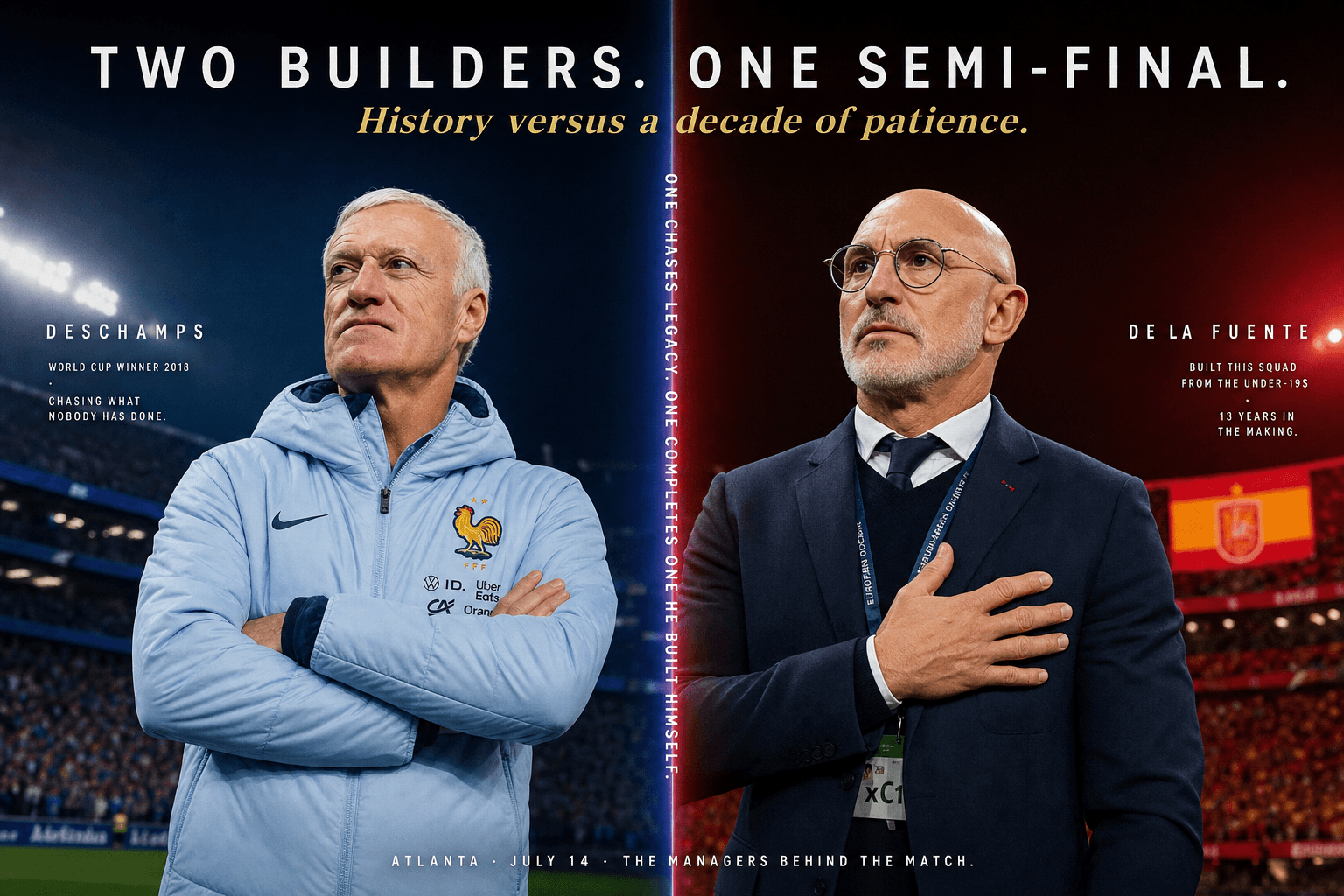
Didier Deschamps has already won a World Cup as manager, already lost one on penalties, and stands two matches from a run of achievements that would place him alone in the sport's ninety-six-year history. Luis de la Fuente has never managed a senior team at a World Cup before this tournament. One man is chasing a specific, quantifiable, unprecedented piece of history — documented across our pieces on Deschamps's bid to become only the second manager ever to win the World Cup twice and his status as one of only three men to win it as player and manager. The other is simply trying to finish what he personally started building thirteen years ago, with a group of players he coached from teenagers into champions himself. As we explored in our France vs Spain semi-final preview, this match is about Mbappé and Yamal, about an unbeaten record and a shattered goalkeeping one. It is also, less visibly, about two managers who have arrived at the same match from opposite ends of football's coaching universe.
Deschamps: The Serial History-Maker
Deschamps's résumé at this specific moment reads like a list of achievements that should not fit inside a single career. World Cup winner as captain in 1998. World Cup winner as manager in 2018, twenty years later, joining Zagallo and Beckenbauer as one of only three men in history to complete that double. World Cup runner-up as manager in 2022, losing the most dramatic final the tournament has ever produced to Argentina on penalties. Now a third consecutive World Cup final within reach — a feat no manager, including Beckenbauer and Helmut Schön, the only two men ever to reach back-to-back finals, has come close to matching. As we detailed in our piece on Deschamps's Marseille story, he even has a specific, personal history of returning to institutions in crisis and fixing them himself — captaining a Marseille double that was partially erased by scandal, then coming back as manager seventeen years later to deliver the club's next actual title, a championship Marseille have still not repeated since. Deschamps's entire footballing life reads as a catalogue of completions: things started, interrupted, and finished, often by the same man in two different roles.
De la Fuente: The Man Who Built His Own Golden Generation
Luis de la Fuente's path to this semi-final is the opposite kind of story entirely. Born in Haro, La Rioja, in 1961, de la Fuente spent his playing career as a left-back at Athletic Bilbao and Sevilla, amassing 254 La Liga appearances and winning two league titles with Athletic — including a league and Copa del Rey double in 1984, the last time Athletic Bilbao have won Spain's top division. His coaching career began not at the elite level but at Club Portugalete in Spain's regional leagues in 1997, followed by third-tier side Aurrera, then youth roles at Sevilla and Athletic Bilbao spanning the 2000s. His first senior job, at Alavés, ended after just eleven matches when he was sacked in October 2011. He spent two years away from football entirely.
De la Fuente's actual path back began in 2013, when Spain's federation appointed him coach of the Under-19 side. He won the 2015 European Under-19 Championship. He was promoted to the Under-21s and won the 2019 European Under-21 Championship, beating Germany 1-0 in the final. He took Spain's Olympic team to a silver medal at the delayed 2020 Tokyo Games, losing narrowly to Brazil in the final. He did not arrive at the senior job as an outsider parachuted in on reputation. He arrived having spent nine years inside Spain's federation, developing the exact generation of players he would eventually inherit.
Mikel Merino, Dani Olmo, Mikel Oyarzabal, Fabián Ruiz, and Unai Simón all won the European Under-21 Championship under Luis de la Fuente in 2019. Seven years later, every one of them is playing for him again — at a World Cup semi-final, as the coach who developed them from teenagers into champions has become the manager trying to make them world champions themselves. Deschamps inherited Mbappé as a generational talent already forming. De la Fuente built his squad, one youth tournament at a time, with his own hands.
The Squad de la Fuente Built From Nothing
The specific detail that separates de la Fuente's achievement from almost every other manager at this World Cup is the continuity between his youth work and his senior success. Due to his background coaching youth setups, de la Fuente has consistently preferred working with younger players he already knew and trusted rather than high-maintenance established stars. Mikel Merino — whose back-to-back substitute goals against Portugal and Belgium decided Spain's last two knockout matches, documented in full in our semi-final preview — is one of the specific players who won the Under-21 European Championship under de la Fuente in 2019 and now plays for him at the highest level the sport offers. Unai Simón, whose 519-minute World Cup clean-sheet record stood until Belgium finally broke it in the quarter-final, is the same goalkeeper de la Fuente developed and trusted at Under-21 level. This is not a manager who inherited a golden generation and organised it well. This is the manager who scouted, coached, and promoted that generation himself, tournament by tournament, over the better part of a decade, before finally getting the chance to lead them at the sport's biggest stage.
Faith, Discretion, and What Actually Drives Him
De la Fuente has no social media presence, is described by Spanish media as an unassuming, discreet man, and makes the sign of the cross before every match — a practice he has explicitly stated "is not superstition, it's faith." This is a specific and deliberate contrast to the modern manager archetype built on media visibility, tactical innovation marketed as personal brand, and the kind of global name recognition that Deschamps, twenty years into his own senior coaching career and a genuine global football celebrity, has long possessed. De la Fuente's motivation, by every available account, is not personal legacy in the way Deschamps's clearly, explicitly is. It is closer to vocational completion — a man who has spent nearly three decades inside a footballing pathway, at every level from regional football to the Olympics, now arriving at the single destination that pathway was always building toward, with the exact group of players whose careers he personally shaped.
Two Managers, Two Historic Droughts They Are Each Connected To
There is a specific structural symmetry between the two men worth naming directly. Deschamps's playing career is permanently tied to Marseille's championship history — the captain of a title stripped by scandal, later the manager who delivered the club's actual next one, a trophy Marseille have still not repeated in the fifteen years since, as documented in our piece on Deschamps's Marseille double and its stripped aftermath. De la Fuente's playing career carries an even longer version of the same weight: he was part of the last Athletic Bilbao squad to win La Liga, in 1984, a full forty-two years ago and counting, with no repeat in sight for a club whose famous Basque-only recruitment policy has made competing with Spain's financial elite increasingly difficult across the decades since. Both men carry, from their playing days, a specific personal connection to a title drought neither has been able to end at the actual club in question — even as both have gone on to build entirely separate coaching legacies elsewhere, at the international level, with different institutions altogether.
What Each Man Is Actually Playing For
Deschamps is playing for history that exists independently of any single player — a third consecutive final, a second World Cup as manager, records that will be discussed in isolation from Mbappé, from Olise, from any specific member of his current squad, documented in our piece on the Mbappé-Olise partnership driving France's campaign. De la Fuente is playing for something more specific and more personal: proof that the players he developed from Under-19 level, the specific generation he shepherded through youth tournaments and an Olympic silver medal before finally inheriting them at senior level, can complete the full arc he set out for them over a decade ago. Spain's world-record unbeaten run is, in that specific sense, not simply a national achievement. It is de la Fuente's own coaching philosophy — patient development, generational continuity, faith in players he trusted before anyone else did — being validated in real time, against the sport's single most decorated active manager, in a World Cup semi-final that will decide which version of building a winning team actually works better when it matters the most.
The Tactical Contrast: Control vs Conquest
The specific footballing philosophies each manager has built also reflect their contrasting paths into this semi-final. De la Fuente's Spain, built through a decade of youth-level continuity, operates from a settled 4-3-3 with associative interiors and wingers holding width — a system he has had the rare luxury of installing gradually, tournament by tournament, with players who learned it as teenagers rather than being asked to adopt it as the finished article overnight. Deschamps's France, by contrast, has always been built around adaptability to whatever generational talent presents itself — a 2018 side organised around defensive solidity and Mbappé's explosive pace in transition, a 2026 side reshaped around the Mbappé-Olise partnership documented in our companion piece. Where de la Fuente coaches a system his players have internalised since adolescence, Deschamps has spent his managerial career reorganising systems around whichever individual talents France's production line has most recently generated. Both approaches have produced World Cup finalists. Only the semi-final in Atlanta will determine which philosophy, at this exact moment, is the stronger one.
There is also a specific generational irony worth noting before the match itself. Deschamps, at 57, is managing a France squad built around 27 year old Mbappe and 24 year old Olise — players roughly half his own age, whose careers he has shaped for years but did not personally discover as teenagers. De la Fuente, at 64, the older of the two managers by seven years, is fielding a squad containing 17 year old Lamine Yamal alongside the Under-21 generation he coached from 2013 onward, a genuinely direct pipeline from his own hands to the World Cup semi-final pitch. Age has not determined method here. Institutional pathway has. One federation gave its most successful post-2010 manager two decades to build toward this exact moment. The other has simply kept promoting the same manager whenever the previous incumbent departed, and Deschamps has kept delivering, tournament after tournament, regardless of what generation of players he was actually handed.
Deschamps chasing unprecedented history. De la Fuente completing the arc of a generation he built himself. Which managerial story do you find more compelling — and whose approach do you think wins in Atlanta? Tell us below.