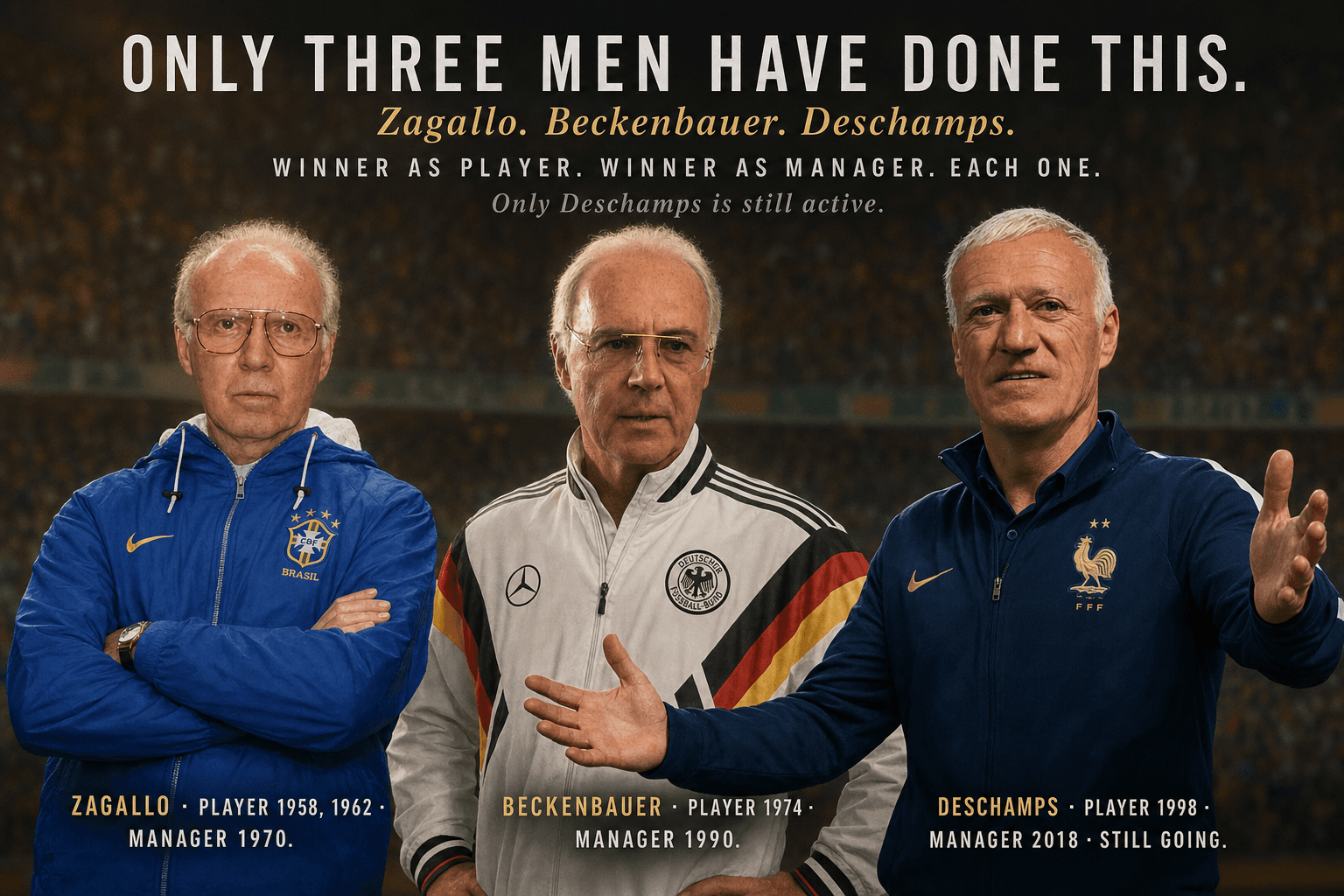
The list of managers who have won the Champions League and the World Cup contains exactly two names — Marcello Lippi and Vicente del Bosque — a fact we documented in full in our piece on the only two men to complete that double. There is a second, equally exclusive club in World Cup history, and it intersects with the France side currently preparing to face Spain in the 2026 semi-final at exactly one point: Didier Deschamps. Only three men in the ninety-six-year history of the World Cup have won the tournament both as a player and, separately, as a manager. Mário Zagallo did it first. Franz Beckenbauer did it second. Didier Deschamps did it third, in 2018, and is now the only one of the three still working — sitting one victory away, as we explored in our France vs Spain semi-final preview, from adding a specific new layer to his own legend.
Zagallo: The First, Twice as Player, Once as Manager
Mário Zagallo was the first person in history to win a World Cup as both a player and a manager. His first title came on June 29, 1958, when the 26-year-old forward scored Brazil's fourth goal in a 5-2 victory over host nation Sweden. He captured a second World Cup crown in 1962 in Chile, playing in Brazil's 3-1 win over Czechoslovakia. Zagallo hung up his boots shortly before the 1966 World Cup and returned to the Brazil national team as manager in 1970 — leading a squad built around Pelé, Jairzinho, Rivelino, and Tostão to a 4-1 demolition of Italy in the final, a team still widely considered the greatest ever assembled. That victory made Brazil the tournament's first three-time champion and made Zagallo the first man in history to lift the trophy in both roles. He later returned as Brazil's manager and reached the 1998 final, losing to France — the exact team, coincidentally, that Deschamps was captaining that same summer.
Beckenbauer: Der Kaiser's Double Redemption
Franz Beckenbauer captained West Germany to the 1974 World Cup on home soil, defeating Johan Cruyff's Netherlands 2-1 in the final on a decisive Gerd Müller goal. He returned to a World Cup final as manager in 1986, where West Germany lost to Diego Maradona's Argentina — before claiming the championship as a manager in 1990, defeating that same Argentina side 1-0 in Italy. Beckenbauer became the second man to win the World Cup as both player and manager, and the specific quality of his achievement is compounded by the fact that he had also captained West Germany to the 1972 European Championship and won the European Cup as a player with Bayern Munich three times — the specific pedigree that makes his 1990 triumph feel less like a coaching surprise and more like the natural continuation of a career built entirely around winning.
Deschamps: Captain in 1998, Coach in 2018
Deschamps won the World Cup as a player in 1998, captaining France to the title on home soil, defeating Brazil 3-0 in one of the most storied finals of recent times. In 2018, he managed Les Bleus to a 4-2 win over Croatia in Moscow, twenty years after his own playing triumph, and France's first appearance in a World Cup final since 2006. Deschamps is the third man in history to complete this specific double, and — with Zagallo having passed away in January 2024 and Beckenbauer in January 2024 as well — he is now the only living, and only still-working, member of this three-man club.
The specific quality that connects all three men is worth noting explicitly: as we detailed in our piece analysing football's rarest managerial achievements, all three were defensive midfielders as players — a position that demands tactical intelligence and the ability to read a match from a central vantage point. It is difficult to argue this is coincidental. The specific cerebral quality that makes a defensive midfielder effective — positioning, game management, reading danger before it develops — appears to translate with unusual consistency into the specific skill set a World Cup-winning manager requires.
Zagallo, Beckenbauer, Deschamps. Three men, ninety-six years of World Cup history, one shared achievement: winning the tournament as a player, then winning it again from the touchline. Deschamps is the only one still active. He is also, as of this World Cup, one win away from a version of history none of the other two ever achieved — a third consecutive appearance in a World Cup final.
Zidane: The Fourth Name Waiting in the Wings
Reports have long suggested Zinedine Zidane wants to take charge of the French national team, with Deschamps expected to step down after this World Cup regardless of the outcome. Zidane — the 1998 World Cup winner known for his brilliance as a player and his subsequent success managing Real Madrid to three consecutive Champions League titles — would become only the fourth man ever to win the World Cup as both player and manager, should he take the France job and eventually win it. The specific succession story adds another layer to what is already one of international football's most compelling individual threads: the possibility that France's national team job could, for a second consecutive appointment, be filled by a legendary former captain seeking to complete the exact same double his predecessor just achieved.
Why the Club Stays So Small
The scarcity of this achievement is structural in the same way the Champions League and World Cup double is scarce, documented in our piece on Lippi and Del Bosque's exclusive club. A player good enough to win a World Cup rarely also possesses the specific temperament, patience, and tactical education required to become an elite manager — the skill sets, while occasionally correlated through positions like defensive midfield, are not the same skill set. And a manager talented enough to win a World Cup on the touchline typically arrives at international management having spent decades coaching rather than playing at the highest level, meaning they were never in genuine contention to win it as a player in the first place. The overlap — a player elite enough to captain a World Cup winner, who then becomes a manager elite enough to win one independently — is a vanishingly rare combination of two entirely different careers succeeding at the absolute highest level. Three men in ninety-six years. Deschamps is the only one who can still add to his own chapter.
Why This Matters Right Now, in Atlanta
The specific reason this list belongs in the conversation this week, rather than as a historical footnote, is that Deschamps's presence in the 2026 semi-final against Spain is not incidental to the story — it is the story continuing to write itself in real time. As we detailed in our France vs Spain semi-final preview, Spain are chasing their own historic parallel — a second World Cup, sixteen years after their first, in only their second-ever semi-final appearance. Deschamps is chasing something no other manager in the sport's history has ever achieved: a third consecutive World Cup final. Beckenbauer reached back-to-back finals as manager (1986 and 1990). Helmut Schön did the same for West Germany in the 1960s and 70s. Nobody has ever managed a team to three consecutive World Cup finals. If France beat Spain on Tuesday, Deschamps does something that neither Zagallo nor Beckenbauer — the two men who share his specific player-manager achievement — ever came close to managing themselves. The club of three becomes, in that specific sense, even more lopsided than it already is.
There is also a specific financial and cultural dimension worth noting: none of the three achieved their double at a small or provincial federation. Brazil, West Germany, and France are three of the sports most historically significant footballing nations, each with the infrastructure, depth, and cultural weight to produce both a world class playing generation and, separately, a coaching culture capable of developing a World Cup winning manager from within its own former players. That specific combination — a football nation deep enough to produce both, twice, independently, is itself part of why this list has stayed at three names for as long as it has, and why the identity of any potential fourth name carries so much weight before it has even been confirmed.
The Other Near-Misses: Managers Who Almost Joined the Club
Several World Cup-winning captains have gone on to management careers without ever quite completing the same double. Franz Beckenbauers West Germany teammate and eventual national team successor never reached a World Cup final as manager. Cafu and Dunga, both World Cup-winning Brazil captains, moved into punditry and briefly into management respectively without replicating Zagallos achievement. Fabio Cannavaro, Italys 2006-winning captain, has managed at club level in China and the Gulf but never taken charge of a major international side at a World Cup. The specific difficulty is not simply winning as a manager — plenty of World Cup winning captains have gone into coaching. It is winning specifically at a World Cup, with your own national team, having already done so as a player. That final, precise requirement is what has kept the list at three for over three decades since Deschamps himself became eligible to attempt it, and it is the same requirement that makes Zidanes potential future candidacy, should he take the France job, worth watching as closely as any transfer saga in the sport.
What makes Deschamps specific case even more remarkable within this near-miss context is that he did not simply move into management gently through club football before eventually reaching international level. He managed Monaco to a Ligue 1 title and a Champions League final in 2004 before ever taking the France job, then rebuilt Marseille domestically — a story with its own specific twist we explore separately — before being appointed national team manager in 2012. By the time he lifted the World Cup as a manager in 2018, he had already spent fourteen years proving, at club level, that his playing career had translated into genuine coaching substance rather than simply reputational goodwill from his 1998 achievement. That specific groundwork is arguably the reason his version of the double has proven the most durable of the three, with Zagallo and Beckenbauer both managing only their respective national teams across their coaching careers.
Zagallo, Beckenbauer, and Deschamps are the only three men to win the World Cup as both player and manager. Could Zidane become the fourth — and does Deschamps deserve more credit for joining this club? Tell us below.