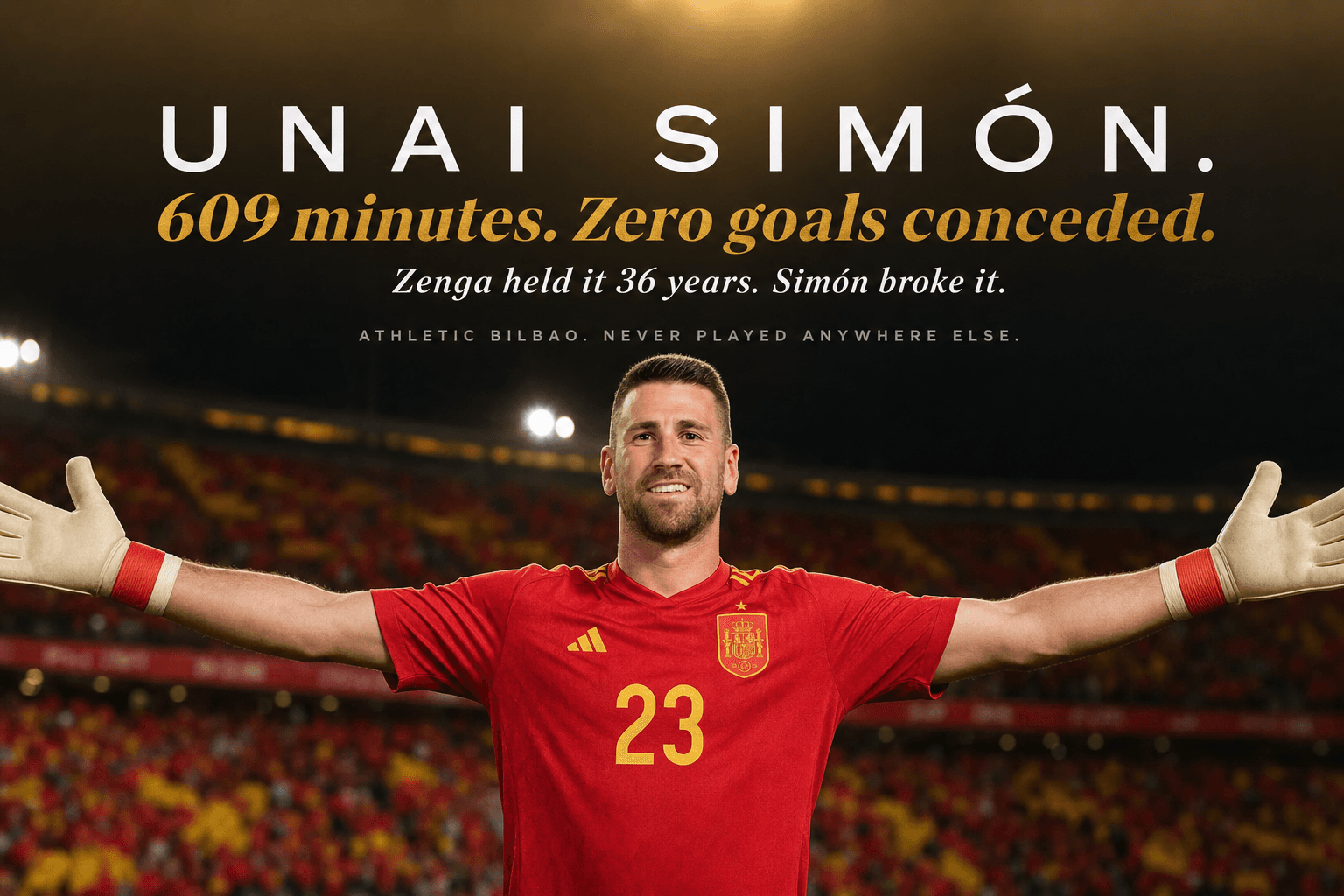
Unai Simón has not conceded a goal at a World Cup in 609 minutes, a run that swallowed a penalty shootout exit in 2022, an entire group stage in 2026, and a Round of 16 date with Cristiano Ronaldo that was supposed to end it. Instead, Spain won 1-0, Ronaldo played his last ever World Cup match, and Simón walked off having broken a 36-year-old record that most people assumed was untouchable.
The Record Nobody Saw Coming
Walter Zenga's mark had stood since Italia '90. The Italian goalkeeper went 517 minutes without conceding across that tournament, a streak that made him a cult figure back home before it was eventually broken by Claudio Caniggia in the semi-final against Argentina. For 36 years, no keeper got remotely close to it. Zenga's number survived the eras of Buffon, Casillas, Neuer and Courtois — goalkeepers who won World Cups, Champions Leagues and Ballon d'Or votes without ever threatening a record built on a single, unglamorous stretch of Italian defending in 1990.
Simón's run began quietly, almost accidentally, at the end of the 2022 World Cup in Qatar. Spain kept a clean sheet through 120 scoreless minutes against Morocco in the Round of 16 before losing on penalties, a game remembered for the shootout heartbreak rather than for what Simón had just done between the posts. Nobody was counting minutes at the time. That streak, uninterrupted by international breaks, friendlies or two full years between tournaments, carried straight into the 2026 finals in North America.
By the time Spain beat Austria 3-0 in the Round of 32 in Los Angeles, Simón had gone past Zenga's number and set a new all-time World Cup record, confirmed by Guinness World Records. He extended it further with clean sheets against Cape Verde, Uruguay and Saudi Arabia in the group stage, then sealed the Round of 16 win over Portugal, pushing the run to 609 minutes without conceding by full time in Dallas. FIFA itself flagged the milestone before the Portugal game even kicked off, posting that Simón had already reached 519 minutes and counting.
Spain also became the first team in World Cup history to keep six consecutive clean sheets, four of them in this tournament alone. Simón has now also passed Iker Casillas's previous Spanish World Cup clean-sheet record, which spanned the 2010 and 2014 editions — meaning the man from Bilbao has now outdone the most decorated goalkeeper his country has ever produced, at least by this particular measure.
The Goalkeeper Who Wasn't Supposed to Start
None of this was assumed heading into the tournament. Simón, who has spent his entire senior career at Athletic Bilbao, arrived at the World Cup fending off two credible challengers for the Spain number one shirt, and by most outside assessments, he was not the favourite to keep it. David Raya had just won the Premier League with Arsenal and carried Champions League pedigree from his time in England, the kind of season that usually forces international coaches to reconsider their pecking order. Joan Garcia had gone one better domestically, winning La Liga with Barcelona in the 2024-25 season while establishing himself as one of the most highly rated young keepers on the continent.
On paper, either would have been a defensible pick. Both had just won their domestic league. Both were younger and, in the eyes of many pundits, offered more upside with the ball at their feet in the modern goalkeeping mould. Luis de la Fuente stuck with Simón anyway. He had already been Spain's first choice through the 2023 Nations League triumph and the 2024 European Championship win, and de la Fuente's decision to keep faith with continuity over two decorated domestic winners has been repaid with the single most statistically dominant goalkeeping run the World Cup has ever seen.
What makes the streak more remarkable is how little Simón has actually had to do to protect it. Spain's defensive structure, built around suffocating opponents before they ever get near the box, means he has faced only a handful of true tests across the entire tournament. Only Uruguay managed more than one shot on target against Spain during the group stage, a detail that says as much about the system in front of him as it does about the man himself. When the moment does arrive — as it did against Ronaldo in Dallas — Simón has been ready.
A tournament record for Unai Simón — 519 minutes played, zero goals conceded, before he even faced Portugal.
Merino, Ronaldo, and the Night in Dallas
The Round of 16 tie against Portugal, played at AT&T Stadium in Dallas, doubled as a farewell for Cristiano Ronaldo, who had confirmed beforehand that 2026 would be his last World Cup. Spain and Portugal had not met at the tournament since 2018, when Ronaldo scored a hat-trick in a 3-3 group-stage classic still remembered as one of the great World Cup games of the last decade. This time, on a much bigger occasion with elimination on the line, the story belonged to someone else entirely.
Ronaldo's best chance fell in the 37th minute, a flicked effort off a deflected header from João Félix that popped up invitingly. Simón had time to react and gathered it comfortably enough, but it was the closest Portugal came to breaking through in the entire match. Bernardo Silva also rattled the crossbar with a header. Beyond those two moments, though, Spain's chances were more numerous and considerably higher quality throughout — Spain finished with an expected-goals value of 1.77 from 15 shots to Portugal's 0.56 from just 9, a gulf that reflected the balance of the entire ninety minutes.
The decisive moment came from Mikel Merino, who had entered as a substitute in the 85th minute. His right foot had needed surgery earlier in the year, a procedure that at one stage put his participation in the tournament itself in doubt, and he turned 30 during the competition. He scored in the first minute of second-half stoppage time — his first ever World Cup goal and his 11th for the national team — to send Portugal home 1-0. Nuno Mendes had already been forced off injured for Portugal earlier in the match, one more blow in a night that never really went Fernando Santos's side's way.
Ronaldo, calm in defeat, said afterwards that he would wake up with a clear conscience, pointing to the titles he had already won with Portugal, including the 2016 European Championship, which he rated as highly as a World Cup. It was a gracious ending to a World Cup career that began in 2006, when Portugal reached the semi-final in Germany, and never quite scaled those heights again despite Ronaldo becoming the first player to score in six different World Cups.
What This Means for Spain's Title Chances
The win over Portugal also extended Spain's remarkable unbeaten run in competitive football, a streak already covered in detail on BackPage FC's Spain unbeaten record breakdown. Since their last defeat, Spain have lost just once in 37 competitive matches, a run built as much on Simón's individual numbers as on the structural discipline that limits how much time opponents get on the ball — the same principle explained in our piece on in-contest possession at this World Cup. Under de la Fuente, Spain have also won the 2023 Nations League and the 2024 European Championship, meaning this generation is now chasing a genuine trophy sweep rather than a single good tournament.
Spain now face Belgium in the quarter-final at Los Angeles Stadium, after Belgium beat co-hosts USA 4-1 in their own Round of 16 tie, with Charles De Ketelaere scoring twice and Romelu Lukaku adding a late fourth in stoppage time. It is Belgium's third quarter-final appearance in the last four World Cups, and it will be their first real test of a Spain defence that has now gone 609 minutes without conceding a single goal.
How teams recover the ball quickly after losing it is another factor behind Spain's defensive numbers, something we broke down in our explainer on ball recovery time as a FIFA EFI metric. Simón rarely needs to be spectacular because Spain rarely allow a game to get that far in the first place — and Belgium, for all their attacking talent in De Ketelaere, Lukaku and Trossard, will have to find a way through a structure that has now stopped six straight World Cup opponents from scoring at all.
Can the Record — and the Run — Survive Belgium?
Records like this one tend to end suddenly rather than gradually, and Belgium arrive in Los Angeles with the attacking talent to end it in one moment. Lukaku, the Red Devils' all-time record goalscorer, is in the kind of form that has already cost the United States their World Cup, and De Ketelaere's performance against the USMNT suggested a player capable of unsettling any defence in the competition.
But Simón's streak has already survived a World Cup exit, a two-tournament gap, and one of the great forwards of his generation on his farewell night. Whatever happens against Belgium, Simón has already rewritten what a World Cup clean-sheet record looks like — and Athletic Bilbao's quiet goalkeeper, not the household names who arrived at this tournament expected to take his place, is the one holding it. Spain's front pages have spent the tournament on Pedri, Yamal and the midfield; the record that might end up defining this World Cup for Spain belongs to the man behind them.
There's also a broader context worth putting around the number itself. A 609-minute run without conceding is roughly six and a half full matches of football, played across two separate World Cups, against opponents ranging from an ambitious Morocco side that eventually reached the semi-final in 2022 to a Portugal team built around one of the greatest attacking players the sport has produced. It is not a streak built against weak opposition padding out a favourable group — Cape Verde's diaspora-built squad caused problems for far more fancied sides earlier in this tournament, and Uruguay were the only team to genuinely trouble Simón at all.
For Athletic Bilbao, a club that has built its entire modern identity around developing homegrown Basque talent rather than importing it, Simón's record is also a point of pride that extends well beyond the national team setup. He has never played club football anywhere else, a rarity for a goalkeeper operating at this level in the modern game, where even the best keepers tend to move at least once in search of a bigger platform. Instead, the platform came to him — first through consistent performances for Spain, and now through a World Cup record that will likely outlast his career at both club and country.
Do you think Unai Simón's record survives the quarter-final against Belgium?