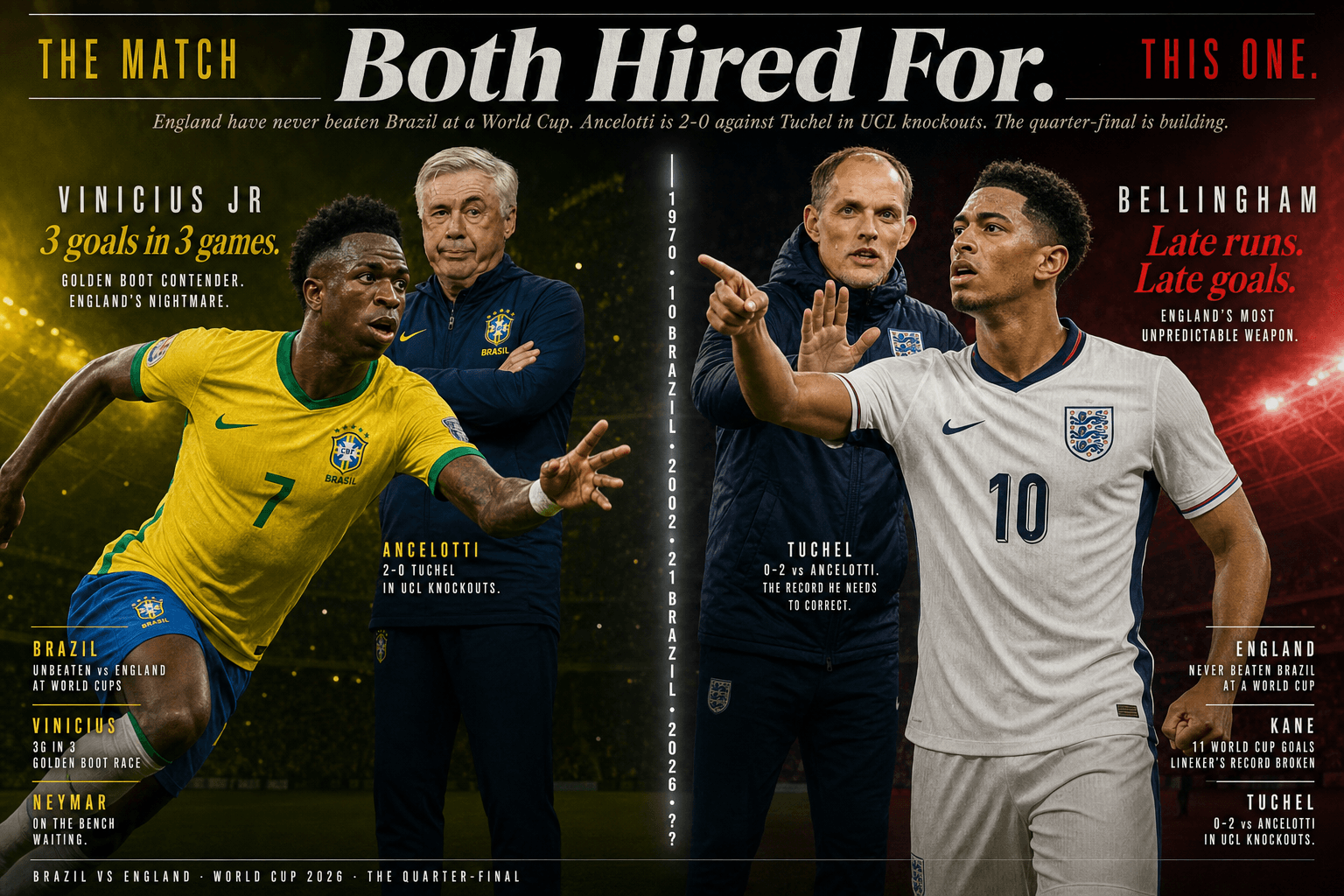
Brazil are playing Japan in Houston right now. England play DR Congo in Atlanta on July 1. If both advance — Brazil through the Round of 16 against Ivory Coast or Norway, England through Mexico at the Azteca — the quarter-final that both managers were specifically hired to win becomes live. Carlo Ancelotti against Thomas Tuchel. Brazil against England. The manager who has beaten Tuchel twice in Champions League knockout football against the manager who has never won a knockout tie against the same opponent. And a historical record that frames the entire contest: in two World Cup meetings between these nations, Brazil have won both times. England have never beaten Brazil at a World Cup in their history. The quarter-final build is covered in our Tuchel vs Ancelotti head-to-head record piece. This piece is the match itself — what it means, what it requires, and what it would produce for both managers' legacies.
The full context of what both men are chasing — the only achievement in football completed by just two people, Lippi and Del Bosque — is documented in our piece on Ancelotti and Tuchel chasing football's rarest double. That piece tells the story of the achievement. This piece tells the story of the specific match that moves one of them closer to it.
Brazil's Group Stage: A Work in Progress With a Golden Boot Contender
The group stage summary for Brazil under Ancelotti has been read in two contradictory ways by different observers, and both readings are accurate. The concerning version: a 1-1 draw with Morocco in the opener, managed only through Vinicius Júnior's equaliser, in a match where ESPN described Ancelotti's Brazil as "bailed out by Vinícius Júnior" and still a work in progress. The encouraging version: 3-0 wins over Haiti and Scotland, seven goals scored, one conceded, Group C comfortably won.
The Vinicius factor is not a work-in-progress. He scored in all three Brazil group stage matches and entered the Round of 32 tied for third in the Golden Boot race. His profile as a wide attacker — pace that no standard defensive line can match one-against-one in open play, movement that creates space for Rodrygo and the midfield runners, finishing quality that does not require many chances to produce goals — makes him the most dangerous threat in this potential quarter-final fixture. England's right side, whoever Tuchel deploys there, will face a player who has been the best in the world on his day since at least 2022.
The other significant development sitting in plain sight: Neymar is on Brazil's bench against Japan today. The squad list NBC Sports confirmed for the Japan match has Neymar as bench cover alongside Endrick and Gabriel Martinelli. The narrative around Neymar's 2026 World Cup has been one of managed expectations — Ancelotti has used him sparingly, conscious of the fitness concerns that have defined his career since 2023. If Brazil advance through the knockout rounds and the competition intensifies, the question of whether Neymar starts becomes the most discussed tactical story in South American football. Against England in a quarter-final, a fit Neymar — even as a 60th-minute substitution — would change the tactical calculus for Tuchel's defensive system in ways that no other player on the bench could replicate.
England's Route: Crawford, Ghana, Panama — and Questions That Remain
England's group stage tells a story that the optimists and the pessimists in English football both have evidence to support. Tuchel's side won Group L with seven points — beating Croatia 4-2 in the opener, drawing 0-0 with Ghana in the second match, then defeating Panama 2-0 to confirm top spot. Harry Kane scored twice against Panama to take his World Cup tally to 11, moving clear of Gary Lineker as England's all-time World Cup scorer.
The Croatia win generated real excitement — four goals, Bellingham's driving runs from midfield, Kane's clinical finishing, the attacking quality that had been promised from this squad since Tuchel took over. Then Ghana, and the 0-0, which cooled everything. The same question that has followed England into every major tournament since 1966 reasserted itself in the space of 90 goalless minutes: can this team create against a team that sits deep and defends compactly? Ghana's plan was not sophisticated. It was compact. England had no consistent answer. As we noted in our analysis of the Ecuador tournament update, compact defensive blocks have been a specific problem for Tuchel's England — Panama had a version of the same system and England's 2-0 win required a Kane penalty and a late goal rather than the sustained attacking quality that would suggest Brazil's defensive organisation will be unlocked routinely.
Against Brazil, that question matters enormously. Ancelotti's Brazil do not defend like Ghana. They press high, they counter with pace, they have Vinicius in behind and Rodrygo between the lines. England would need to both defend the transition — where Brazil are most dangerous — and find a way to create against a defensive shape that Ancelotti specifically designed to be difficult to break down. The Ghana 0-0 does not suggest England have found that mechanism yet. The Croatia 4-2 suggests they have the attacking quality to produce it.
The Historical Record: Why England Have Never Won This Fixture
The two World Cup meetings between England and Brazil are separated by 32 years and defined by two singular moments of individual genius that England could not prevent. In 1970 in Mexico, Gordon Banks produced what many observers still consider the greatest save in football history — a reaction stop from Pelé's downward header that had already beaten the goalkeeper before Banks somehow recovered and scooped the ball over the crossbar. Jairzinho scored the only goal anyway. England lost 1-0. In 2002 in Japan, Ronaldinho's free-kick lobbed David Seaman from 40 yards — the defining image of England's most recent quarter-final exit. Brazil won 2-1. England have never beaten Brazil at a World Cup. The record is absolute.
The 1970 team had Bobby Moore, Geoff Hurst, Martin Peters — the World Cup winners, the most decorated England squad since their only title four years earlier. They could not beat Brazil. The 2002 team had David Beckham, Michael Owen, Paul Scholes, Rio Ferdinand, Ashley Cole — arguably England's deepest generation since 1966. They could not beat Brazil. The question is not whether Tuchel's side is good enough to beat Brazil in isolation. The question is whether this England squad is categorically better than the ones that failed before. On the evidence of the group stage, the answer is: possibly, but not demonstrably so yet.
England have never beaten Brazil at a World Cup. Brazil 1-0 England in 1970 — Banks's save, Jairzinho's goal, Pelé's brilliance. Brazil 2-1 England in 2002 — Ronaldinho lobbed Seaman, England's best generation since 1966 went home. Tuchel's England must do what no England team has done. Against the manager who has beaten Tuchel twice in Champions League knockouts. In a quarter-final. The stakes cannot be higher.
What Ancelotti Needs to Solve — and What He's Avoiding
The specific argument the Brazil-European-curse article makes — told in full in our piece on why Ancelotti was hired to solve Brazil's European problem — is that every World Cup since 2002 has produced a European opponent with a clear tactical system that Brazil's individual brilliance could not overcome. France 2006, Netherlands 2010, Germany 7-1 2014, Belgium 2018, Croatia penalties 2022. Five European opponents. Five Brazil exits.
England is different from all five in one specific way: they have never beaten Brazil at a World Cup. The European teams that eliminated Brazil all had explicit tactical identities — Zidane's positional control in 2006, Sneijder and Robben's transition play in 2010, Germany's automatism in 2014, De Bruyne's passing range in 2018, Croatia's resilience in 2022. England's tactical identity under Tuchel has been harder to categorise from the group stage. They pressed Croatia, sat back against Ghana, controlled Panama. The system has flexibility. The question is whether that flexibility means England are more difficult to plan for — or whether it means they are less identifiably threatening and therefore easier for Ancelotti to neutralise than the opponents who have defined themselves more clearly.
Ancelotti's preparation will focus specifically on three elements: Bellingham's late runs from midfield (their most unpredictable attacking mechanism), Kane's movement to receive in the channel (his most dangerous position), and England's capacity to exploit set pieces (where Kane and the centre-backs provide real aerial threat). If Ancelotti can limit those three mechanisms to below their average output across the group stage, Brazil's attacking quality through Vinicius, Rodrygo, and the midfield should be sufficient to find a winning goal. That is the Ancelotti plan in outline: defend the specific England threat, then create through the Brazilian quality that Europe consistently underestimates.
What Tuchel Needs to Win — and Why the H2H Makes This Personal
The head-to-head context — Ancelotti 2-0 Tuchel in Champions League knockout ties, as documented in our complete Tuchel vs Ancelotti head-to-head record — is not merely a trivia point. It represents Tuchel's specific unresolved competitive relationship with the same opponent he now faces in the highest-stakes single-match environment in football. Chelsea were 3-0 up in the second leg in Madrid in 2022 — within 80 seconds of going through — and Rodrygo's goal sent Real through. Bayern were competitive across both legs in 2024 and still lost. Tuchel has been close. He has not been close enough.
The structural difference between a UCL two-legged tie and a World Cup single match, however, is the one Tuchel will be focused on. In a single 90 minutes, Ancelotti cannot manage across two legs. The specific patient quality that Real produced — absorbing pressure across a full two-legged tie, preserving the ability to produce the decisive moment when it arrived — is compressed into a single contest. Tuchel's defensive organisation, which produced results at Chelsea that Ancelotti himself has acknowledged as impressive, is well-suited to a single-match elimination context. If Tuchel can prevent Vinicius from finding his one decisive moment across the 90 minutes, he creates the conditions for England to win with a single Kane header from a set piece, or a Bellingham run that draws a mistake. That specific scenario — disciplined England defence, single England goal — is the template Tuchel needs to prove against the one manager whose record he needs to correct.
If Brazil Win: The European Curse and What It Means for Ancelotti
If Brazil beat England in the quarter-final, the specific significance for Ancelotti is worth stating precisely. Brazil would have beaten a European nation in a World Cup knockout stage for the first time since 2002. They would not merely have beaten England — they would have ended the sequence that prompted their entire managerial strategy since 2023. And they would have ended it against the European nation whose historical World Cup record gave them the best possible argument for why a Brazilian win was always likely. Brazil beating England at a World Cup is, historically, what Brazil do. The challenge Ancelotti was hired to meet was beating the European teams that had reversed that pattern — France, Germany, Netherlands, Belgium, Croatia. Those are the teams that had beaten Brazil. England is the team that Brazil had beaten. In a strange inversion, Ancelotti's most straightforward path through the European curse might run directly through the European nation that has never actually been part of the curse.
Whether that constitutes solving the problem, or simply avoiding it through a favourable bracket route, is a question that only the semi-finals would answer. But if Brazil win the quarter-final, Ancelotti will have done something no Brazil manager has done since Scolari in 2002: beaten a European nation in a World Cup knockout stage. And he will have done it while simultaneously extending his unbeaten UCL-knockout record against the manager on the other touchline. The double he is chasing — the Champions League and the World Cup, the achievement only Lippi and Del Bosque have managed — gets one round closer.
The Bracket: Why This Quarter-Final Is the One Both Camps Are Watching
The confirmed bracket path makes the quarter-final specific and dateable. Brazil play Japan today in Houston (June 29). If they advance, they face the winner of Ivory Coast vs Norway in New York on July 5. England play DR Congo on July 1 in Atlanta. If they advance, their Round of 16 is Mexico at the Estadio Azteca — a specific challenge we covered in the Ecuador tournament article, noting the altitude and hostile crowd Mexico bring to their home ties. If England get through Mexico — which would require the kind of performance their group stage has only partially provided — the quarter-final follows approximately July 10-11.
This is not a remote possibility. It is the most explicitly forecast quarter-final in English football media right now. Every major British outlet — Sky Sports, TNT Sports, BBC, ESPN UK — has mapped the bracket to this specific meeting. Both sets of supporters know the road. The question is whether both teams can walk it. For Brazil, Japan and then Ivory Coast or Norway. For England, DR Congo and then Mexico. Neither path is comfortable. Both are achievable. And if both are achieved, the highest-stakes managerial meeting in this tournament's short history becomes real.
Three Tactical Battles That Will Decide the Match
Vinicius vs Kyle Walker/Trent Alexander-Arnold: Vinicius is Brazil's most dangerous ball-carrier — three group stage goals, relentless movement in behind defensive lines. England's right-sided defensive cover, whether Walker or Alexander-Arnold pushes high, will be the first test of every Ancelotti attack. If Vinicius gets in behind even twice across 90 minutes, one of those chances scores. That is the pattern of his career.
Bellingham vs Casemiro: England's most unpredictable attacking mechanism is Bellingham's late runs from midfield — arriving in the penalty area from deep, which defensive systems find harder to track than a centre-forward's movement. Casemiro, one of the most experienced defensive midfielders in the world at 34, will be specifically tasked with reading and cutting off those runs before they develop into shooting positions. The contest between Bellingham's timing and Casemiro's positional intelligence may be the game's central duel.
Kane vs Marquinhos/Magalhaes: Brazil's central defensive partnership of Marquinhos and Gabriel Magalhaes — Arsenal's first-choice centre-back, familiar to Kane from Premier League football — will face England's record World Cup scorer. Kane at his best takes one chance. His goal return against Panama confirmed he is in form. Whether Brazil's central defenders can limit his touches in the box to below one genuine opportunity across 90 minutes is the specific defensive calculation Ancelotti will have been planning since the bracket was confirmed.
Brazil vs England in the quarter-final: Ancelotti is 2-0 against Tuchel in UCL knockouts and England have never beaten Brazil at a World Cup. Who wins — and does a Brazil victory mean Ancelotti has solved the European problem or simply avoided it? 👇