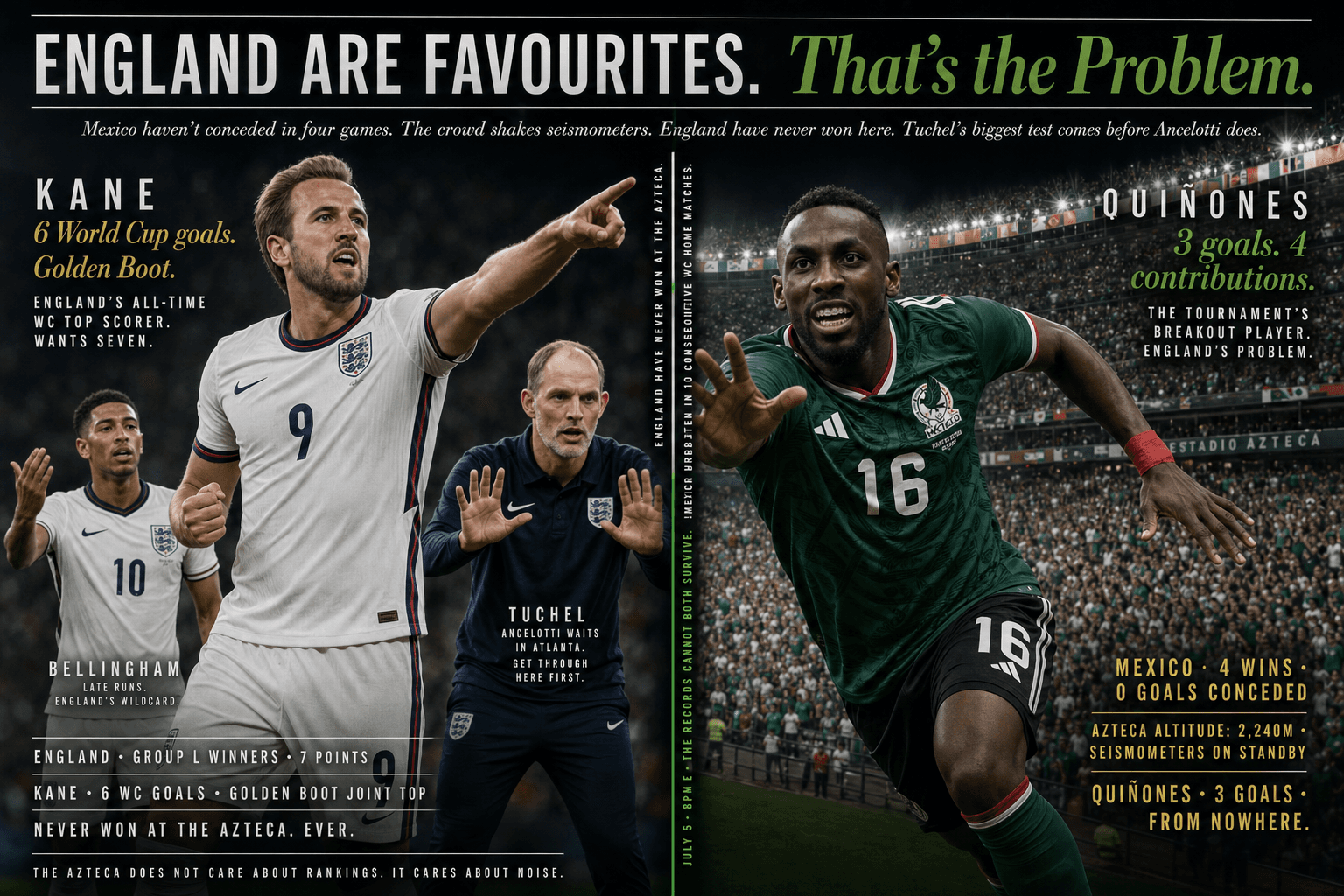
The specific danger of walking into the Azteca as the favourite is that the Azteca does not respond to favourites the way other stadiums do. In 1986, England arrived in Mexico City as a team that had Diego Maradona in front of them and the Hand of God waiting on the other side. They were not the favourite that day. The favourite was Argentina. England left 1-2 down, carrying the most controversial goal in the history of the sport. The Azteca does not care about rankings. It cares about noise. And on Sunday July 5, when Mexico and England kick off at 8pm ET in a World Cup Round of 16 that could set up the quarter-final English football has been discussing since the draw was made, the noise will be something England's preparation cannot fully simulate. As we noted in our analysis of how Mexico 2-0 Ecuador made Mexico's home fortress even more significant, Mexico are unbeaten in 10 consecutive World Cup matches at the venue. England have never won there. The favourites tag carries weight everywhere except the Estadio Azteca.
Why England Are Favourites — and Why That Framing Is Misleading
The favourites label comes from the FIFA rankings, England's group stage record, and the perceived quality gap between the two squads. England topped Group L with seven points — a 4-2 win over Croatia, a 0-0 draw with Ghana that cooled enthusiasm, and a 2-1 win over DR Congo that required Anthony Gordon off the bench and two Harry Kane goals in the second half to complete a comeback after England conceded in the first minute. Mexico won all four of their World Cup matches, including Tuesday's 2-0 demolition of Ecuador at the Azteca, and have not conceded a single goal — joining France as the only team to win every game at this tournament.
The quality gap between squads is real. Jude Bellingham, Harry Kane, Phil Foden, Bukayo Saka, and the attacking depth Tuchel has available exceeds what Javier Aguirre can call upon in the final third. But squad quality operates differently at 2,240 metres above sea level, in a stadium that holds 100,000 people, against a team that has played every match at the same venue and used every minute of that home advantage to impose their intensity from the first whistle. Mexico outpressed Ecuador so comprehensively in the opening fifteen minutes on Tuesday that Ecuador could barely leave their own half. England are significantly better than Ecuador. The opening fifteen minutes will still require them to handle an environment that their preparation in England cannot replicate.
The Azteca Effect: When the Crowd Shakes the Ground
There is one specific fact about the Estadio Azteca that any pre-match analysis owes the reader. When Mexico score at the Azteca, the crowd's response — the explosion of noise, the jumping, the stamping — has literally registered on seismometers monitoring earthquake activity in Mexico City. The phenomenon has been recorded since at least the 1994 World Cup, when Mexican fans' celebrations were picked up by monitoring equipment as minor tremors. The stadium does not merely host football matches. It physically vibrates.
England's players will have been briefed on this. Tuchel will have shown video of what Tuesday looked like when Quiñones drove into the near post in the 22nd minute and the stadium erupted. The understanding of the environment is available. The preparation for the physical reality of standing in that specific noise, at that specific altitude, in 30-degree July heat, is not something any training ground can manufacture. It has to be managed in the moment. Against a Mexico team that has not been behind once across four World Cup games and whose confidence from that record compounds the Azteca's own specific pressure, the first England goal matters more than the second. Getting through the Azteca's opening quarter of an hour — surviving the crowd, surviving the altitude impact on pressing intensity, surviving Mexico's specific desire to produce the early goal that ended Ecuador in the 22nd minute — is Tuchel's primary task before the match's tactical battles begin.
Mexico are unbeaten in ten consecutive World Cup matches at the Azteca. The crowd has registered on seismometers when Mexico score there. England have never won at the venue. Tuchel's side are the bookmakers' favourites. The favourites have a habit of underestimating exactly this combination of factors — and the last team to discover that on Tuesday was Ecuador, who beat Germany.
Mexico's Specific Danger: The Clean Sheet and the Counter
The Mexico defensive record — four consecutive clean sheets across the group stage and the Ecuador knockout match — is not merely the product of playing weaker opponents. South Korea, South Africa, Czechia, and Ecuador all provided different challenges across four matches, and none of them scored. Goalkeeper Raúl Rangel has produced a series of crucial saves across the tournament, not simply benefited from minimal attacking threat — against Ecuador he made a fine stop to deny John Yeboah, and across the group stage several significant interventions were required to maintain the shutout.
The specific tactical profile of how Mexico keep clean sheets is worth understanding precisely. Aguirre's system is not passive defending — it is an aggressive, compact mid-block that pressures the ball carrier immediately on transition, uses the wide midfielders to close the channels quickly, and relies on the central defensive partnership of César Montes and Johan Vásquez to win aerial duels and dominate the penalty area. The system that Ecuador tried to break — patient build-up, finding the channel, creating the single set-piece moment — did not produce a shot on target until late in the match. England, whose most dangerous mechanism against DR Congo was Anthony Gordon's direct running and Kane's movement into space to receive, will find those mechanisms tested by a defensive shape specifically designed to deny them.
The counter-attack is where Mexico are most dangerous. Julián Quiñones — three goals, four direct contributions in five matches at this tournament, compared to two goals in 22 previous Mexico appearances — has been the tournament's breakout player. His run against Ecuador came from a Roberto Alvarado transition that split the Ecuadorian defensive line in less than four seconds from turnover to shot. England's high defensive line, which Bellingham and the midfield runners support, is specifically vulnerable to the kind of transition Quiñones generates. The Haaland-Vinicius comparison is not applicable. But in his specific context — one-v-one in space, explosive pace, direct running to goal — Quiñones is the most dangerous single player England face at this tournament below elite tier. Against Ghana, England's defence handled a similar profile without incident. Quiñones is operating at a higher level than Ghana's attacking options.
Kane's Golden Boot Position and England's Real Weapon
Harry Kane enters Sunday's match with six goals at the 2026 World Cup — two against Croatia, two against Panama, two against DR Congo — which places him level with Lionel Messi and Kylian Mbappé at the top of the Golden Boot race. His career tally now stands at 13 World Cup goals. He is 31 years old and playing at a tournament where the pressure of both collective and individual record-chasing sits entirely compatibly. Kane scoring his seventh at the Azteca, in a Round of 16 win, against a team that has not conceded a goal all tournament — that specific image is worth more to his legacy than anything his club career at Bayern Munich, however decorated, can produce.
The mechanism through which England create Kane's chances has evolved at this tournament. Anthony Gordon's performances off the bench against DR Congo revealed the specific quality Tuchel has been reserving — direct running, willingness to beat defenders in one-on-one situations, the crossing accuracy to find Kane on the move. Gordon's two assists in the DR Congo match suggested Tuchel may start him against Mexico, or deploy him earlier than the second half. Mexico's defensive width has been well-organised across four matches. Gordon's directness — and Bellingham's late runs from midfield — are the combination that most plausibly creates the space through which Kane can score in a match where Mexico's defensive shape will be the first priority.
What Is at Stake: The Tuchel-Ancelotti Quarter-Final
The context beyond Sunday's match is the most compelling element of the entire bracket. If England beat Mexico at the Azteca, they advance to a quarter-final at Mercedes-Benz Stadium in Atlanta on Tuesday July 7 — against the winner of Brazil vs Norway, which kicks off earlier on Sunday at MetLife Stadium in New Jersey. As we documented in our complete Tuchel vs Ancelotti head-to-head analysis, the UCL knockout record between the two managers sits at 0-2 in Ancelotti's favour — Chelsea in 2022, Bayern in 2024. A World Cup quarter-final between England and Brazil would be the highest-stakes version of that specific competitive relationship yet assembled.
The full implications of that quarter-final — England's historical record against Brazil (two meetings, two Brazil wins), the European curse Brazil hired Ancelotti to solve, the double that both managers are chasing — are covered in our Brazil vs England quarter-final preview. All of that becomes live only if Tuchel wins on Sunday in Mexico City. The Mexico match is the prerequisite. The Azteca, which registered on seismometers when Quiñones scored against Ecuador, does not care that Ancelotti and Tuchel might be waiting in Atlanta. It cares about the next goal in this specific stadium. England need to stop that noise from being generated long enough to produce a goal of their own. Then another. The Azteca's record says they probably cannot. The football reason says they might.
The Brazil vs Norway Context: Why Sunday Has Two Stories
Mexico vs England kicks off at 8pm ET on Sunday. Brazil vs Norway is at 4pm ET on the same day, at MetLife Stadium in New Jersey. As we covered in our Brazil vs Norway Round of 16 preview, Haaland has five World Cup goals — level with Messi at the top of the tournament scorers — and Norway are the most dangerous European team remaining in the draw. The winner of that match faces the winner of Mexico vs England. Sunday July 5 determines the quarter-final in its entirety. All four teams know who they are playing in the other match. All four managers have been preparing for two opponents simultaneously. The tournament's most loaded single matchday begins at 4pm in New Jersey and ends when the Azteca finally goes quiet in Mexico City.
England's Three Biggest Concerns Heading Into Sunday
The altitude press problem. Tuchel's England like to press high and win the ball back quickly. At 2,240 metres, pressing requires approximately 20-30% more aerobic effort than at sea level for players not acclimated. Mexico's players have played four matches at this altitude. England have played zero. The fitness and press intensity that produced the Croatia win may not be available in the same volume through 90 minutes at the Azteca.
The Ghana problem, amplified. The 0-0 draw with Ghana showed England struggling to break down a compact defensive block. Mexico are a more organised, more experienced version of exactly that challenge — with a goalkeeper who has kept four clean sheets and a defensive unit that has not been breached once. If England cannot create against disciplined defences, the Azteca is the worst possible environment for that limitation to be exposed. In front of 100,000 Mexico fans, the pressure of not scoring amplifies with every minute that passes.
The first goal. England have not scored a first-half goal from open play in their last three tournament games at this World Cup. Mexico scored in the 22nd minute against Ecuador. In the group stage, they scored early in every match. If Mexico score first in front of that crowd, England are playing catch-up against the clean sheet record, at altitude, in heat, in the loudest stadium in North America. That is a specific combination Tuchel needs his players ready for. The team that conceded in the first minute against DR Congo and still won carries the experience of that recovery. The question is whether they can prevent the situation arising again, against an opponent better at converting those early opportunities than DR Congo were.
England are the favourites at the Azteca. Mexico are unbeaten in 10 consecutive home World Cup matches and haven't conceded in four games. Kane has six tournament goals. Quiñones has three. The seismometers are ready. Who wins on Sunday — and does England's favourite status help them or simply add weight they do not need? 👇