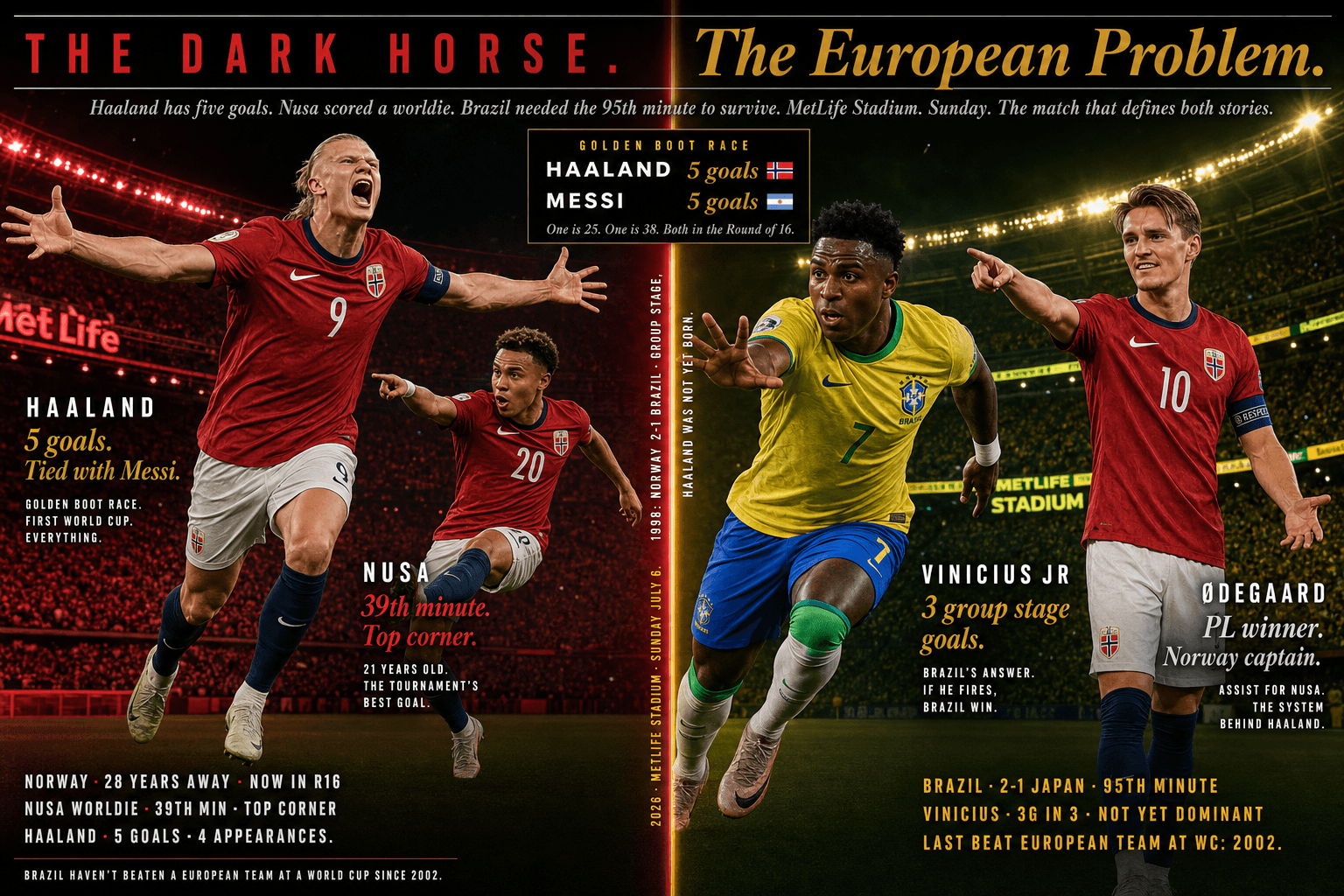
When the 2026 World Cup draw was made, Brazil and Norway in the Round of 16 was a possibility rather than a certainty. It required Brazil to navigate Japan in Houston — which they did, barely, with Gabriel Martinelli's 95th-minute finish from a Bruno Guimarães pass completing a comeback from 1-0 down. And it required Norway to get past Ivory Coast in Dallas — which they did, dramatically, with Antonio Nusa curling a worldie into the top corner from a Martin Ødegaard assist in the 39th minute, absorbing an Amad Diallo equalizer, and then watching Erling Haaland — rested against France, fully focused on this knockout run — finish calmly in the 86th minute to send Norway through 2-1. At MetLife Stadium in New Jersey, on Sunday July 6, those two paths meet. Brazil hired Ancelotti specifically to solve the European problem. Norway are the most dangerous European team nobody planned for. The problem has arrived early.
Nusa's Worldie and What It Means for Norway's Belief
The Antonio Nusa goal against Ivory Coast in the 39th minute belongs in the conversation about this tournament's most purely beautiful individual moments. Ødegaard played the ball into Nusa's feet on the left channel. Nusa opened his body, shifted the ball onto his right foot, and curled a finish into the top-right corner with the kind of technique that makes football fans stop scrolling and rewatch the clip three times before it is even over. It is the goal that defines what Nusa is — not a traditional wide attacker who crosses, not a pressing machine who wins the ball back, but a player who, in the one specific moment he touches the ball in the right space, produces something extraordinary enough to decide a World Cup knockout match.
The goal also confirmed something about Norway that the pre-tournament dark horse label had always implied but never fully proven in competitive knockout football. As we documented in our analysis of Norway as the tournament's most dangerous underdog, the argument for them was never that they would dominate opponents over 90 minutes. It was that they would produce one moment — from Haaland, from Ødegaard, from Nusa — that was of sufficient quality to win the match, even if the surrounding performance was not. Against Ivory Coast, they did that twice. Nusa's first-half worldie gave them the lead. Haaland's 86th-minute finish won it after Amad Diallo's equalizer had looked like sending the game to extra time. The dark horse machine produced two decisive moments from two different players, in two different phases of the game, against a team containing Yan Diomande — one of the Bundesliga's most discussed young players of the season, who had scored against Germany in the group stage. Norway were tested. They produced anyway.
Haaland's 5 Goals: The Golden Boot Race Is Tied
When Haaland converted Patrick Berg's pass in the 86th minute against Ivory Coast, he became the joint-top scorer in the tournament — five goals from four matches, tied with Lionel Messi in the Golden Boot race, entering the Round of 16 as the two highest scorers at the tournament. He scored twice against Iraq. Twice against Senegal. Once against Ivory Coast. He was rested for the France defeat. Every time he has been on the pitch in a competitive World Cup context, he has scored. That conversion rate is not comparable to any other striker at this tournament.
The historical context of five World Cup goals in this run is explored in full in our piece on Haaland's first World Cup and what it has already produced. The short version: he was born in July 2000, two years after Norway last played at a World Cup, and his presence at this tournament is the direct product of a qualifying campaign in which he scored 16 goals across eight matches — documented in our full account of Norway's 28-year World Cup absence. The conversation around him has recently included a Spanish presidential candidate appearing on television with a Haaland Real Madrid shirt, claiming a release clause exists — a story the club immediately and firmly denied, as covered in our Haaland release clause explainer. He arrives at MetLife Stadium against Brazil with five goals in four appearances, a valid Golden Boot claim, and the specific motivation of a player who has waited his entire career for a stage this large.
Nusa curled a worldie into the top corner in the 39th minute. Haaland finished calmly in the 86th to win it. Norway beat Ivory Coast 2-1 and face Brazil in the Round of 16. Haaland has five World Cup goals. Messi has five World Cup goals. The tournament's Golden Boot race is tied — between a 38-year-old playing his last tournament and a 25-year-old playing his first. Both meet their Round of 16 opponent on Sunday. The stories being written this summer are almost impossibly good.
Brazil's Warning Signs and the Rayan Generation
Brazil arrived at the Round of 16 with all the conviction of a team that needed a 95th-minute goal from a substitute to beat Japan. Japan's Kaishu Sano intercepted a careless Danilo pass in the 29th minute and finished clinically. Brazil offered very little in the first half. Casemiro — 34 years old — equalised in the 56th minute. And Martinelli, on as a substitute, won it in injury time after being played in by Guimarães. ESPN confirmed that this was the second-oldest Brazil squad to field at a World Cup since 1966. The average age issue is not merely a talking point. It is a structural reality.
The specific tension within Ancelotti's squad is between the experienced core — Casemiro, Marquinhos, Alisson, all 30-plus — and the generation that is supposed to be the future and has not yet fully arrived in the present. Vinicius Júnior, the player Brazil depend on for match-changing quality, had a shot tipped onto the post by Japan's keeper in what would have been a tournament-defining individual goal. He did not score. He has scored at this World Cup but has not yet dominated a game in the way his club form at Real Madrid would predict. The gap between Vinicius at Madrid and Vinicius at the Seleção — only 13 goals in 53 international appearances against club records that suggest he should be producing double that — remains unexplained.
And then there is Rayan. The 19-year-old Bournemouth right winger who started against Japan at the age where most footballers are still in youth academies. He had the fewest touches of all Brazil outfield players in the first half against Japan as Japan's disciplined defensive structure kept him isolated. But he has been part of a squad — across the Bournemouth season and his Brazil appearances — that has not experienced defeat in any competitive game this year. The unbeaten record is not his individual statistic. It is a collective record that happens to include him. But the specific detail of a 19-year-old starting for Brazil at a World Cup, having come through a domestic season at a Premier League club without losing, carries its own narrative weight. He is one of the youngest players ever to start a World Cup knockout match. On Sunday in New Jersey, he starts against Norway's back line.
The Ancelotti Context: Does Norway Count as Solving the European Problem?
Here is the specific question that Brazil vs Norway poses for Ancelotti's mission at this World Cup. Brazil have been eliminated by a European team at every World Cup since 2002 — France, Netherlands, Germany, Belgium, Croatia, in consecutive editions. Ancelotti was hired with five Champions Leagues to his name to solve a problem that has lasted five consecutive tournaments. Norway are a European team. If Ancelotti's Brazil win this Round of 16, they will have beaten a European nation at a World Cup for the first time in 24 years. Whether that constitutes solving the problem depends on your definition. Norway are the dark horse. They are not France, Germany, or Croatia. But they have five goals from Haaland, a worldie from Nusa, and a system from Solbakken that has been preparing for this specific month for five years.
The deeper Ancelotti connection is to the double he is chasing — covered in full in our piece on Ancelotti and Tuchel pursuing football's rarest achievement. Only Marcello Lippi and Vicente del Bosque have ever won both the Champions League and the World Cup as manager. Ancelotti has five Champions Leagues. If Brazil win this tournament, he joins that list. Norway, who have gone to two World Cups in 2006 without Haaland and 2026 with him, are the first obstacle on that path. The manager who has beaten Tuchel twice in UCL knockout ties — who the H2H shows has a specific ability to find the decisive moment when knockout football demands it — will need those specific qualities on Sunday in New Jersey. Ancelotti has been here before in different stadiums with different jerseys. The Haaland problem, specifically, requires him to find the answer his defensive structure has not yet been tested on at this tournament.
Where the Match Is Won: Vinicius vs Ajer, Haaland vs Marquinhos
The individual matchups that will define Brazil vs Norway on Sunday mirror the questions both teams have been asking themselves since the tournament began. Norway's defensive shape — the back five that absorbed Ivory Coast's pressure across the first half — will face Vinicius on one side and Rayan on the other. The width question for Norway is whether their wing-backs can handle two different profiles of attacker simultaneously: Vinicius's direct pace and Rayan's more technical movement. Against Japan, Brazil created very little from the sides. Against Norway, whose wing-backs pushed high in support of Nusa against Ivory Coast, the space behind them is the specific avenue Brazil will target in transition.
In the other direction, Haaland against Marquinhos and Gabriel Magalhaes is the central contest. Marquinhos has managed elite strikers at PSG for a decade — Benzema, Lewandowski, Kane in European competition. He is not easily beaten aerially or physically. But Haaland is not primarily an aerial threat. He is a player who arrives in space at pace from deep positions, whose movement is as much about timing as physicality. The 86th-minute goal against Ivory Coast was not a header from a long ball. It was a clinical finish after reading Berg's run and arriving at exactly the right moment. Marquinhos's ability to read that movement — to position himself between the pass and the arrival — will determine whether Haaland adds to his five goals or goes through a World Cup game without scoring for only the second time in this tournament.
The bracket beyond Sunday adds a specific intensity to this match that neither team would acknowledge publicly but both are aware of privately. If Brazil win, Ancelotti's potential quarter-final opponent is England — and the Ancelotti vs Tuchel head-to-head that has been building through this entire tournament becomes live, covered in full in our complete Tuchel vs Ancelotti head-to-head record. If Norway win, Haaland is in a World Cup quarter-final. The dark horse has become the story. And the man who has waited 28 years — who was born two years after his country last played at this stage — becomes the most compelling figure in the tournament.
Norway's 28-Year Wait — and Why This Match Matters Beyond Football
The bracket context is extraordinary enough. But so is the historical one. Norway last appeared at a World Cup in 1998 — a tournament they left as a team that had beaten Brazil. In the 1998 group stage in France, Norway came from 1-0 down with eleven minutes remaining to beat Brazil 2-1 — Tore André Flo and Kjetil Rekdal's penalty deciding a match that remains the most famous result in Norwegian football history. They then lost to Italy in the Round of 16 and did not return to a World Cup for twenty-eight years.
Erling Haaland was born in July 2000. He was not alive when that Brazil result happened. He has spent his entire career playing for a national team that the older generation of Norwegian fans associate primarily with the memory of that specific win over five-time world champions. On Sunday in New Jersey, Norway face Brazil again. In a World Cup knockout match. Haaland, with five goals, is the most dangerous striker in the tournament. The 1998 team beat Brazil with individual moments in the final minutes. This Norway team has shown it can do the same. The history is not coincidental. It is the context through which every Norwegian fan will watch every minute of Sunday's 90 minutes.
Brazil vs Norway. MetLife Stadium. Sunday July 6. Haaland has 5 goals. Nusa scored a worldie. Brazil needed the 95th minute to beat Japan. Which team advances — and does Ancelotti's Brazil finally beat a European opponent at a World Cup for the first time since 2002? 👇