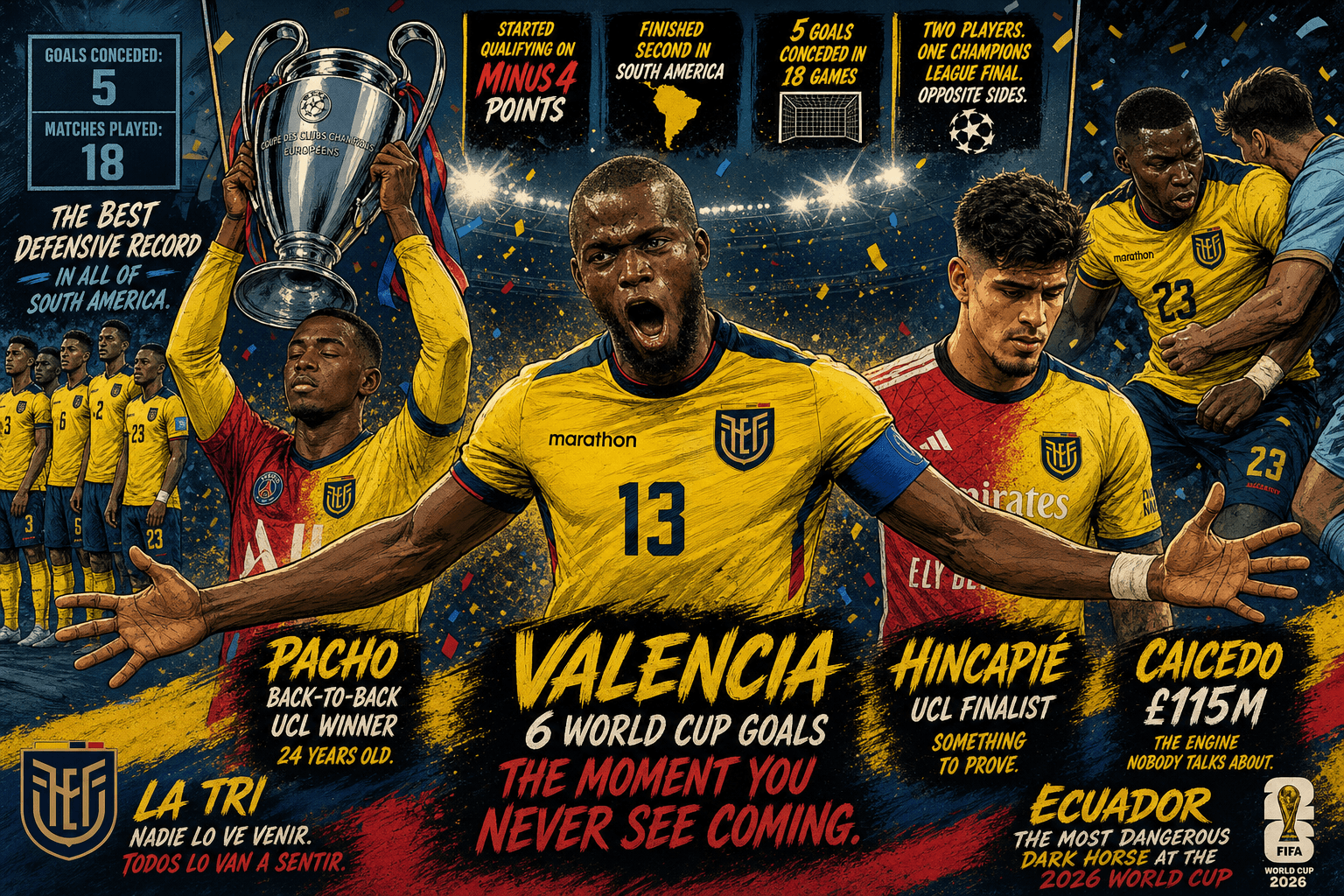
Before a single qualifying match was played, Ecuador were already losing. FIFA docked them three points over a falsified passport from the previous cycle — a punishment applied to a completely different generation of players who had nothing to do with the original offence. Their opening match brought a 1-0 defeat away to Argentina, the reigning world champions. So at the end of matchday one, Ecuador sat on minus four points. That is, statistically, almost impossible to recover from. What happened next was one of the most quietly extraordinary qualifying campaigns in the history of CONMEBOL football. Ecuador finished second. Above Brazil. Above Uruguay. Above Colombia. They conceded five goals in eighteen matches — the fewest of any nation in South American qualifying. Five goals. Eighteen games. Nobody is talking about Ecuador. They should be.
The Deduction That Should Have Ended It Before It Started
The Byron Castillo case is worth understanding properly because it shapes everything about Ecuador's mentality heading into this tournament. In the 2022 World Cup qualifying cycle, Ecuador fielded Castillo — a player whose birth documents were later found to have been falsified. The matter was disputed through multiple appeals. FIFA ultimately upheld Ecuador's 2022 qualification but imposed a three-point deduction to be applied to the following CONMEBOL qualifying campaign — meaning the punishment fell on a squad that contained almost none of the players or officials involved in the original situation.
Ecuador began the 2026 qualifying programme carrying that debt before kick-off. Their first task was to lose the opening away game to Argentina, leaving them effectively four points adrift of where they needed to be on day one. Most squads would have lost confidence. Sebastián Beccacece's Ecuador did not. They won eight, drew eight, and lost only two of their remaining seventeen matches — both defeats coming away to Argentina and Brazil, the two most formidable opponents they faced. By the end, they finished with 29 points. Second in South America. The penalty they had been given before the first whistle had been absorbed, overcome, and made irrelevant.
The Manager Who Has Never Played a Professional Game
Beccacece's coaching career is unusual in the specific way that genuinely great coaches sometimes are. He never played professional football. His entire relationship with the game has been as a student, an analyst, and eventually a manager — working through Argentine club football at Independiente, Racing Club, and Defensa y Justicia before being appointed Ecuador head coach in August 2024. It was his first international management role. He lost just one of his first sixteen games in charge.
The system he installed is simple to describe and extremely difficult to play against. Ecuador defend deep in a disciplined block, make themselves almost impossible to break down through organised pressing and positional discipline, and win matches through a single moment of quality — a counter-attack, a set piece, a flash of individual brilliance from a player who has spent 80 minutes waiting for exactly that opportunity. It is not entertaining football in the way that Brazil or France produce entertainment. It is effective football in the way that champions produce results.
The numbers prove it. Thirteen clean sheets in eighteen qualifying matches. Approximately 0.28 goals conceded per game. Brazil, for comparison, conceded seventeen goals in the same eighteen-match programme. Ecuador and Brazil finished first and second in their qualifying group — but on defensive numbers, they are not in the same category. Ecuador are in a category almost entirely their own.
Ecuador conceded five goals in eighteen World Cup qualifying matches. Brazil conceded seventeen. Germany conceded six in eight European qualifying games. Ecuador's defensive record is not just the best in South America — it is better than almost every serious team at this tournament.
The Two Centre-Backs Who Just Played in Opposite Ends of the Champions League Final
Here is the detail that should define how the world thinks about Ecuador heading into June. Last Saturday night, in Budapest, the Champions League final between PSG and Arsenal produced one of the most extraordinary footnotes in the competition's history: for the first time ever, two players from the same nation were starting on opposite sides. Both were Ecuadorian. Both were centre-backs. Both will start for Ecuador at the World Cup.
Willian Pacho started for PSG. He had already won the Champions League with them in 2025 — the first Ecuadorian in the history of the competition to do so, having played in the 5-0 demolition of Internazionale in Munich at the age of 23. PSG won again on Saturday. Pacho has back-to-back Champions League winner's medals. He is 24 years old.
Piero Hincapié started for Arsenal. The two men grew up together, trained together as children at Independiente del Valle in Quito, and dreamed together about what European football could look like. Hincapié told reporters before the final: "I've known him since we were very young. We dreamed about moments like this together. He has already been champion, and hopefully this time it will be my turn." It was not his turn on Saturday. He will arrive at the World Cup carrying the weight of that loss alongside all the quality that earned him a starting place in a Champions League final. That is not a player who is satisfied. That is a player with something to prove.
These two men — both products of the same Ecuadorian youth system, both built at Independiente del Valle, both now representing the absolute elite of European club football — form Ecuador's centre-back partnership. At 24 and 23 years old respectively, they are among the most technically accomplished defenders on the planet in their age group. When Ecuador defend, they defend with Champions League-calibre quality at the back.
Moisés Caicedo: The £115 Million Engine Room
In front of Pacho and Hincapié sits Moisés Caicedo. Chelsea paid Brighton £115 million for him in August 2023 — at the time the largest fee ever paid for a midfielder in the history of football. The transfer record has since been surpassed, but the quality it represents has been consistent: Caicedo is one of the finest holding midfielders in European football, a player who combines physicality, technical range, and positional intelligence in a way that very few players at his position can match.
His role in the Ecuador system is the one that makes everything else possible. He is the body between the defensive block and the rest of the pitch — the player who wins second balls, breaks up transition attacks before they develop, and distributes quickly when Ecuador win possession. He does not produce the highlights. He produces the conditions in which highlights happen. Pacho, who describes Caicedo as his best friend and as a "beast" on the field, benefits from having him in front of that defensive line. Together, the three of them — Caicedo, Pacho, Hincapié — form a spine that no CONMEBOL opponent managed to consistently break down across eighteen qualifying games.
Enner Valencia: The Man Who Disappears and Then Scores
And then there is the captain. Enner Valencia is 36 years old, plays in Brazil's Serie A with Internacional, and has been the most reliable scorer Ecuador have produced in living memory. His nickname is Superman. The nickname is earned.
Valencia is Ecuador's all-time leading international scorer. More importantly, he is Ecuador's all-time leading scorer at World Cups — six goals across the 2014 and 2022 tournaments. In 2014 in Brazil, he scored all three of Ecuador's goals in the group stage. In 2022 in Qatar, he scored three of their four goals — including both goals in the opening match victory over hosts Qatar, the goal that drew them level with the Netherlands in the second match, and eventually finished as joint top scorer in the tournament's opening round alongside Kylian Mbappé. He is the first South American player to score in six consecutive World Cup matches — a record that puts him alongside Eusébio, Paolo Rossi, and Oleg Salenko in the conversation about the most productive tournament performers in the competition's history.
The way he produces those goals is the thing that makes him genuinely difficult for oppositions to plan around. Valencia does not impose himself on matches continuously. He does not demand the ball every minute, does not press relentlessly, does not appear in the statistics in ways that mark him as a constant threat. He drifts. He finds space. He waits. And then, in one specific moment — often late, often when a defence has decided it has managed him — the ball arrives in exactly the right place and it is in the net before anyone has processed the sequence. Ask Qatar. Ask the Netherlands. That is the Valencia mechanism: invisible for 80 minutes, decisive for one.
The Climate Advantage Nobody Is Factoring In
Here is the practical reality that most European previews of Ecuador will ignore entirely. Ecuador train and play their home games in Quito — a city sitting at 2,850 metres above sea level, in the Andes, in one of the most physically demanding football environments on the planet. Teams from Europe travel to Quito for qualifying games and arrive oxygen-depleted, their aerobic capacity reduced, their pressing intensity compromised before kick-off. Ecuador's players have spent their entire careers preparing for, adapting to, and recovering from those conditions.
The World Cup in the United States will not replicate Quito's altitude. But Group E has Ecuador playing in Houston (NRG Stadium) and Kansas City (Arrowhead Stadium) in June — humid, warm, demanding conditions that are much closer to what South American players train in than the controlled indoor environments and temperate climates that European squads are accustomed to. Germany, Ivory Coast, and Curaçao will be adjusting to that heat. Ecuador will not need to.
This is not a small advantage. At the 2014 World Cup in Brazil, European teams consistently noted the physical difficulty of playing in humid, high-temperature conditions. Ecuador played four matches in Brazil in the group stage and reached their comfortable rhythm far faster than their opponents did. The same pattern applies here: a South American squad built for physical demand in warm conditions will be more acclimatised to Group E's environment than any of their opponents.
Group E: Germany First, Then What?
Ecuador are drawn in Group E alongside Germany, Ivory Coast, and Curaçao. On paper, Germany are the clear group favourites — four-time world champions, ranked third in the world, with Jamal Musiala and Florian Wirtz as two of the most technically gifted attacking players in the tournament. Ivory Coast have genuine quality. Curaçao, as we explored in our piece on the smallest nation in World Cup history, will be a determined opponent in their debut appearance but are not at Ecuador's level.
The Germany fixture is the opening game, and Beccacece's system is arguably built for exactly that challenge. Germany want to control possession, build through the lines, and create space through intelligent movement. Ecuador's low block and disciplined shape disrupts exactly that kind of patient build-up. If Ecuador can make the first game a tight, compressed, uncomfortable ninety minutes and emerge with a point or better, the route to the knockout stage opens significantly. Win or draw against Curaçao. Get something from the Ivory Coast. Suddenly Ecuador are through to a round of 32 where the bracket could deliver them opponents their defensive system is specifically designed to neutralise.
Ecuador have made the round of 32 their target — which would equal their best-ever World Cup result from 2006, when England eliminated them with a David Beckham free-kick. Given what they have in this squad, that target looks modest. A team with back-to-back Champions League winner Pacho, Arsenal's UCL finalist Hincapié, £115 million Caicedo, and the most decorated scorer in Ecuadorian World Cup history is not a team that should be setting its sights at a single round.
Why Ecuador Are the Most Underrated Team at This World Cup
The case for Ecuador is not built on hope or romantic narrative. It is built on demonstrable, verified evidence from eighteen qualifying matches against the best teams in South America, produced by a squad that contains genuine elite talent at the spine and a system that has proven almost impossible to break down.
They started qualifying with a handicap that no team had ever recovered from to finish second in CONMEBOL. They conceded five goals in eighteen games. They built the best defensive record in South American football. They feature two centre-backs who have just competed in the Champions League final from opposite sides — both products of the same Ecuadorian academy, both at the peak of their powers. They have a holding midfielder who cost £115 million and is worth it. And they have a captain who has scored in every World Cup he has attended and who produces his most important goal in the moment nobody is expecting it.
Ecuador are ranked 23rd in the world. They are 100/1 to win the tournament. Most pre-tournament coverage focuses on France, Brazil, England, Argentina, and Spain. That is the correct coverage for the teams most likely to win. But the question of which team could end your tournament with a 1-0 win from a single Enner Valencia moment in the 72nd minute — that is a different question. And the answer, more than almost any team at this World Cup, is Ecuador.
Ecuador start minus three points, finish second in South America, and arrive at the World Cup with the best defensive record in CONMEBOL and two players who just competed in the Champions League final. Which side in the bracket do you think would least want to face them in the knockout rounds? 👇