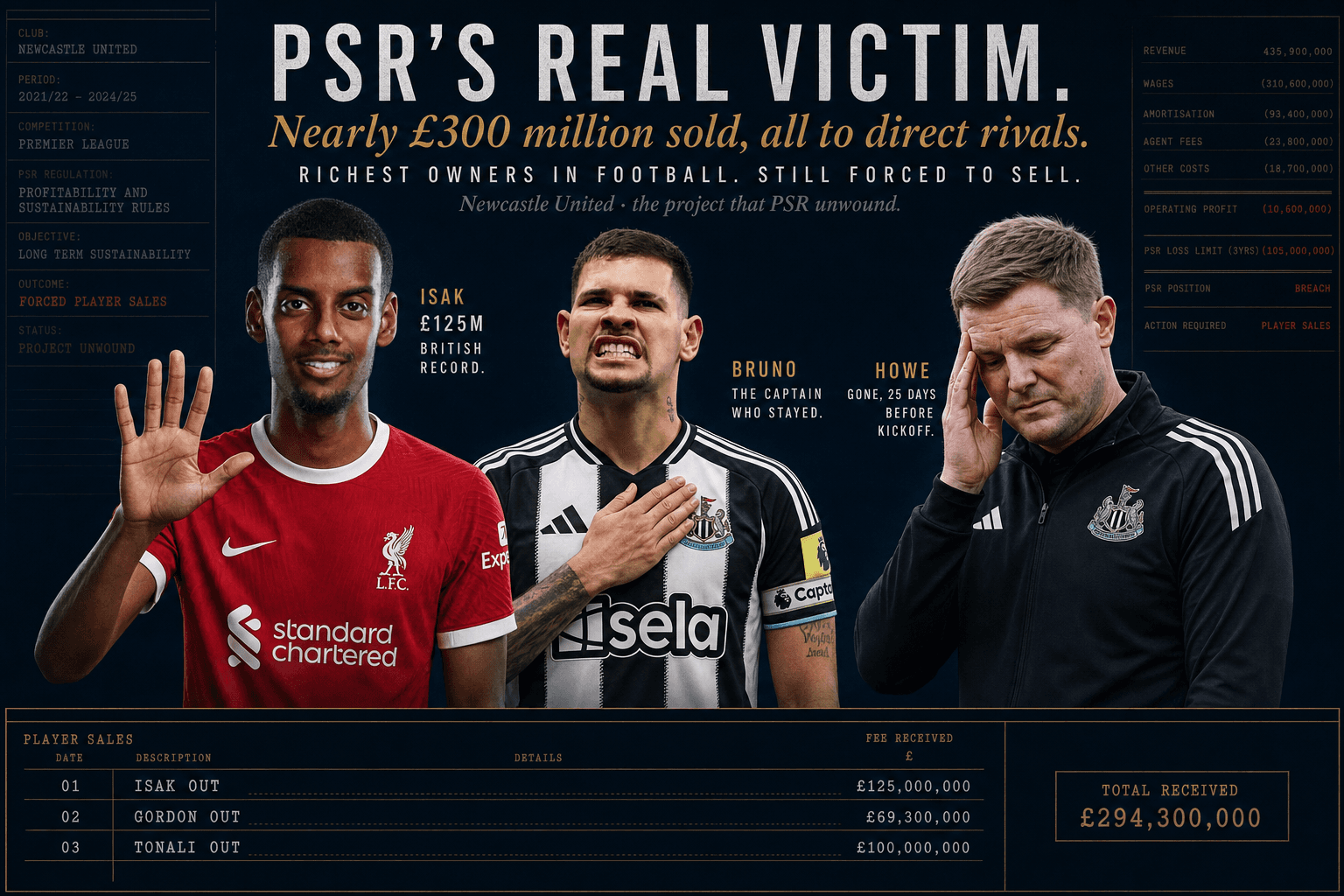
On Wednesday night, Newcastle United lost 4-1 to Championship side Bristol City in a pre-season friendly. On Thursday, Eddie Howe resigned. Five years, one Carabao Cup, two Champions League qualifications, and the most ambitious project English football has seen outside the traditional elite, ended twenty-five days before a season opener against Liverpool. The friendly result itself means nothing. What it revealed means everything, because the squad Howe watched get dismantled at Ashton Gate was not the squad he built. It was what remains after the Premier League's Profit and Sustainability Rules spent three consecutive summers forcing Newcastle to sell its best players to the exact rivals those rules were supposed to help them compete with. We explained the machinery of this system in our piece on why PSR lets the big six outspend everyone. Newcastle's collapse is that argument, no longer in theory, playing out in real time.
The Sales That Hollowed Out a Project
Start with the ledger, because the ledger is the story. Alexander Isak, sold to Liverpool last summer for a British-record £125 million, a transfer that tops the sales column on Newcastle's complete transfer record and simultaneously sits atop Liverpool's record signings. Anthony Gordon, sold to Barcelona for £69.3 million this summer. Sandro Tonali, sold to Tottenham for £100 million, instantly becoming Spurs' record signing and the centrepiece of the De Zerbi rebuild we covered in our piece on Tottenham's record-breaking summer. Three windows, nearly £300 million in sales, and every single one of those players left for a club Newcastle were supposed to be overtaking. That is not a selling club's business model by choice. That is PSR arithmetic: a club whose commercial revenue cannot yet match its ambition, owned by the wealthiest sovereign fund in world football, legally prevented from spending that wealth, and therefore forced to balance its books with the only asset it has, the players themselves.
Why the Richest Owners in Football Couldn't Save It
This is the specific perversity we broke down in our PSR explainer, and Newcastle is its perfect case study. The Saudi Public Investment Fund could buy every player Newcastle has sold without noticing the money was gone. PSR does not care. The rules cap losses relative to revenue, and revenue is precisely where Newcastle cannot compete: St James' Park generates a fraction of what Tottenham's stadium empire produces, a gap we quantified in our piece on how Spurs' stadium revenue converts directly into PSR spending headroom. The big six built their commercial machines over decades of Champions League exposure. Newcastle got one Champions League campaign, a group-stage exit, a famous 4-1 night against PSG, and then an 8-3 aggregate evisceration by Barcelona in last season's Round of 16. The window to build sustainable revenue closed before the project could climb through it, and once it closed, every summer became a hostage negotiation with the spreadsheet. Even Dan Burn, the £13 million local-boy signing whose story we told across our pieces on his England debut at 32 and his outsized value under PSR constraints, exists as a signing precisely because Newcastle's recruitment had to find £13 million miracles while rivals spent £100 million on certainties.
Newcastle sold Isak to Liverpool, Tonali to Tottenham, and Gordon to Barcelona, nearly £300 million of talent in three windows, every player going to a club they were built to overtake. The richest owners in world football watched it happen, legally prevented from stopping it. Then the manager who built the project walked away. PSR did not slow Newcastle down. It reversed them.
Bruno: The Captain Watching the Walls Come Down
Which brings us to the captain. Bruno Guimarães, signed from Lyon for £35 million in January 2022, the signing that announced the project's seriousness, the man who declared "I really believe we can win the League" when Newcastle were 19th, the story we told in full in our piece on Bruno being born for this club. Arsenal want him, talks have been running through intermediary Kia Joorabchian, and as we covered in our piece on Bruno's Arsenal situation, the £60 million question has hung over the entire summer. The telling detail, widely noted, is the contrast in conduct: Bruno has handled his situation with visible respect for the club, refusing to agitate publicly, a deliberate contrast to the way Isak's Liverpool move turned poisonous last summer. Howe's final act as manager, hours before resigning, was to publicly insist he wanted Bruno to stay. Whether Howe's departure now kills the Arsenal move to prevent a full exodus, or accelerates it because the last reason to stay just left the building, is the question that will define Newcastle's next month. Everything about how clubs discover and trigger these deals, we broke down in our piece on how release clauses actually work.
The Pivot to Kids: What Newcastle Are Now
Look at who arrived this summer and the new strategy states itself: Bazoumana Touré, a 20-year-old winger. Sean Steur, an 18-year-old midfielder. Ewen Jaouen, a 20-year-old goalkeeper. Newcastle, the club that signed Isak for £63 million and Tonali for £55 million at their peak ambition, now shop exclusively in the unproven-potential aisle, buying low in the hope of selling high, because PSR has converted them from a destination club into a development club. Howe reportedly told the hierarchy he believed he could take Newcastle forward this season, provided they recruited well. They sold Tonali and Gordon instead. He admitted after the Bristol City defeat that he had lost authority over transfer matters. Twenty-four hours later he was gone, and Matthias Jaissle, a 38-year-old coach arriving from PIF-owned Al-Ahli, is set to inherit a squad whose three best players of the last three years all now play for direct rivals.
The North East Problem Nobody at the Top Table Wants to Fix
There is a harder truth underneath the accounting, one Newcastle supporters have always known and the market keeps confirming: elite players, given the choice, pick London or Manchester or Liverpool over the North East. Newcastle missed out on target after target this summer to clubs with less sporting justification but better postcodes and bigger commercial platforms. When a club cannot outspend rivals because of PSR, and cannot out-recruit them on lifestyle and brand, and watches its manager resign and its captain get courted by Arsenal, the honest description is not a rebuild. It is a retreat. The Carabao Cup of March 2025, Dan Burn and Isak on the scoresheet against Liverpool, the club's first domestic trophy in seventy years, now stands as the project's summit rather than its foundation. Two defeats to newly promoted Sunderland last season, a 12th-place finish, and a Championship side putting four past them in pre-season mark the descent.
What Happens Next
Jaissle's appointment, expected within days, opens the next chapter, and we will cover his arrival and the full anatomy of Howe's departure in our companion piece on the resignation that ended the Howe era. The wider lesson already stands, and it is the one that should worry every ambitious club outside the established elite, from Aston Villa to Brighton: Newcastle did everything the sport claims to want. New ownership, patient building, a coach who over-delivered, a trophy, Champions League football. PSR unwound all of it anyway, because the rules protect the revenue advantages the big six accumulated before the rules existed. Chelsea, meanwhile, are demonstrating the other side of the same system, spending freely within PSR through amortisation engineering and a revenue base Newcastle can only dream of, a shift we examine in our piece on Xabi Alonso tearing up the BlueCo model. One club forced to sell its captain's supporting cast. Another signing 36-year-olds for fun. Same rulebook. That is the story.
Newcastle had the richest owners in football, a generational coach, and a trophy. PSR still forced them to sell Isak, Gordon and Tonali to direct rivals, and now Howe is gone. Is PSR protecting football's finances, or just protecting the big six? Tell us below.