On the day Roberto De Zerbi was appointed Tottenham manager in April 2026 with seven games to avoid relegation, the club's latest financial results had just confirmed a loss of £94.7 million for the year ending June 2025 and a net debt of £831 million. These are not the numbers of a club that should be able to promise its incoming manager a significant transfer budget. And yet Tottenham's sporting director Johan Lange told De Zerbi during the appointment process that major investment was coming — that the club was committed to a proper rebuild and not simply a survival band-aid. That gap between the financial results and the investment promise is explained by one building: the Tottenham Hotspur Stadium and the commercial revenue it generates regardless of what happens on the pitch inside it.
What the Stadium Actually Produces
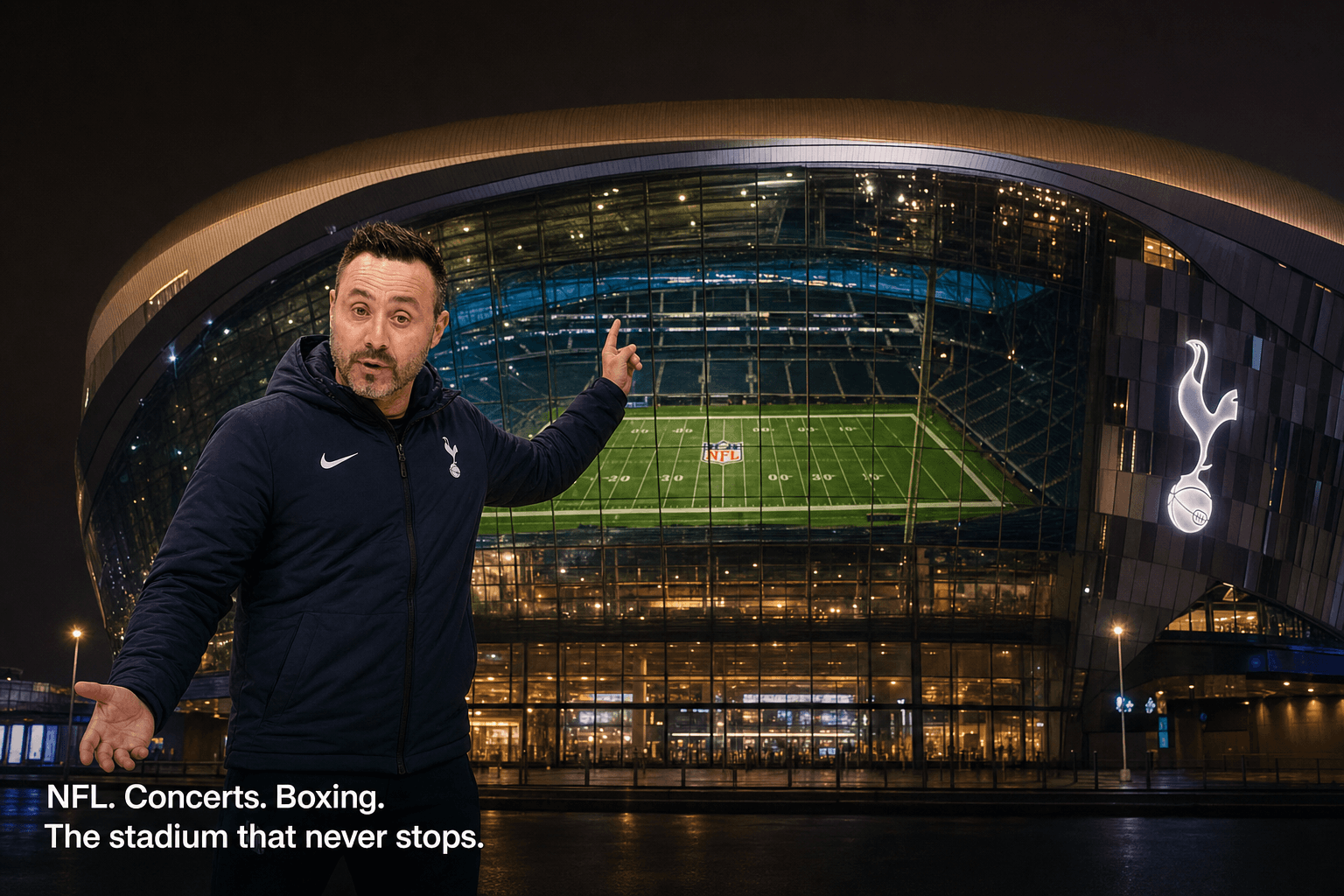
Tottenham Hotspur Stadium opened in 2019 and is the second-largest club stadium in England, with a capacity of 62,850. But its size is not what makes it financially significant. It is the specific design features that enable it to generate revenue across 365 days of the year rather than 25 Premier League home matchdays. The stadium has a dedicated NFL surface — the only purpose-built NFL facility in Europe — that can be installed beneath the main grass pitch. The NFL has played regular-season games at the stadium since 2019, generating tens of millions of pounds per season in hosting fees, hospitality revenue, broadcast contributions, and commercial sponsorship activations. The non-matchday revenue from NFL games alone has been consistently among the highest of any single sporting event in the UK annual calendar.
Concerts at Tottenham Hotspur Stadium have become one of the UK's most significant large-venue events. The building's acoustic design, sightlines, and backstage infrastructure make it competitive with dedicated entertainment venues. Major artists who have performed there generate hospitality revenue, parking and F&B income, and event management fees that flow directly into the football club's commercial accounts. Boxing events — including several significant world title fights — add another revenue stream. Corporate hospitality and conference facilities operate outside matchday windows. The stadium that was built to host football generates perhaps as much income from its non-football functions as from the Premier League fixtures it was primarily constructed for.
Why This Matters for PSR and Spending Power
The Premier League's Profitability and Sustainability Rules — covered in full in our complete PSR explainer — assess club finances across a rolling three-year period, allowing a maximum loss of £105 million before allowable deductions. The crucial element of PSR that makes Tottenham's stadium economics so significant is what counts as revenue and what does not. Commercial income from the stadium — NFL fees, concert revenue, hospitality packages, naming rights across non-matchday events — counts toward a club's sustainable revenue base. Owner equity injections, by contrast, do not count as revenue for PSR purposes. A billionaire owner pumping £200 million into a club to cover losses does not give that club additional PSR headroom to spend on transfers. The commercial revenue from a stadium that generates money independently does. As we explored in the Chelsea Vision 30 model analysis, the distinction between commercial revenue and owner injection is the specific mechanism that separates the Big Six from their challengers — and within the Big Six, the stadium economics separate Tottenham from the clubs below them in the commercial revenue rankings.
The Newcastle and Aston Villa Problem — and Why Tottenham Doesn't Have It
The contrast with Newcastle United and Aston Villa makes Tottenham's stadium advantage most visible. Both clubs have extraordinarily wealthy owners — Newcastle's Saudi-led consortium has resources that dwarf any other Premier League ownership group, and Villa's Nassef Sawiris and Wes Edens have demonstrated willingness to invest significantly. Both clubs compete in Europe. Both clubs have performed admirably in recent Premier League seasons. And yet both clubs operate under transfer budget constraints that the Big Six — including a nearly-relegated Tottenham — do not face to the same degree. The reason is not the owners' willingness to spend. It is PSR. Newcastle's commercial revenues, while growing rapidly since the takeover, remain far below Arsenal's or Tottenham's. Aston Villa's commercial base, despite European football driving growth, is similarly below the levels that give the traditional Big Six their structural transfer advantage. As we explore in our PSR Premier League spending explainer, the advantage is structural, not motivational. Newcastle can want to spend more. PSR limits how much they sustainably can.
Tottenham's stadium revenue removes this constraint to a meaningful degree. Even in a season where they nearly went down, where matchday revenues were suppressed by poor performances driving lower hospitality uptake, the NFL games and concert revenues continued generating income that counted toward the club's PSR-compliant revenue base. The £94.7 million loss that ESPN reported for the year ending June 2025 is not the full financial picture. The PSR calculation runs on a three-year basis and includes all commercial revenues across those three years, not just the matchday and broadcast income that varies with performance. The stadium's consistent non-football revenue smooths Tottenham's financial profile in a way that makes their sustainable spending capacity higher than a single loss year suggests.
What De Zerbi Gets to Spend — and Why No-Europe Helps
The combination of stadium commercial revenue and the absence of European football creates an unusual financial environment for De Zerbi's first full season. Not playing in Europe means no additional squad costs for European campaigns, no fatigue management requiring rotation squad depth, and no registration complications that UEFA competition triggers. The full transfer budget can be deployed toward a domestic-only squad without the compromise that European football forces. And the PSR-relevant commercial revenues continue regardless of the league table. De Zerbi has, in the specific financial sense that matters most under the current rules, more to work with than either the near-relegation or the loss figures suggest. ESPN reported that Tottenham's sporting director made clear to De Zerbi that a more aggressive approach to the club's wage structure was planned — long comparatively conservative by Big Six standards — as part of the commitment to rebuilding properly rather than simply surviving. The stadium makes that promise credible. The PSR headroom that the stadium's commercial revenues create makes it deliverable. That is why Tottenham could promise their newly appointed survival manager a genuine rebuild budget. And that is why the first three transfer targets are not emergency signings but carefully selected players from a manager who already knows exactly how they function in the system he is building.
The Abramovich Comparison — and Why It Doesn't Apply
The Chelsea story from the Roman Abramovich era — covered in our piece on how Abramovich's spending shaped modern Premier League football — represents the model that PSR was designed to prevent recurring. An owner injects unlimited capital, the club buys whoever it wants, the wage bill inflates to unsustainable levels relative to the commercial base, and the consequence when the owner departs or is sanctioned is a structural imbalance that takes years to correct. Tottenham's stadium model is the opposite of that: it generates commercial revenue independently of ownership, sustains a spending capacity that is directly linked to asset performance rather than owner generosity, and creates a financial floor that does not collapse if the ownership situation changes. The NFL is not going to stop paying Tottenham because Daniel Levy decides to sell the club. The concerts are not contingent on any individual's continuing involvement. The revenue is structural. The PSR headroom it creates is permanent rather than contingent. That is the specific quality of stadium-based commercial income that distinguishes it from owner injection as a foundation for sustainable Premier League spending.
The Comparative View: Arsenal, Chelsea, Tottenham vs Challengers
The specific commercial revenue hierarchy in the Premier League makes the PSR dynamic visible when expressed numerically. Arsenal's total revenue for 2024-25 was approximately £450 million — matchday, broadcast, and commercial combined. Chelsea's was comparable following the Boehly era's commercial deals. Tottenham's, boosted by the stadium, was in the £350-400 million range even in their difficult season. These figures generate PSR headroom that allows sustained spending even in underperforming years. Newcastle's total revenue has grown significantly since 2021 — from under £200 million to approaching £300 million — but the gap to Arsenal's commercial baseline remains £150 million or more annually. Across three years, that gap is £450 million of cumulative revenue difference. The implication for PSR headroom is direct: Arsenal can sustain £450 million more in losses across the three-year period than Newcastle can, before either club hits the PSR threshold. That is not a slight advantage. It is a structural separation that allows the Big Six to keep spending during bad seasons while their challengers must moderate spending during bad seasons. Tottenham's stadium is the specific asset that keeps them on the Big Six side of that structural separation, even when their football results suggest otherwise.
The Long-Term Picture: Stadium vs Squad
The strategic question that Tottenham's stadium economics raise for the next decade is whether commercial infrastructure can substitute for on-pitch trophies as the basis for sustained Premier League competitiveness. Arsenal's answer — commercial revenue plus consistent top-four finishes plus Champions League revenue — produced back-to-back league titles. Tottenham's answer has been commercial revenue plus European receipts in good years plus the stadium baseline in bad years. The near-relegation season of 2025-26 tested the stadium-without-football-revenue version of that model to its limit. The stadium held the PSR position together. De Zerbi's seven-game survival run preserved the Premier League broadcast allocation. The combination produced a club that, despite its worst season in decades, can still fund a genuine rebuild. That is the specific proof of what the stadium is worth — not the NFL games as a concept, but the revenue they generate when the football is generating nothing.
Tottenham nearly went down but could still promise big summer investment — because the stadium generates revenue that other clubs cannot match. Does the NFL-concert-boxing model make Tottenham genuinely competitive financially with Arsenal and City — and does De Zerbi know how to use that advantage? Tell us below.