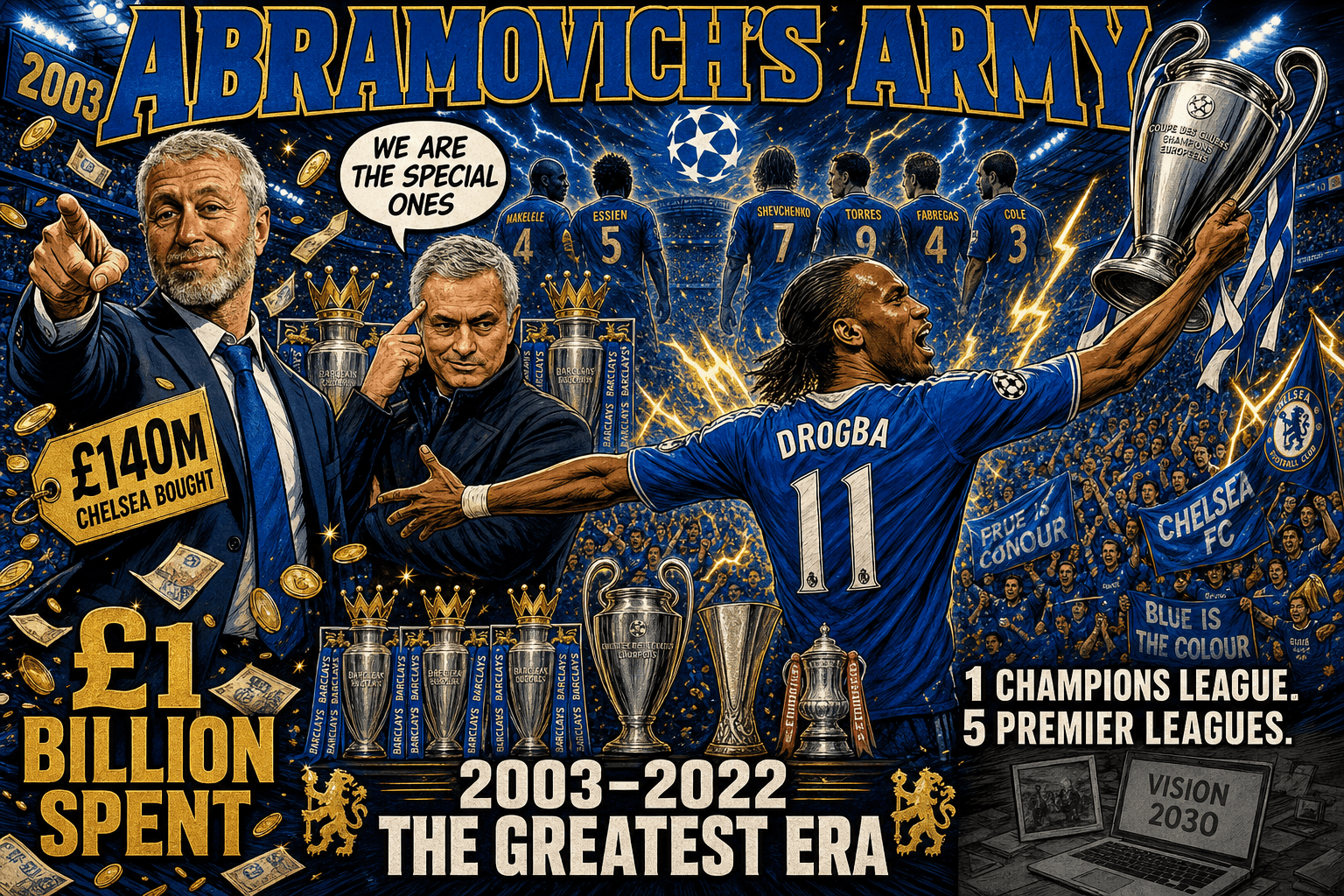
In 2003, a Russian billionaire nobody outside Moscow had heard of walked into Stamford Bridge and handed Ken Bates a cheque that changed English football permanently. In 2022, an American consortium paid £4.25 billion for what that billionaire had built — and immediately began dismantling it. Chelsea Football Club has lived two completely different lives in the same twenty-year stretch, under two completely different philosophies, producing two completely different versions of what a modern superclub is supposed to look like. This is the full story of both.
July 2003: The Day Roman Abramovich Changed Everything
Chelsea were a mid-table club with ambition and debt when Roman Abramovich arrived. The deal, worth £140 million in total, was the biggest in British football history at the time — £60 million for the club itself and another £80 million in outstanding debts that Abramovich absorbed without hesitation. The transaction was finalised on 1 July 2003. By the following morning, Chelsea were the most talked-about football club in England. By the following August, they had spent more money in a single transfer window than most clubs spend in a decade.
What Abramovich did was not simply buy a football club. He bought the concept that English football could be accelerated — that a club's history of gradual progress, built across decades, could be compressed into a single transfer window if the chequebook was big enough. The Premier League had never seen anything quite like it. Manchester United had Sir Alex Ferguson. Arsenal had the Invincibles. Liverpool had their history. Chelsea, under Abramovich, had something different: an essentially unlimited willingness to spend.
The first summer alone cost him over £120 million on players. Hernán Crespo, Argentina's world-class centre-forward, arrived from Inter Milan for £16.8 million. Claude Makélélé was prised away from Real Madrid for £16.6 million — the defensive midfielder who was so indispensable to the teams around him that, when Real Madrid let him go, Zinedine Zidane said: "Why put another layer of gold paint on the Bentley when you are losing the entire engine?" It took four years without a trophy for Real Madrid to understand what that meant. Chelsea understood immediately. In the years that followed, the holding midfield position Makélélé perfected became known universally as "the Makélélé role" — perhaps the most extraordinary tribute any player has ever received from the sport itself.
The Squad That Shocked the Premier League
The summer of 2003 was Abramovich's opening statement. The summer of 2004 was the declaration of war. A new manager arrived: José Mourinho, fresh from winning the Champions League with Porto against all odds, announcing himself to the English press as "The Special One" at his very first conference. He meant it. And with Abramovich's resources behind him, he was able to back it up immediately.
Didier Drogba arrived from Marseille for £24 million — then a Chelsea club record. The Ivory Coast striker was relatively unproven at the top level, and Abramovich reportedly asked Mourinho who he was. The manager's answer, according to his own telling of the story, was simple: "Pay and don't speak." It was perhaps the most productive instruction in Chelsea's history. Drogba scored 164 goals across two spells at the club, won four Premier League titles, two Champions Leagues, and produced the most famous moment in the club's European history — an equaliser in the 88th minute of the 2012 Champions League final against Bayern Munich, when Chelsea had been down to ten men and seemingly out of the competition entirely. He scored in ten finals out of the ten he played. No player in any era at Stamford Bridge has a record like it.
Then came Michael Essien. In August 2005, Chelsea paid £24.4 million to sign the Ghanaian midfielder from Lyon — surpassing the Drogba fee as the new club record. Essien, nicknamed "The Bison" for his physical dominance and relentless energy, became the first African player to win Chelsea's Player of the Year award. He was a complete midfielder: destructive in the tackle, technically sharp in possession, capable of producing goals of extraordinary quality. In 2006, Andriy Shevchenko arrived from AC Milan for £30.8 million — the 2004 Ballon d'Or winner, a man who had scored 127 league goals in seven seasons in Italy, the kind of player who had been considered Europe's finest striker for most of a decade. Chelsea broke the British transfer record to sign him. It did not work out — Shevchenko scored just nine league goals in 48 appearances — but the ambition behind the signing was entirely consistent with everything Abramovich was building. When Chelsea decided to sign someone, they did not wait for a discount.
The Shevchenko purchase marked the fourth time Chelsea had broken a transfer record in the Abramovich era. The pattern was already clear. And it was not limited to players.
The Managers: Serial Winners in the Dugout
Abramovich's approach to managers was the same as his approach to transfers: he wanted the best available, at whatever cost, right now. The results of that policy were extraordinary — and also, at times, chaotic.
Mourinho arrived in 2004 and won the Premier League in his very first season — ending the club's 50-year wait for a top-flight title. He won it again the following year. Chelsea conceded just 15 league goals in 2004-05 — still the record low in Premier League history. Mourinho's Chelsea were not just winning; they were dominant in a way the division had not seen since Manchester United's peak under Ferguson. He became the first manager in Premier League history to win the title in his debut season at a club — a distinction that would eventually be shared by several others, but that Chelsea themselves would claim twice more.
After Mourinho was sacked in 2007 — one of Abramovich's more impulsive decisions given what Mourinho had delivered — the managerial merry-go-round that would define the Abramovich era in its later years began. Avram Grant. Felipe Scolari. Guus Hiddink as interim. And then, in 2009, Carlo Ancelotti.
Ancelotti was, at the point of his appointment, the most successful Champions League manager alive — having already won the competition twice with AC Milan. He too won the Premier League in his debut season, 2009-10, with a team that scored 103 league goals — a Premier League record at the time. Drogba finished as the division's top scorer with 29. Chelsea won the double. They were, that season, as free-scoring and dominant a domestic force as English football had seen in years. Like Mourinho before him, Ancelotti was sacked the following year after a trophyless season.
Antonio Conte arrived in 2016, fresh from a spell as Italy national team manager and having won three consecutive Serie A titles with Juventus without losing a single league game across those campaigns. He switched Chelsea's formation to a three-at-the-back system mid-season, triggered a 13-match winning streak, and won the Premier League in his first season. Three managers: Mourinho, Ancelotti, Conte. Three Premier League titles. Three debut seasons. It remains one of the most remarkable managerial records in the history of English football. Only a handful of managers in the entire history of the Premier League have achieved what each of them did in their first campaigns, and three of them were at Chelsea under the same owner.
Then came Thomas Tuchel. The German had guided PSG to the Champions League final in 2020 — losing to Bayern Munich — before being sacked with the club in mid-table. Chelsea appointed him in January 2021. He did not win the Premier League. He did something arguably harder: he won the Champions League. In May 2021, Chelsea beat Manchester City 1-0 in Porto to win their second European title, completing one of the more extraordinary managerial full circles in the competition's history. Tuchel had gone from Champions League finalist to winner in twelve months, doing the second half with a completely different club. Abramovich's Chelsea had, again, found the right man at exactly the right moment — and this time the right man delivered the right result.
Later Years: The Spending Continued
The final decade of the Abramovich era produced more record-breaking transfer activity. Fernando Torres arrived from Liverpool for £50 million in January 2011 — the British transfer record at the time, and one of the most discussed flop purchases in Premier League history. Torres scored 20 goals in 110 appearances. The fee was unjustifiable by any measure. And yet, within two years, Chelsea won the Champions League with him in the squad, the Europa League followed, and the club added more FA Cups, a further Premier League title, and another Europa League before Abramovich was forced to sell in 2022.
Cesc Fàbregas joined from Arsenal for £30 million in 2014 and immediately became one of the central creative forces of Mourinho's second title-winning team in 2015. Diego Costa arrived the same summer and scored 20 league goals in his debut season. Jorginho, one of Europe's finest deep-lying playmakers, was signed for £57 million in 2018 and went on to become a key figure in Tuchel's Champions League campaign. Romelu Lukaku returned to the club in 2021 for £97.5 million — the biggest fee in Chelsea's history and one that did not produce returns to match it.
By the time Abramovich was forced to sell in March 2022 following Russia's invasion of Ukraine and the subsequent sanctions freezing his UK assets, Chelsea had won 21 major trophies under his ownership: five Premier Leagues, two Champions Leagues, two Europa Leagues, five FA Cups, three League Cups, a FIFA Club World Cup, a UEFA Super Cup, and two Community Shields. He had personally loaned the club £1.5 billion across 19 years. He had spent approximately £2 billion on transfers. He had appointed 13 managers. He had, in the process, transformed a club that had won one league title in 98 years into one of the dominant forces in English and European football.
This is what Real Madrid's Galácticos strategy looked like in England. As we broke down in our analysis of Real Madrid's own transfer playbook, the Spanish giants built their dominance through patient Bosman acquisitions and contract-expiry manoeuvres. Abramovich's Chelsea did the opposite: they paid maximum fees for maximum talent at maximum speed, making the waiting game irrelevant by simply buying the best players before anyone else could position themselves. Two different approaches. Both, for extended periods, devastatingly effective.
May 2022: The Sale That Ended an Era
The circumstances of the sale were entirely outside football. Russia's invasion of Ukraine in February 2022 triggered UK government sanctions against Abramovich, freezing his assets and making it legally impossible for him to continue as Chelsea's owner. The club was sold to a consortium led by Todd Boehly and Clearlake Capital for £4.25 billion in May 2022 — the most expensive sale of a sports franchise in British history. Abramovich had bought it for £140 million. He left it worth thirty times that figure. He also wrote off the £1.5 billion he had personally loaned the club, directing that net sale proceeds go to victims of the war in Ukraine.
The Boehly-Clearlake era began with a straightforward question: what do you do with the most expensive sports franchise in British history, a club built on a philosophy of spending, when you are not prepared to simply continue spending in the same way?
The Boehly Era: A New Philosophy Built for the Long Term
The first twelve months under Boehly were, to put it charitably, unconventional. In the summer and winter windows of 2022 and early 2023 — before the club had appointed formal sporting directors — Boehly effectively acted as his own transfer chief. Chelsea spent €630 million in fees across those two windows, signing Raheem Sterling, Kalidou Koulibaly, Mykhailo Mudryk, Pierre-Emerick Aubameyang, and many others. The club finished mid-table. The exercise demonstrated, at significant expense, that spending alone did not solve the problem.
The second phase — what began in the summer of 2023 under new sporting directors Paul Winstanley and Laurence Stewart — was different in character, if not in volume. Chelsea launched what has been internally referred to as their "Vision 30" project: a long-term plan built on signing the most talented players under the age of 24, tying them to contracts of six, seven, eight, or nine years, and betting that their combined market value would appreciate significantly over time. The logic was financial as much as footballing: by spreading transfer fees across longer contract terms, Chelsea could manage their amortisation costs within the Premier League's Profit and Sustainability Rules (PSR), effectively allowing them to continue spending at a level that would otherwise breach financial regulations.
Since taking over in 2022, Chelsea have spent over £1.5 billion on transfers — funding no fewer than 45 permanent signings, with contracts typically stretching six to eight years. Cole Palmer, signed from Manchester City for £40 million, immediately became one of the Premier League's most creative players and the early vindication of the model. Enzo Fernández, signed for £107 million from Benfica — a British transfer record — represents the larger end of the strategy. Moisés Caicedo was signed from Brighton for £115 million, surpassing Fernández as the new record. The combined squad is, on paper, extraordinarily expensive and extraordinarily young.
The results on the pitch have been more complicated. Chelsea finished 12th in the Premier League in 2022-23. They improved to sixth in 2023-24. By 2024-25, they were pushing for the top four and, in a significant step forward for the Boehly era, won the UEFA Conference League — their first trophy under the new ownership and, historically, the final piece of a complete set of European trophies for the club.
The Tension at the Heart of the Boehly Model
The structural tension in Chelsea's current approach is not difficult to identify. A squad of 40-plus players, each on wages and under contracts lasting the better part of a decade, creates extraordinary managerial complexity. Coaches have repeatedly noted the difficulty of managing a playing group where the gap between what is expected and what is available is so wide. Players signed as long-term investments do not always develop on schedule. Some do not develop at all. CBS Sports' analysis noted the fundamental conundrum: after all those signings, are Chelsea actually anywhere near good enough to match their expectations?
The financial architecture of the model has also attracted scrutiny. UEFA changed its amortisation rules to cap the spread at five years regardless of contract length — a move widely seen as a direct response to Chelsea's approach. The club's controversial £198.7 million sale of their women's team to parent company BlueCo, which pushed them into overall accounting profit, added further questions about the boundaries of what is permissible under PSR frameworks.
Boehly's response to those who question the pace of the rebuild has been consistent: patience, and the argument that players retain value as assets even if results take time to follow. "We are not spending the money, we are investing the money," he said in 2024. "Those players continue to hold their value." There is a financial logic to that position. Whether it translates into a Premier League title, the benchmark Abramovich's managers consistently delivered, is the question the next several seasons will answer.
Two Eras, One Club, Two Completely Different Bets
The contrast between the Abramovich era and the Boehly era is, at its core, a contrast between two entirely different theories of how to build a football club. Abramovich believed in buying the finished article: Drogba, Essien, Shevchenko, Torres, Fàbregas, Costa, Jorginho. Players at the peak of their careers, proven at the highest level, capable of winning immediately. Managers — Mourinho, Ancelotti, Conte, Tuchel — hired for identical reasons. The result was 21 major trophies in 19 years and a complete transformation of what Chelsea represented in world football.
Boehly believes in buying the potential article: Cole Palmer at 21, Enzo Fernández at 22, Moisés Caicedo at 21, Malo Gusto at 20. Players who might become the finished article, on contracts long enough to hold the value of the investment even if the development takes longer than expected. No manager under Boehly has yet won the Premier League. One has won a European trophy. The squad, statistically, is the youngest among Europe's major clubs. The results are improving — but they are not yet consistent enough to claim the model is working at the level Abramovich's era set.
What both approaches share, ironically, is scale. Abramovich spent £2 billion across 19 years. Boehly has spent £1.5 billion in three. The philosophical difference is real, but the appetite for spending — the fundamental belief that Chelsea's ambitions justify extraordinary outlay — has not changed. What has changed is where that money goes: from established winners to emerging talent, from serial champions to potential stars, from immediate gratification to long-term positioning.
Whether the Boehly model produces the same kind of sustained success that Abramovich's did — five Premier League titles, two Champions Leagues, a complete set of European trophies — is the defining question hovering over Stamford Bridge right now. The infrastructure is being built. The talent is being accumulated. The trophies, at the scale Chelsea expect them, are yet to arrive at scale.
In the next part of this series, we break down the specific impact of the Boehly model in detail: who is coming through, what the finances actually look like under PSR, and whether Vision 30 can ever produce what Abramovich's chequebook delivered on demand.
Is Chelsea's youth-driven model the right path for a club of their stature, or should big clubs always prioritise proven winners? And which Abramovich-era signing do you think defined that period more than any other? Drop your thoughts in the comments. 👇
What Comes Next
Chelsea's story is not finished. The Boehly era is still being written — still being judged. What is certain is that the club has been through two genuinely distinct transformations in twenty years, each one complete enough to produce a different kind of Chelsea. The Abramovich version won everything immediately and repeatedly. The Boehly version is building structures that may take another decade to fully mature. Both versions have been the most expensive exercise in English football in their respective eras. And both versions, whatever else they represent, confirm that Chelsea Football Club remains incapable of doing things quietly, cheaply, or without ambition. That is not a criticism. It is a description. This is what Chelsea are.