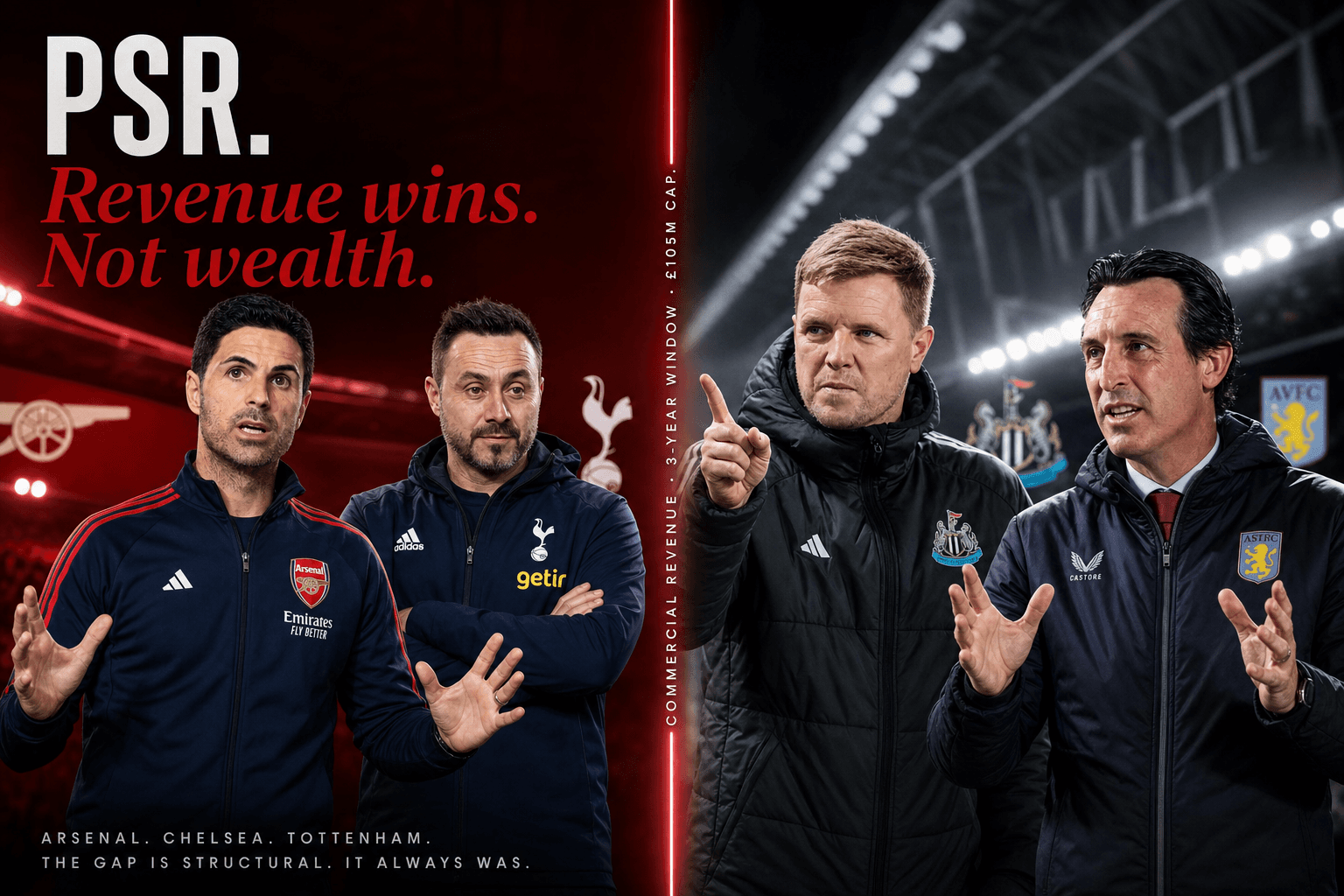
The most misunderstood rule in English football is the one that generates the most transfer window complaints. Every summer, supporters of Newcastle United, Aston Villa, and other clubs ask the same question: our owner is wealthier than most Big Six owners. Why can they spend more than us? The answer is the Profitability and Sustainability Rules — Premier League PSR — and the answer is more specific and more structural than most football coverage suggests. PSR does not punish clubs for having wealthy owners. It does not reward clubs for having rich history or large stadiums by themselves. It rewards clubs for generating commercial revenue. And the commercial revenue gap between the traditional Big Six and the emerging challengers is the specific mechanism through which the Big Six maintain a structural transfer advantage regardless of what happens on the pitch.
What PSR Actually Is
The Premier League's PSR rules require clubs to balance their books across a rolling three-year assessment period. Clubs can sustain losses of up to £105 million across the three-year window before allowable deductions. Those deductions include academy development costs, women's football investment, and stadium and training ground infrastructure. The assessment uses a club's profit and loss account across those three years — not just the most recent season. The key variable is revenue: the higher a club's revenue, the more it can spend while remaining within the loss threshold. And revenue, under PSR, means specifically commercial income — matchday receipts, broadcast distributions, sponsorship, commercial partnerships, and non-matchday facility usage. It does not include owner equity injections. A wealthy owner putting £200 million into a club does not create PSR headroom. A stadium generating £50 million in non-matchday revenue annually does.
Why the Big Six Have the Structural Advantage
Arsenal, Chelsea, Liverpool, Manchester City, Manchester United, and Tottenham have commercial revenue bases that reflect decades of global brand development. Shirt sponsorships worth £50-70 million annually. Stadium naming rights worth tens of millions. Global commercial partnerships with brands that pay precisely because the club's name appears on the largest broadcast footprint in world football. This revenue exists independently of Premier League performance. Arsenal can finish fifth and still generate £300-plus million in total revenue. Their commercial partners do not leave because they missed the top four. Their shirt sponsor does not reduce their payment because the manager was sacked in March. The commercial base is structurally secured in a way that performance-contingent revenue — broadcast distributions, prize money, European qualification fees — is not. As we covered in our piece on Chelsea's Vision 30 PSR amortisation strategy, the specific financial engineering that clubs deploy within PSR is complex — but the fundamental advantage is simple: the clubs with larger commercial revenue bases can sustain larger losses, therefore can spend more on transfers, regardless of owner wealth.
The Newcastle Problem Explained Precisely
Newcastle United's Saudi-led PIF consortium has resources that make every other Premier League ownership group look modest by comparison. Saudi Arabia's sovereign wealth fund has assets exceeding $700 billion. The ownership group that controls Newcastle could, in theory, spend whatever they chose on football. PSR prevents them from spending most of it. Newcastle's commercial revenues — growing rapidly since the 2021 takeover, boosted by new sponsorships, stadium upgrades, and the profile improvement that comes with consistent top-half Premier League and European football — remain significantly below Arsenal's and Tottenham's. The gap is not a reflection of the owners' investment appetite. It is a reflection of thirty years of Premier League history during which Arsenal and Tottenham built global commercial relationships that Newcastle did not. Closing that gap requires years of sustained commercial growth rather than a single transfer window statement. Newcastle can accelerate the process. They cannot shortcut it. PSR ensures that the financial consequence of thirty years of commercial history cannot be overcome by a single wealthy owner's decision to spend more.
Aston Villa's situation is similar in structure if different in detail. European football has accelerated Villa's commercial growth significantly — European broadcast distributions, continental commercial partnerships, and the profile uplift of competing against Madrid, Bayern, and Barcelona in the same competition all contribute to revenue growth that genuinely improves PSR headroom. But the baseline commercial revenue that Villa started from when their current ownership arrived is lower than Arsenal's by a margin that years of Europa League and Champions League participation cannot immediately close. As we explored in our piece on how Tottenham's stadium economics create a spending advantage, the specific example of non-matchday revenue from Tottenham Hotspur Stadium illustrates how commercial income can sustain PSR headroom even in a season of poor results. Villa do not have an equivalent revenue stream. Newcastle's new stadium plans, if realised, could eventually create one.
What Amortisation Does to the Calculation
The second element of PSR that generates confusion is amortisation. When a club spends £60 million on a player with a five-year contract, the loss impact on PSR accounts is not £60 million in year one. It is £12 million per year across the five years — the transfer fee amortised across the contract length. This is why clubs sign players to long contracts: the longer the contract, the smaller the annual PSR impact of the transfer fee. Chelsea's specific use of this mechanism — long contracts, young players, amortised fees spread over seven or eight years — is the model we documented in our full Chelsea Vision 30 amortisation explainer. The principle applies across all clubs: amortisation is not a loophole. It is a standard accounting treatment that PSR uses as its framework. Clubs that understand it use it. The Big Six have had longer to optimise their use of it, which is another structural advantage the challengers are still closing.
The 2026 Summer: Who Has Headroom and Who Doesn't
The practical consequence of the PSR structure for the 2026 summer window is visible in which clubs are expected to spend significantly and which are constrained. Arsenal, with consistent top-four Premier League finishes and Champions League revenue compounding on top of their commercial base, have genuine headroom for major investment. Tottenham, whose stadium revenue sustains their commercial base regardless of results, can fund De Zerbi's rebuild despite the near-relegation. Chelsea, whose amortisation strategy across the Boehly era's extensive acquisition programme has created a complex picture, can continue spending within the model they have built. Newcastle and Villa, whose commercial growth is real but has not yet closed the historical gap, face more significant constraints — particularly in a summer where neither can rely on Champions League qualification revenue to boost the PSR calculation. The rules are the same for everyone. The commercial history that the rules assess is not.
The Practical 2026 Summer Picture
The practical consequence of the PSR structure for the 2026 summer window is visible in which clubs are expected to spend significantly and which are constrained. Arsenal, with consistent Champions League revenue compounding on top of their commercial base, have genuine headroom for major investment. Tottenham, whose stadium revenue sustains their commercial base regardless of results, can fund De Zerbi's rebuild despite the near-relegation — as we covered in our piece on De Zerbi's arrival, survival, and summer rebuild at Tottenham. Newcastle and Villa, whose commercial growth is real but has not yet closed the historical gap, face more significant constraints — particularly in a summer where neither can rely on consistent Champions League qualification revenue to boost the PSR calculation. The rules are the same for everyone. The commercial history that the rules assess is not. And that is the specific answer to the question every Newcastle and Villa supporter has been asking since their clubs became genuinely competitive: why can Arsenal and Tottenham still spend more?
The Abramovich Model and Why PSR Replaced It
The specific reason PSR exists is the Abramovich era — the period from 2003 to 2022 during which Chelsea demonstrated that unlimited owner capital, injected directly into a football club, could purchase Premier League dominance and Champions League trophies without any organic relationship to the club's commercial operations. As we covered in our piece on the Abramovich era and how it changed Premier League football, the model produced trophies but also produced a structural imbalance that other clubs could not compete with through any conventional means — domestic commercial development, broadcast distribution, or matchday revenue growth could not generate the kind of capital Abramovich was deploying. PSR was the regulatory response: a rule that prevented clubs from sustaining unlimited owner-funded losses, while still allowing the commercial revenue that clubs had built through their own operations to translate into competitive spending. The rule disadvantages clubs whose commercial revenues have not grown as fast as their results or their owner's ambitions. It protects clubs whose commercial revenues reflect decades of brand development. Whether that protection is the right policy outcome — whether it is appropriate for a regulatory framework to preserve advantages built in a different era — is the legitimate question that Newcastle and Villa's rise has put back on the agenda.
PSR rewards commercial revenue, not owner wealth. That is why Newcastle and Villa face limits that Arsenal and Tottenham do not. Is the current PSR system the right way to regulate Premier League finances — or does it simply entrench the existing Big Six advantage? Tell us below.