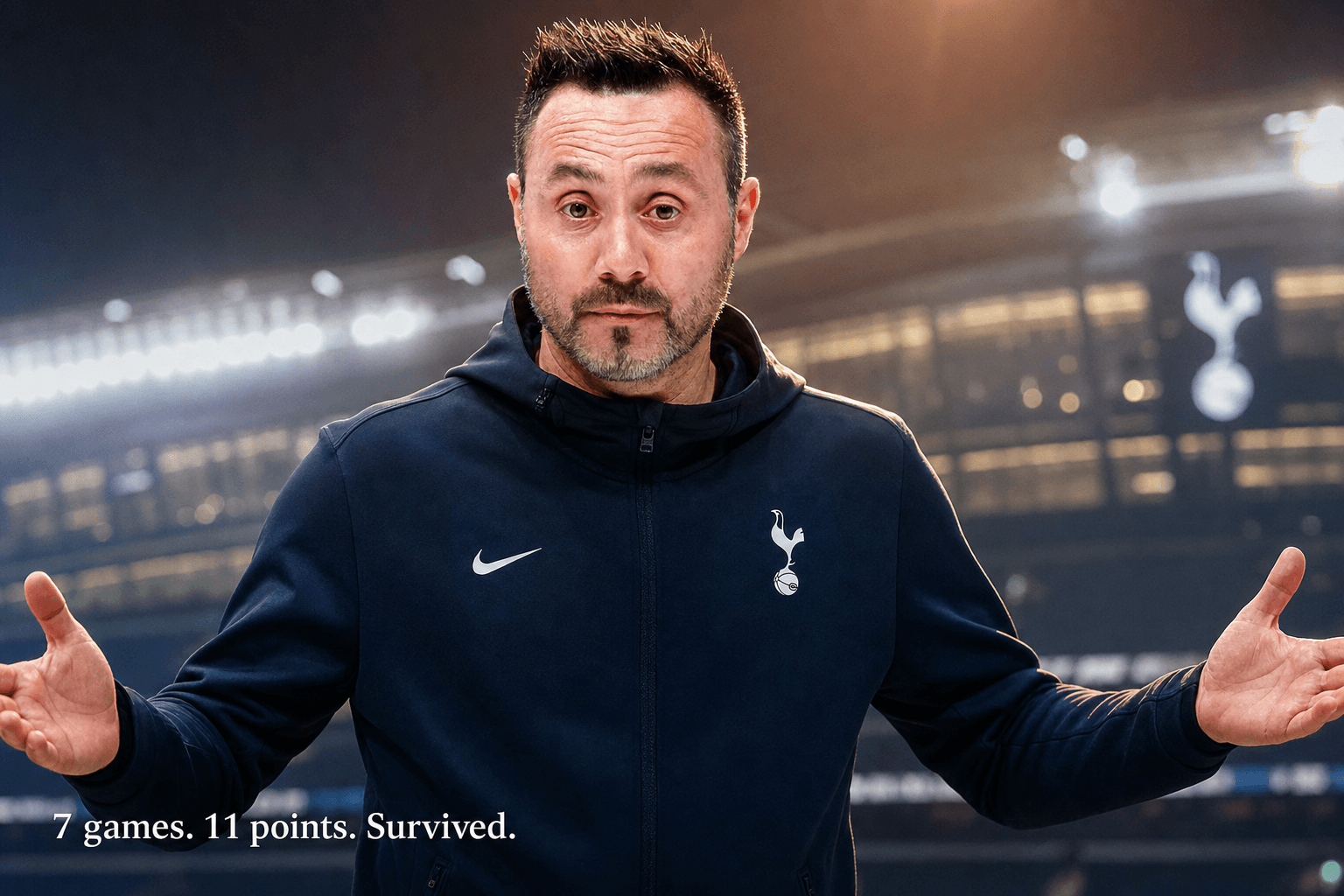
The specific detail that defines Roberto De Zerbi's Tottenham appointment is not that he took the job when the club were a point above relegation, or that he was the third manager of the season, or that he had just left Marseille in February and was available at the precise moment Spurs needed someone. The specific detail is the contract. Five years. No relegation release clause. When asked directly about what would happen if Tottenham were relegated, De Zerbi said: I signed five years of contract because, for me, it is a big challenge and I will be the coach of Tottenham next season, no matter what. A manager does not say that sentence if he plans to leave. He says it because he means it. And Tottenham, who had just watched Igor Tudor win none of his five league games in six weeks after Thomas Frank was sacked in February, needed someone who meant it.
The Situation De Zerbi Walked Into
The facts of Tottenham's position on April 1, 2026 need to sit alone before any tactical or strategic analysis can meaningfully follow. Spurs were 17th in the Premier League table with 30 points, one point above West Ham United in the bottom three. Seven games remained. They had not won a league match under their previous two managers across a combined eleven games. They were facing the prospect of their first relegation since 1977. The Tottenham Hotspur Supporters Trust issued a statement raising serious and far-reaching concerns about the De Zerbi appointment specifically — not about the appointment of a new manager, but about this specific manager's association with Mason Greenwood during his time at Marseille. The club acknowledged those concerns internally during the hiring process. They appointed him anyway, because the football argument was overwhelming and the alternative — another interim, another six weeks of drift, another manager who was not their long-term choice — was worse than the controversy.
ESPN reported that De Zerbi had actually been Tottenham's preferred choice even before Tudor's appointment — they had tried to hire him in February when Frank was sacked, but De Zerbi had only just left Marseille and was not immediately ready to take a new position. By the time Tudor's six weeks of failure were over at the end of March, De Zerbi was available, still the club's first choice, and the circumstances had become significantly more desperate. The club signed him to a five-year deal without a relegation release clause specifically to signal to players, staff, and opponents that this was not a survival appointment. It was a long-term appointment that happened to begin during a survival emergency.
Seven Games, Eleven Points, Final Day Survival
What De Zerbi produced in those seven games is one of the more quietly remarkable managerial achievements in recent Premier League history. He picked up 11 points from 7 matches — wins over Sunderland, Brighton, Wolverhampton, and Everton on the final day, with draws against Aston Villa and Chelsea — to keep Tottenham in the Premier League. Survival was confirmed on May 24 against Everton at the final whistle of the final match of the season. The margin was not comfortable. The process was not smooth. But the outcome was the only one that mattered, and De Zerbi delivered it without the benefit of a pre-season, without the signings he wanted, without any of the preparation that makes a manager's system implementable. He won 11 points through force of personality, tactical clarity under pressure, and the specific ability to raise the performance level of players who had been visibly disengaged under two previous managers that same season.
The tactical approach he implemented in those seven games was not the possession-dominant, high-press system that made his reputation at Brighton. It was a pragmatic, structured defensive organisation with fast transitions — the system appropriate to a team fighting for survival in the final stretch of a Premier League season, rather than the system he intends to build over the following four years. The distinction matters because the criticism that follows De Zerbi's Tottenham tenure to date — that the football was not always attractive, that the results were tight, that the survival felt uncomfortable — misses the point of what he was doing. He was not implementing his system. He was keeping Tottenham in the Premier League with whatever he had available. His system comes now. The summer is where this actually begins.
Why Tottenham Can Now Spend: The PSR and Stadium Advantage
The financial context of what De Zerbi is building matters because Tottenham's ability to fund the rebuild is not simply a function of their owner's wealth. It is a function of the specific financial rules that govern Premier League spending — the Profitability and Sustainability Rules that we cover in depth in our full PSR explainer. The short version: clubs can spend money generated by their football operations — revenue from matchdays, broadcast rights, commercial partnerships, and stadium non-matchday usage. They cannot simply inject owner money and call it revenue. The stadium is therefore not just a facility. It is a financial engine.
Tottenham Hotspur Stadium — which generates revenue from NFL games (the only dedicated NFL venue in Europe), concerts, boxing, rugby, and hospitality events — provides Tottenham with a commercial revenue base that their footballing results do not reflect. In a season where they nearly went down, the stadium was still hosting NFL matches worth tens of millions of pounds in non-matchday income. That income flows through the football club's accounts and affects what Tottenham can sustainably spend under PSR. As we covered in our piece on how Tottenham's stadium economics separate them from the rest of the Premier League, the gap between what Spurs can spend and what their recent results suggest they should be able to spend is specifically the product of that non-matchday revenue. De Zerbi has money. The source of that money is the building he manages from, not just the football he produces in it.
The Rebuild: Brighton's DNA Coming to North London
The early indications of De Zerbi's recruitment strategy are revealing. The Telegraph reported that his first three targets are Carlos Baleba, Jan Paul van Hecke, and Bart Verbruggen — three players from Brighton, the club where De Zerbi spent two and a half of the most productive years of his managerial career. Baleba in midfield, Van Hecke in central defence, and Verbruggen as the ball-playing goalkeeper his system specifically requires. The pattern is not nostalgia. It is precision. De Zerbi knows exactly how Baleba operates in a high-press system. He knows Van Hecke's ability to play out from the back and contribute to build-up phases that most centre-backs cannot. He knows Verbruggen's sweeping range and his comfort distributing under pressure. These are not players he is assessing. They are players whose specific qualities he has already integrated into a system. Bringing them to Tottenham is not recruitment. It is installation.
Marcos Senesi from Bournemouth adds to the defensive rebuild. The Argentine centre-back has been one of the Premier League's more quietly impressive defenders across the past two seasons, bringing the positional intelligence and composure in possession that De Zerbi's high defensive line specifically requires. The overall picture that emerges from the early recruitment activity is of a manager who knows precisely what his system needs at each position and is signing players to fill those roles rather than players to impress supporters with their names. It is the same approach that produced Brighton's remarkable run of Premier League performance relative to their budget. Whether it produces the same at Tottenham — with a larger budget, a bigger stadium, and the expectation that the result of staying up is genuine title competition — is the question that makes the next eighteen months the most interesting period in Tottenham's recent history.
No Europe, No Distraction: Why This Is Tottenham's Chance
There is one consequence of last season's near-relegation that De Zerbi will not publicly describe as an advantage but that tactically functions as one: Tottenham will not play European football next season. No Europa League Thursday matches. No Conference League group stages to navigate with a rotated squad. No nine-month campaign that stretches a 25-player squad across 55-plus matches. The Premier League title race of 2026-27 will feature clubs with European campaigns pulling resources, managing fatigue, and making squad decisions around continental obligations. Tottenham will not. Every training session, every recovery day, every late signing will be orientated around a single 38-game Premier League campaign. As we noted in our analysis of how Chelsea's structure has evolved under multiple managers, the Premier League is already competitive enough that the clubs not managing a European campaign carry a measurable advantage in the final stretch of the season. De Zerbi does not need to win Europe. He needs to build something that can challenge Arsenal and whoever emerges from City's post-Guardiola rebuilding. The absence of European obligation makes that specifically more achievable in year one than it would otherwise be.
What De Zerbi Said and Why It Matters for the Rebuild
The five-year contract without a relegation clause is the specific document that tells you everything about what both Tottenham and De Zerbi intend this relationship to be. Most managerial appointments at clubs in relegation battles come with some form of exit mechanism — a parachute, a performance-based extension review, an understanding that the long-term commitment is conditional on survival. De Zerbi and Tottenham agreed none of that. The five years are unconditional. That decision, taken at the most precarious moment of Tottenham's recent history, reflects a shared belief that the project is worth committing to regardless of the short-term outcome. De Zerbi believed Tottenham were a club whose infrastructure — the stadium, the training ground, the commercial operations — was significantly better than their footballing results suggested. Tottenham believed De Zerbi was the manager who could close the gap between the infrastructure and the results. Both beliefs were confirmed within seven games. Now they can be tested properly across a full pre-season and a full campaign.
As we noted in our analysis of Chelsea's Vision 30 model and how PSR amortisation works across Premier League clubs, the difference between clubs that build sustainably and clubs that spend reactively is usually visible in the transfer window immediately following a near-relegation. Reactive spending means signing players to replace the ones who leave, patching the immediate holes, and hoping the squad is good enough next season. Sustainable spending means signing the players the manager has already identified as fitting the system, building the tactical infrastructure the style requires, and accepting that the system takes time to implement. De Zerbi's Brighton targets suggest the latter. This is not panic buying. It is planned installation. The nearly-relegated Tottenham of April 2026 is building the genuinely ambitious Tottenham of 2027 through a process that starts with the right goalkeeper and the right central midfield pair and ends, if De Zerbi's Brighton story is any template, with a club consistently overperforming their resources and their recent history.
De Zerbi took Tottenham with 7 games left and 1 point above the drop. He stayed. He built something. Now the real project starts. Do you think this is the summer Tottenham genuinely become title challengers — and is De Zerbi the right manager to take them there? Tell us below.