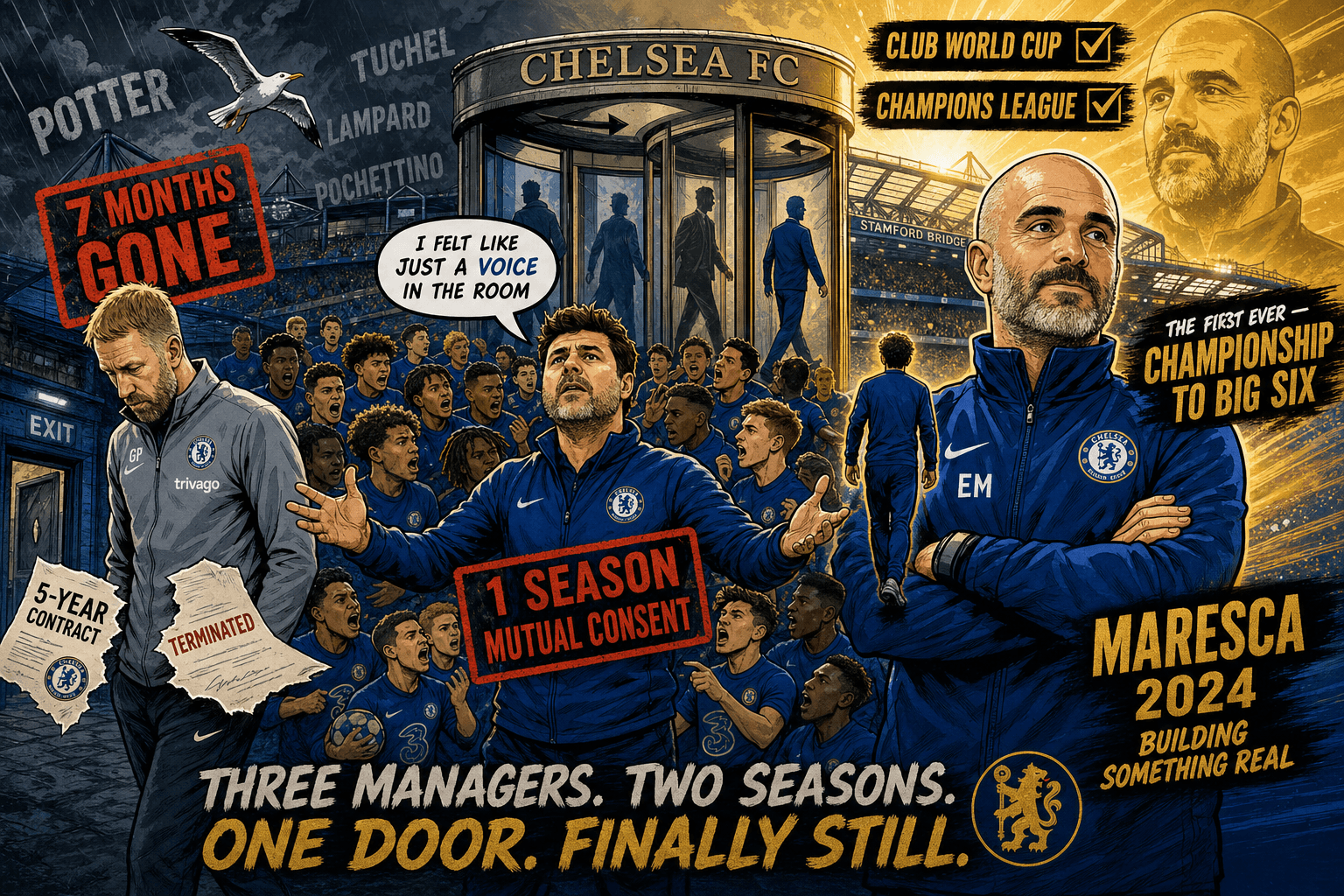
Before reading this piece, the full story of how Chelsea's transfer model and PSR strategy was built is covered in Part One: From Abramovich to Boehly and Part Two: The PSR Loophole and the £200m Player Factory. This is Part Three — the story of the managers Chelsea chose to run it.
There is a version of Chelsea Football Club's managerial merry-go-round since 2022 that looks like pure chaos: a Champions League winner sacked in September, a Brighton manager who won less than a third of his games, an Argentine given one season and shown the door, an Italian hired from the Championship who had never managed a top-flight game in his career. Four managers in two years. Billions spent. Mid-table finishes. And yet, underneath the apparent chaos, there was a logic. Not always a successful one. But a logic. This is the story of how Chelsea's managerial choices between 2022 and 2025 were not random — they were, in each case, attempts to find a specific kind of manager that the Abramovich era never needed and the Boehly era could not function without.
The Shift That Made Everything Else Necessary
Under Roman Abramovich, Chelsea's relationship with managers was simple: hire the best available, give them money, expect trophies, and sack them when they stopped delivering. Mourinho, Ancelotti, Conte, Tuchel — serial winners, proven in the dugout at the highest level. The system worked because the squad was built for winning immediately. Champions League-winning coaches managing Champions League-winning squads did not require much nurturing.
When BlueCo took over in 2022 and committed to the Vision 30 model — young players, long contracts, low wages with performance incentives — they simultaneously committed to a different kind of manager. A squad of 20-year-olds with enormous potential but limited top-level experience does not need someone who knows how to win the Champions League right now. It needs someone who knows how to make 20-year-olds better. That is a completely different skill. And identifying which managers possessed it, at a club where the fan base expected silverware, was the hardest challenge of the Boehly era.
Graham Potter: The Right Idea, the Wrong Moment
When Thomas Tuchel was sacked in September 2022 — just nine games into the season, having won the Champions League 18 months earlier — the decision was widely condemned as impulsive. It may have been. But the replacement choice told you everything about what the new owners were trying to build. They did not go for a decorated European manager. They went to Brighton for Graham Potter.
Potter had guided Brighton to finishes of 15th, 16th, and then 9th in his three full Premier League seasons, transforming a club with modest resources into one of the division's most admired playing styles. He had developed Moisés Caicedo — later sold to Chelsea for £115 million — Marc Cucurella, and Yves Bissouma from relative unknowns into Premier League-quality players Brighton sold for significant profits. The pattern was exactly what BlueCo wanted replicated at a larger scale.
The logic was impeccable. The execution was a disaster. Potter arrived to a squad in transition, a dressing room with players signed for different systems by different managers, and a club that had just spent over £300 million in a single window without a coherent philosophy behind the spending. He was sacked in April 2023 after winning just 12 of his 31 games across all competitions, with Chelsea sitting 11th in the Premier League — the lowest win rate of any permanent Chelsea manager in the 21st century at 39%.
Potter was not a bad manager who happened to fail at Chelsea. He was a good manager placed in an impossible situation: asked to build something long-term with a squad assembled for short-term winning, inside a club where the fan base still expected immediate results, with an owner who had spent £600 million in two windows and had no patience left.
It is worth being precise about the context of Potter's failure. When Chelsea called him away from Brighton in September 2022, the Seagulls were in fourth place in the Premier League — above Chelsea on the table. By the time Potter was sacked in April 2023, Brighton had risen to sixth under his successor Roberto De Zerbi and were on their way to European football. Potter had not suddenly become a bad coach. Chelsea's situation had overwhelmed the philosophy that had made him attractive in the first place. The club replaced a Champions League winner with a player developer and then provided conditions in which no developer could develop anything. It was the worst possible version of a reasonable idea.
Mauricio Pochettino: Progress, Patience, and a Baffling Exit
After Frank Lampard's brief caretaker spell, Chelsea turned to a more familiar name. Mauricio Pochettino arrived in the summer of 2023 with a CV that looked perfectly calibrated for what the club needed: a manager who had developed Dele Alli and Harry Kane into world-class players at Tottenham, who had guided Spurs to a Champions League final in 2019 on a fraction of the resources Chelsea were deploying, and who had managed PSG — a club with its own complicated ownership dynamic and impatient expectations. He was not purely a developer. He was not purely a winner. He was, on paper, both.
The 2023-24 season was bumpy but ultimately promising. Chelsea finished 12th in December — echoing the dark months of the Potter era — before a stunning turnaround that saw them lose just once in their final 15 league games. They finished sixth, reached the FA Cup semi-finals, and lost the EFL Cup final to Liverpool after extra time in a game that could have gone either way. In isolation, those were not bad outcomes for a club still in fundamental transition.
And then Pochettino left by mutual consent two days after the final league game of the season. The official statements were warm. The reality, according to multiple reports, was more complicated. Sources suggested Pochettino had grown frustrated with the structure of authority at the club — specifically, his lack of control over transfer decisions. The sporting directors Winstanley and Stewart ran recruitment according to the Vision 30 criteria; Pochettino's role was to coach the players he was given, not to shape the squad he wanted. Pochettino, who was used to having significant influence over player recruitment at every previous club, reportedly felt like one voice in a room full of voices — heard but not decisive.
The tension that ended Pochettino's Chelsea career was, in its way, structural rather than personal. Vision 30 requires that no single manager can override the recruitment model, because the model itself is the strategy. The players Chelsea signed were not signed for Pochettino — they were signed for the project. When Pochettino wanted a different type of player, or a different number of players, or a different timeline, the model would not bend to accommodate him. Whether that was the right call — whether a manager of Pochettino's calibre deserved more control in exchange for delivering Champions League-threatening football in the season's second half — is the most interesting unanswered question of the Boehly era so far.
Enzo Maresca: A Different Kind of Pioneer
The summer of 2024 produced Chelsea's most unconventional managerial appointment yet. With a field of highly credentialed candidates available — Roberto De Zerbi, Kieran McKenna, Thomas Frank — the club chose a 44-year-old Italian who had never managed a single top-flight league match as a head coach. Enzo Maresca had been Pep Guardiola's assistant at Manchester City during their treble-winning 2022-23 season and had previously run Manchester City's under-23 development squad. His only head-coaching experience at first-team level before Chelsea had been 14 games at Parma in 2021 and a single Championship season at Leicester City — where he won the title and won promotion at the first attempt.
The transcript of Maresca's Chelsea tenure is one of the more remarkable statistical stories in modern Premier League management. The club had told him his target was Champions League qualification — within his first two seasons. He delivered it in his first, with a fourth-placed finish and confirmation of a Champions League return for 2025-26. Along the way, Chelsea beat Real Betis 4-1 in the UEFA Conference League final in Wroclaw — becoming the first club to have won all five major UEFA club trophies — and then, in July 2025, won the FIFA Club World Cup by beating Champions League holders Paris Saint-Germain 3-0 in the final in the United States.
Maresca's philosophy, shaped entirely by his years inside Guardiola's system at Manchester City, was built around three principles: positional control, technical precision, and the patient development of collective understanding rather than individual inspiration. His training sessions were reportedly among the most structured and demanding in English football, with positional rules and movement patterns drilled to an almost mathematical precision. In a squad as young and technically varied as Chelsea's, the approach required patience — from players, staff, and supporters — before the results would reflect the process.
What the Three Managers Share
Potter, Pochettino, and Maresca are very different managers. Potter's strength is developmental methodology; Pochettino's is relationship management and player maximisation; Maresca's is structural system-building within a Guardiola-derived framework. And yet all three were chosen by Chelsea for essentially the same reason: they were managers who could work with young, technically gifted players and improve them without the kind of ego-driven authority that traditional superstar managers demand.
José Mourinho demanded control over every transfer. Carlo Ancelotti needed established talent to express his football. Antonio Conte rebuilt squads wholesale in his image. None of those approaches is compatible with a model where the sporting directors — not the manager — determine who gets signed, at what price, at what age, and on what contract structure. BlueCo's Vision 30 requires a manager who works within a system rather than above it. Potter understood that intellectually but couldn't survive the chaos of the first phase. Pochettino understood it and eventually rebelled against it. Maresca appeared to accept it — and for a season, the model and the manager aligned closely enough to produce trophies.
The Structural Question That Keeps Recurring
The exit of each manager has contained the same recurring note. Potter was overwhelmed by a squad he had not built. Pochettino was frustrated by a recruitment process he could not shape. Maresca, according to sources at the club, eventually grew frustrated by the limits of his authority too — the belief that his successes had earned him a larger voice, one the club structure would not give him. ESPN reported that Chelsea liken their sporting model to Liverpool under Arne Slot — where the manager is one important voice in a wider structure rather than the dominant figure. The theory is that a club shaped this way is not over-reliant on any single manager, meaning a departure does not derail the project.
That model has a compelling intellectual logic. It is also, demonstrably, difficult to sustain when you hire managers who are good enough to believe they deserve more control — and who, by delivering results, arguably earn the right to make that case. The tension is probably inevitable. Whether Chelsea can continue to attract and retain managers who genuinely accept the constraint is the question that will define the next phase of the Boehly era more than any individual signing.
What the three managers of the Vision 30 era do collectively represent, however, is a deliberate attempt to build something durable rather than to win something immediately. Every Abramovich manager was hired to win now. Every Boehly manager has been hired to build toward winning. Whether those two projects are ultimately compatible — whether a club of Chelsea's size, commercial scale, and historical expectations can sustain a long-term project model without regular silverware — is the question the next decade will answer.
The progression is real: 12th under Potter, 6th under Pochettino, 4th under Maresca with two trophies. The direction is upward. Whether it continues depends, as it has always depended at Stamford Bridge, on who walks through the manager's door next.
Potter, Pochettino, Maresca — which of Chelsea's three Vision 30 managers do you think was treated most unfairly? And who should BlueCo appoint next to continue the project? Drop your take below. 👇