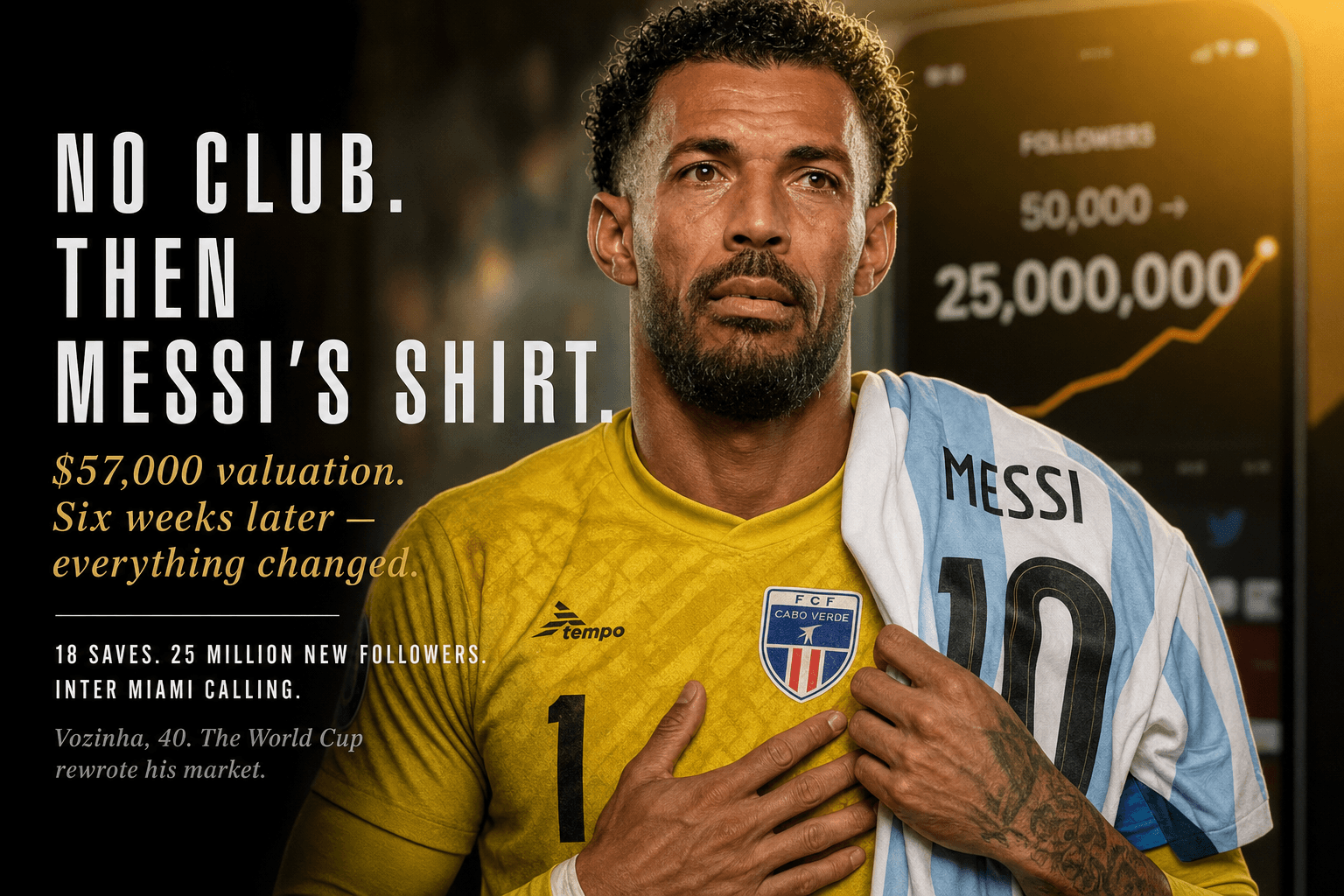
On May 31, 2026, Vozinha's contract with Chaves — a Portuguese second-division club — expired. Nobody was rushing to replace it. His manager at the time, Vítor Martins, described him as a player at a very specific point in his career, someone who had reached a moment in his life he had perhaps once thought impossible: playing at a World Cup at 40 years old. Martins added, gently, that Vozinha's next step probably would not be with Chaves. That was the entire transfer story as of June 1. Six weeks later, Vozinha had swapped shirts with Lionel Messi, gained roughly 25 million Instagram followers, received two transfer proposals from Brazil's second division, and become the subject of reported "strong interest" from David Beckham's Inter Miami. As we documented in our piece on Cape Verde's extraordinary World Cup debut, the football itself was remarkable. What happened to the market value of the players who produced it is its own story — and it is not the story anyone would have predicted on May 31.
Vozinha: From Free Agent to Beckham's Inbox
The specific value of Vozinha's transfer situation lies in the contrast between his conventional market profile and his current market position. Transfermarkt valued him at approximately $57,000 heading into the tournament — a figure that reflects a 40-year-old goalkeeper playing in Portugal's second division, not a player any recruitment department would flag as a priority target. Nothing about that valuation has changed in football's conventional sense: he is still 40, still without a club in one of Europe's top five leagues on his CV, still a player whose technical ceiling was always going to be modest by elite standards.
What has changed is everything else. Fabrizio Romano confirmed Vozinha already has two proposals from Brazil's second division, and that David Beckham's Inter Miami hold him in "high regard" following his World Cup performances — 18 saves across four matches, including seven against Spain in his tournament debut. Mexican outlet El Informador added that Beckham personally wants to complete a deal once the tournament ends, with approaches expected to intensify in the following weeks. Inter Miami already have Canada international Dayne St Clair as their starting goalkeeper — meaning Vozinha would arrive as backup, not saviour. That detail matters. Nobody is signing Vozinha to solve a goalkeeping crisis. Every club interested in him is buying something else: the story, the visibility, the specific commercial value of a 40-year-old who cried on television after his mother could not get a visa to watch him play, and who then went up to Lionel Messi after Argentina's win and asked to swap shirts. Messi agreed. Vozinha later recounted the exchange: Messi hugged him, told him he was great, and said his people should be proud of him.
Why the Market Cannot Simply Ignore This
FootballTransfers' analysis of the situation was specific about where the real opportunity lies: not in the Champions League, where squad structures and wage frameworks make a 40-year-old goalkeeper an improbable target regardless of form, but in England's League Two, the National League, France's lower professional pyramid, and Belgium's semi-professional tiers — leagues where gate receipts, community engagement, and media attention drive financial decisions as much as pure footballing upside does. A club in that bracket signing a goalkeeper with tens of millions of new followers and a World Cup clean sheet against Spain generates coverage those clubs cannot otherwise access at any price. The specific insight is that Vozinha's transfer value did not increase because he suddenly became a better goalkeeper. It increased because the market for what he represents — visibility, narrative, a 40-year-old who spent two decades playing in Slovakia, Angola, Moldova, and Cyprus before this — expanded into a category that conventional Transfermarkt valuations were never built to capture.
Vozinha's Transfermarkt valuation: $57,000. His actual market position: two Brazilian second-division proposals, reported interest from Beckham's Inter Miami, 25 million new Instagram followers, and a shirt swap with the greatest player of his generation. The gap between those two numbers is the entire story of what a single World Cup tournament can do to a player the conventional transfer market had already filed away as finished.
Logan Costa: The One Whose Value Was Already Rising
Not every Cape Verde player's transfer story runs through the same mechanism as Vozinha's. Logan Costa — the Villarreal centre-back born in Paris, documented in our piece on where Cape Verde's World Cup players were actually born — was already Cape Verde's most valuable asset heading into the tournament, playing in La Liga for a club competing in European competition. He was reportedly earning in excess of £30,000 per week even before the tournament, and had missed a significant portion of the preceding season recovering from an ACL injury — meaning his World Cup involvement was itself already a milestone regardless of whether Cape Verde advanced. Costa's transfer trajectory is the conventional version of what a strong World Cup does to a player already inside Europe's elite league structure: incremental value growth, increased scouting attention from clubs a tier above Villarreal, and a stronger negotiating position at his next contract renewal. It is a normal transfer story, elevated by a tournament performance. Vozinha's is not a normal transfer story at all.
The Turkey Pipeline: Pina, Cabral, and the Squad's Working-Class Earners
The financial reality for most of Cape Verde's squad sits considerably below both Costa's La Liga wages and the media attention Vozinha now commands. Kevin Pina — who scored Cape Verde's first-ever World Cup goal, the free-kick through Uruguay's wall — earns approximately £18,000 per week with Krasnodar in Russia. Wagner Pina and Sidny Lopes Cabral both play in Turkey, with Cabral reportedly leaving Benfica to join Trabzonspor on wages of roughly $1.49 million per year. Ryan Mendes, Cape Verde's captain and most-capped player with 94 international appearances, plays for Iğdır FK in the Turkish second tier — a wage level that reflects loyalty to Cape Verde over financial maximisation, given his career has included spells across multiple European leagues where higher-paying opportunities were available.
The most specifically remarkable recruitment story in the entire squad belongs to Roberto "Pico" Lopes, the Ireland-born defender based in Dublin. Lopes, who plays for Shamrock Rovers in the League of Ireland, was reportedly first invited to play for Cape Verde via a message on LinkedIn. A World Cup starter, recruited through a professional networking platform rather than a scouting network. It is the specific detail that captures what the diaspora recruitment model, documented in our piece on how Cape Verde built their squad from players born abroad, actually looked like in practice: manager Bubista and his staff finding eligible players through whatever channel worked, including, apparently, LinkedIn.
What This Means for the Next Generation of Recruitment
The specific consequence of this transfer window activity extends beyond the individual players involved. Cape Verde's federation now has proof — visible, quantifiable, globally reported proof — that representing the Blue Sharks carries a specific market value that did not exist eighteen months ago. The next Cape Verdean-eligible player weighing a decision between representing Cape Verde or a larger federation now has a different data point available: Vozinha went from a $57,000 valuation and an expired second-division contract to a shirt swap with Messi and interest from a club co-owned by David Beckham. That story did not exist as a persuasive recruitment tool before July 2026. It exists now, and Bubista's successor — whoever inherits the project following his resignation, a story we cover in full elsewhere — inherits a recruitment pitch considerably stronger than the one that built this squad in the first place.
What Six Weeks of Visibility Is Actually Worth
The specific financial mechanism at work in Vozinha's situation deserves closer examination, because it is not unique to him — it is a pattern that has repeated across small-nation World Cup breakouts before, from Iceland's 2016 and 2018 tournaments to Morocco's 2022 semi-final run. A player's on-pitch value, measured by conventional scouting metrics, changes gradually and predictably. A player's commercial value — sponsorship potential, shirt sales, social media reach, the specific premium a club can charge for hospitality packages built around a signing — can change instantly and by orders of magnitude when a single moment captures global attention. Vozinha's save count against Spain (seven) and his overall tournament total (18) are modest by elite goalkeeping standards. His emotional story — the tears, his mother's visa complications, two decades in Slovakia and Moldova and Cyprus before this — combined with the specific opponent (Spain, ranked first in the world entering the tournament) and the specific context (a nation of 525,000 people making its World Cup debut) produced a viral moment that conventional transfer valuation models are not built to price. The market is now attempting to price it in real time, through Beckham's interest and Brazilian second-division proposals, because no existing formula tells clubs exactly what a 40-year-old free agent with 25 million new followers is worth. They are finding out by making offers.
The scale of this effect is worth naming precisely because it will not be visible in any future scouting report or valuation spreadsheet. Vozinhas contract with Chaves ended without renewal offers on the table. His manager described his next move as unlikely to keep him at the club, in the gentle, resigned language used for a player nearing the end. Six weeks later, his name was being discussed in the same breath as David Beckhams Miami project and Lionel Messis personal generosity. The gap between those two realities is not a football story in the conventional sense. It is a story about what a global audience of billions, watching a single tournament, can do to a persons life in the space of a month.
For Cape Verde as a federation, the Vozinha situation is also a preview of a specific new revenue stream that small nations rarely access: the commercial afterlife of a breakout tournament. Merchandise featuring his image, licensing opportunities, and the broader marketing value of his story all sit outside conventional transfer fees but represent real income potential for a federation whose entire annual budget, before this World Cup, would have been a fraction of what a single Premier League clubs kit deal generates in a week. The story is still being written. But the direction of travel — a 40-year-old with no club and no offers becoming one of the most talked-about free agents in world football — is already permanent, regardless of where he signs next.
Vozinha went from a $57,000 valuation and an expired contract to Messi's shirt and Inter Miami's interest in six weeks. Which Cape Verde player's transfer story do you find most remarkable — and where do you think Vozinha ends up next? Tell us below.