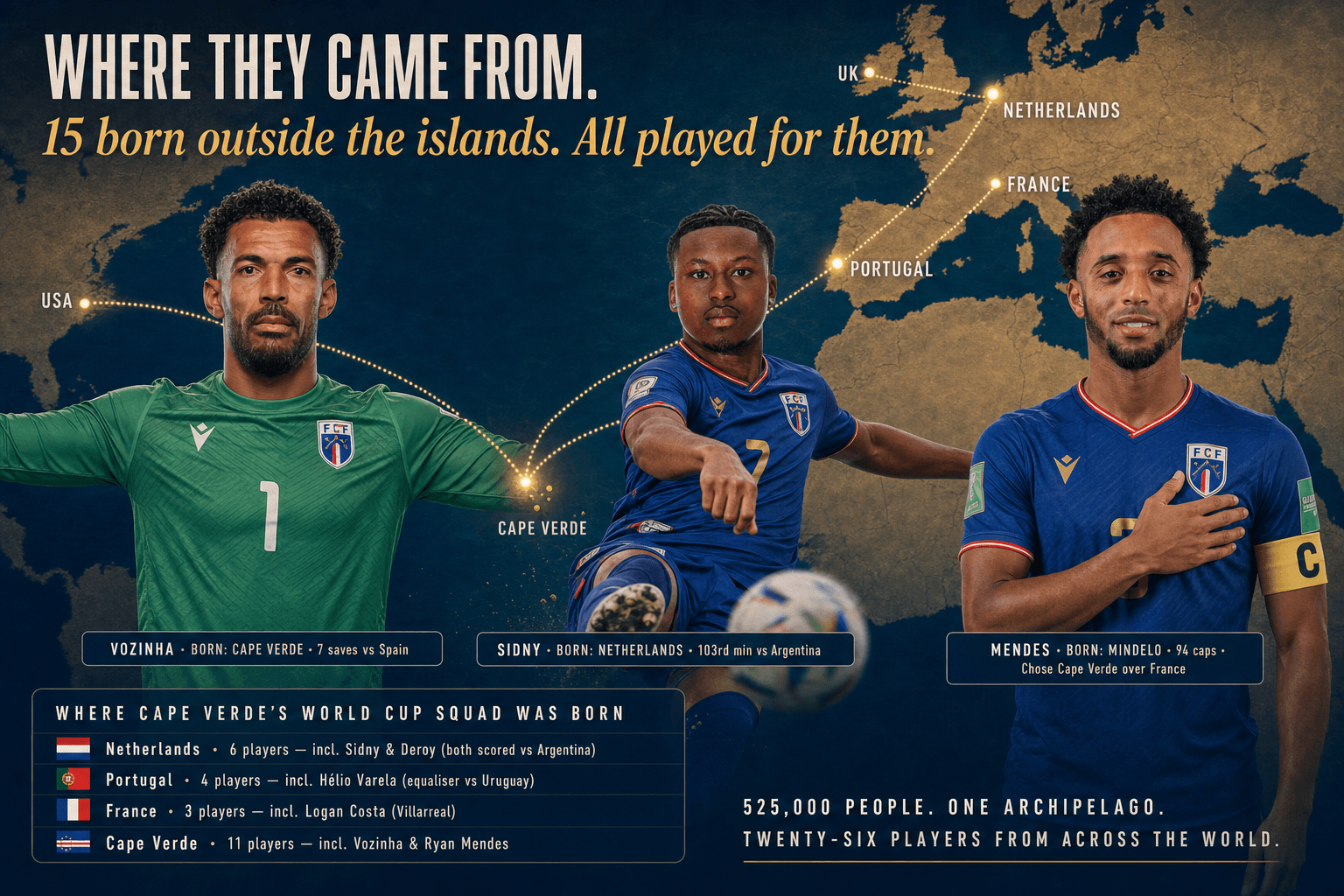
After Cape Verde drew with Spain, held Uruguay, reached the Round of 32, and then equalised twice against Argentina in one of the 2026 World Cup's most dramatic matches, the world wanted to know one specific thing about the Blue Sharks that football coverage was not answering clearly: where are these players actually from? The question is not asked with suspicion. It is asked with curiosity — because the squad that drew with the team ranked first in the world, and scored one of the tournament's great wonder goals against the reigning champions, clearly did not come exclusively from an archipelago of 525,000 people in the Atlantic Ocean. As we documented in our pieces on Cape Verde's extraordinary World Cup debut and the diaspora model that built this squad, the specific answer is well-documented. But the full list — player by player, country by country, European club by European club — is what people are searching for. Here it is.
The Simple Answer: How Many Cape Verde Players Live in Cape Verde?
Of the 26 players in Cape Verde's 2026 World Cup squad, 15 were born outside Cape Verde. The Netherlands provided six players — more than any other country. Portugal provided four. France provided three. Ireland and the United States provided one each. Of the remaining players born on the Cape Verdean islands, the vast majority play professionally in European leagues. The answer to "how many Cape Verde players live in Cape Verde" for this specific World Cup squad is effectively zero at the elite professional level. Cape Verde's domestic football infrastructure does not yet produce players of the technical quality that this World Cup required. Every member of this squad developed their professional career either through European youth academies or through European professional leagues. The 525,000-person archipelago produces the identity. The diaspora produces the quality. The combination produces the World Cup squad.
Born in the Netherlands: Six Players, Two Tournament Heroes
The Netherlands provides the largest single group of Cape Verde-born-abroad players at the 2026 World Cup — six in total. The Cape Verdean community in the Netherlands, particularly in Rotterdam, has been established since the 1950s and 1960s when Cape Verdeans emigrated as part of the Portuguese colonial migration to Northern Europe. The community now numbers in the tens of thousands and has produced several generations of Dutch-raised players who have chosen to represent the country of their heritage rather than the Netherlands. The six players born in the Netherlands and representing Cape Verde at the 2026 World Cup are:
Sidny Lopes Cabral — the player whose name became known globally on July 3, 2026, in the 103rd minute at Hard Rock Stadium in Miami. Born in the Netherlands, Sidny curled a finish from the edge of the penalty area past Emiliano Martínez to make it 2-2 in extra time against Argentina. As we explored in detail in our piece on Sidny Lopes Cabral's wonder goal and what it means, ESPN described it as an all-time great tournament goal. Netherlands-born. Playing for an island nation most spectators in Miami had never visited.
Deroy Duarte — also born in the Netherlands. He scored Cape Verde's second goal in the Argentina match — the equaliser in normal time that made the match 1-1 and sent it to extra time in the first place. Two of the most important Cape Verde goals at the 2026 World Cup were scored by Netherlands-born players in a single match against the reigning champions.
The other four Netherlands-born players in the squad are Jamiro Monteiro (midfielder, previously at Philadelphia Union and Sporting CP), Laros Duarte, Garry Rodrigues, and Dailon Livramento. The Rotterdam football culture — one of the Netherlands' most technically demanding youth environments — runs through several members of this group. The specific passing quality, the comfort under pressure, the ability to play in tight spaces that characterised Cape Verde's 0-0 draw against Spain was partly the product of a Dutch football education applied to the colours of an Atlantic island.
Born in Portugal: Four Players and a Colonial Connection
Portugal provides Cape Verde's second-largest group of foreign-born players — four in total. The connection between Cape Verde and Portugal is specifically historical: Cape Verde was a Portuguese colony until independence in 1975. Portuguese is still the official language. The cultural ties, reinforced by the fact that many Cape Verdean families emigrated to Portugal after independence, mean that the Portuguese player pool for Cape Verdean selection is one of the most established and historically significant of any African nation in European diaspora football. World Soccer Talk confirmed that Portugal's influence on Cape Verde's squad extends beyond the four players born there — the Portuguese language that the entire squad speaks, and the Portuguese-language coaching instructions that flow between Bubista and his players, reflects the colonial history still present in daily Cape Verdean life.
Hélio Varela — born in Portugal, plays for Maccabi Tel Aviv in Israel. He scored the most dramatically timed goal of Cape Verde's group stage: the second-half equaliser against Uruguay that completed the comeback from 2-1 down. He came off the bench, received the ball from a disastrous Olivera back-pass, and converted with the composure of someone playing the occasion rather than being consumed by it. Portugal-born. Cape Verdean heart. 2-2 at 90 minutes against the two-time world champions.
The other Portugal-born players are Jovane Cabral (winger, previously at Sporting CP and Lazio in Serie A), Telmo Arcanjo, and Wagner Pina. Jovane Cabral's career — through Sporting CP's academy, Lazio, and various European loan spells — represents the specific quality of player that the Portugal diaspora connection produces for Cape Verde: technically refined, European-professional-standard, representing the nation their families came from rather than the nation whose league they learned in. Not every player of Cape Verdean descent made that same choice — as we explored in our piece on the most famous footballers of Cape Verdean descent who represented other nations, Nani, Ronaldo, and Larsson all reached the elite level without ever wearing the Blue Sharks jersey.
The Netherlands gave Cape Verde six players — including both players who scored against Argentina. Portugal gave four — including the midfielder who equalised against Uruguay at 2-1 down. France gave three — including the Villarreal centre-back who organised the defensive line that held Spain scoreless. Ireland gave one. The United States gave one. The islands gave the goalkeeper who made seven saves against Spain on his World Cup debut. Every part of this squad, from every corner of the European diaspora, was required to produce what Cape Verde produced at their first World Cup. None of it was accidental. All of it was planned.
Born in France: Three Players Including the Villarreal Centre-Back
Logan Costa is the most prominent France-born player in Cape Verde's squad — a starting centre-back who plays for Villarreal in La Liga. Born in Paris, Costa is the specific product of France's youth football development system applied to a player who chose Cape Verde rather than France or Cameroon for international representation. His presence in the defensive line that held Spain scoreless in their group stage opener — Vozinha's seven saves aside, Costa's organisation of the backline was a specific contribution — reflects the quality that France's football education system produces even for players who ultimately represent other nations.
Steven Moreira and Willy Semedo complete the France-born group. Moreira, a right-back who has played in Ligue 1 and across European leagues, provides the specific technical quality that growing up in the French football system — one of the world's best youth development environments — tends to produce. The France connection to Cape Verde is less historical than the Portugal one but reflects the significant Cape Verdean community that has developed in French cities, particularly in the Paris suburbs, over several generations of migration.
Born in Ireland and the USA: Pico Lopes and CJ Dos Santos
Roberto "Pico" Lopes is the most geographically unexpected member of Cape Verde's diaspora squad: born in Ireland, making him one of the very few sub-Saharan African national team players born on the island of Ireland. His presence in the squad — centre-back, experienced European professional — is the specific product of Cape Verde's outreach across the full extent of their diaspora rather than limiting selection to the Portuguese-speaking European countries where the community is most concentrated. The Irish-Cape Verdean connection is small in historical terms but Pico Lopes makes it World Cup-relevant.
CJ Dos Santos represents the only player in the squad born in the United States — a connection that reflects the Cape Verdean community in New England, particularly in Massachusetts and Rhode Island, which dates back to the whaling industry of the 19th century. Cape Verdean whalers were a significant presence in the American northeast for generations, creating one of the oldest non-European Cape Verdean diasporas in the world. Dos Santos's presence in the squad is the specific football expression of that centuries-long connection.
Born in Cape Verde: The Island Players at the Centre of It All
Of the 11 players born on the Cape Verde islands themselves, almost none plays in Cape Verde's domestic league at the senior professional level. The domestic league infrastructure, while improving, does not yet provide the training environment, coaching quality, or competitive level that produces World Cup-ready players. Cape Verde-born players who enter the professional game in Europe typically do so through Portuguese clubs, which have active relationships with Cape Verdean football development, or through trials at clubs in other European countries. The most prominent Cape Verde-born members of the squad are:
Ryan Mendes — born in Mindelo, Cape Verde's cultural capital, the most-capped player in Cape Verde's history with 94 appearances and 22 international goals. He plays for Iğdır FK in Turkey — having spent his career across Europe, including spells in Portugal, France, and Turkey. He grew up in Cape Verde, plays for Cape Verde, and represents the soul of a project that he has been central to across nearly a decade of international appearances. As we explored in our piece on the diaspora model, Mendes chose Cape Verde rather than France — his other option — and that specific loyalty has made him the face of the squad for a generation.
Josimar José Évora Dias — Vozinha — Cape Verde's goalkeeper, born on the islands, who made seven saves against Spain in his World Cup debut and was named Man of the Match as a first World Cup game ended goalless against the team that had not conceded in 34 consecutive competitive matches. He plays in Europe, having developed his career through European clubs, but his origin is the islands. The goalkeeper who gave Cape Verde their first World Cup point was born in the country he was representing.
Kevin Pina — born in Cape Verde, scored the first World Cup goal in the nation's history: a driving free-kick through Uruguay's defensive wall in the 21st minute on June 21, making him the player whose name will always be attached to Cape Verde's first-ever World Cup goal. He plays in European professional football, as almost every member of this squad does at the senior level.
Why Almost No Cape Verde Players Live in Cape Verde
The simplest answer to the most-searched question about this squad: almost no member of Cape Verde's 2026 World Cup squad lives or plays in Cape Verde. This is not a reflection of ambivalence about the country. It is a reflection of an economic and historical reality that the football team both reflects and transcends simultaneously. Cape Verde's per-capita GDP is significantly lower than any of the European countries where its players live. The professional league structure does not generate the wages that allow a player to remain home and still develop at the level required for World Cup football. The diaspora that sent these players' families to the Netherlands, Portugal, France, Ireland, and the United States also sent the players themselves — or their parents — in search of professional opportunities that the islands could not yet provide. The Cape Verdean Football Federation's deliberate and systematic outreach to diaspora players, which has shaped this squad's composition since Bubista took over in 2020, converts a historical economic reality into a sporting competitive advantage. Al Jazeera's profile of the squad confirmed that the diaspora recruitment model is intentional rather than incidental — each player's eligibility was researched, their connection to the islands verified, and their willingness to represent Cape Verde rather than their country of birth confirmed through direct outreach by the federation.
For comparison, the Curaçao model — documented in our piece on the 156,115-person island making World Cup history — operates through the same structural mechanism. Small island nations with large diaspora communities in wealthy football cultures use the diaspora as a talent pool that their domestic infrastructure cannot replicate. Haiti's approach, explored in our piece on Haiti's first World Cup in 52 years and their diaspora squad, reflects the same reality. Cape Verde's specific version is the most successful of the three at this tournament — reaching the Round of 32 in their debut, drawing with Spain, Uruguay, and Saudi Arabia, and then equalising twice against Argentina in extra time. The model works. The players may not live in Cape Verde. But they played for it.
15 of 26 Cape Verde World Cup players were born outside the islands. Almost none of the squad lives in Cape Verde. Portugal, the Netherlands, and France built the professional careers of most of them. The islands gave them the reason to play. Which player's origin story do you find most remarkable — and does the diaspora model represent the future of smaller nation football at World Cups? Tell us below.