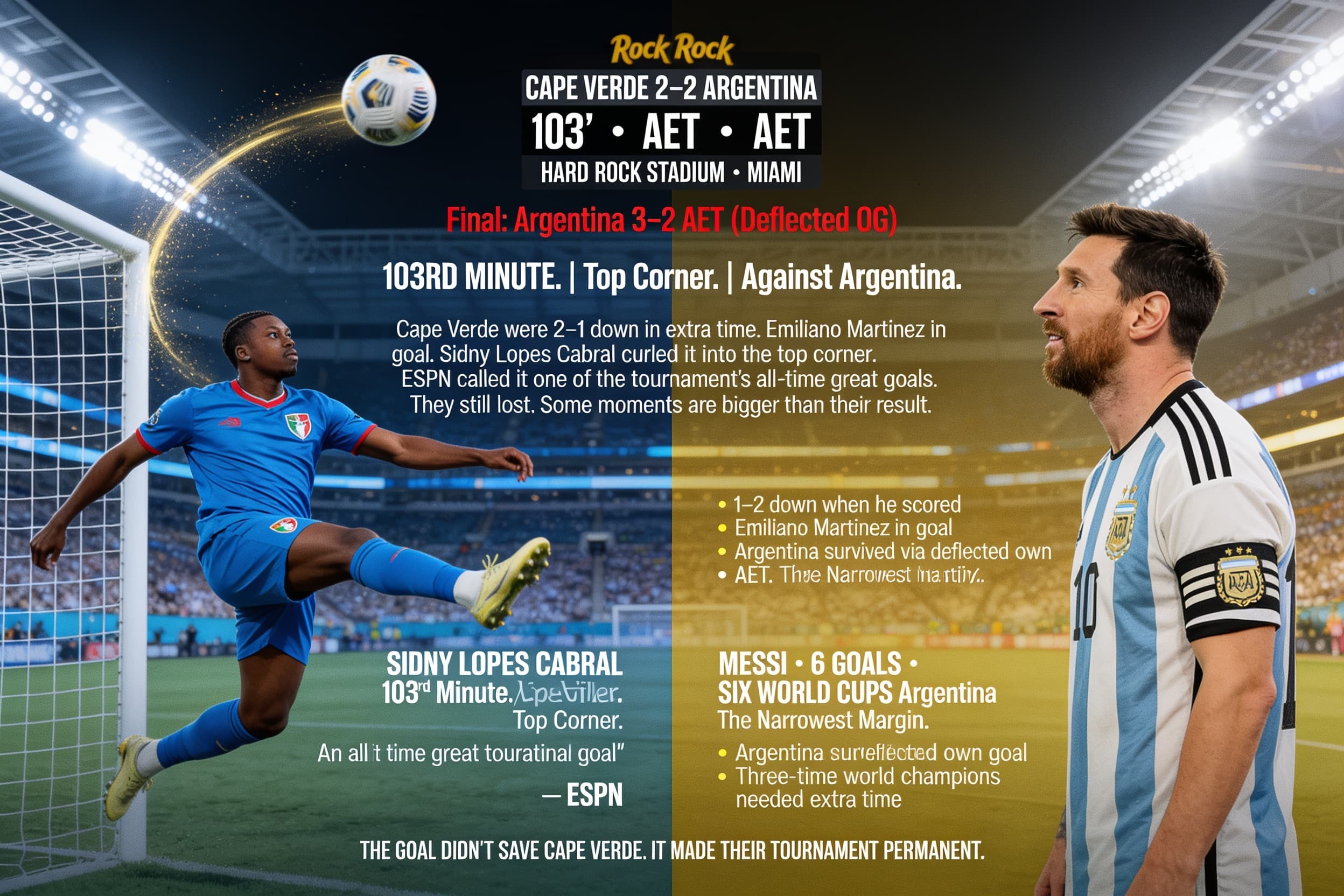
There are moments in football that arrive before they can be described. The 103rd minute at Hard Rock Stadium in Miami was one of them. Argentina were 2-1 up in extra time. The reigning three-time world champions had taken the lead through Lionel Messi in the 29th minute of normal time, watched Cape Verde equalise through Deroy Duarte, then restored their lead through Lisandro Martínez in extra time. Cape Verde had been magnificent for 102 minutes. They were going home. Then Sidny Lopes Cabral received the ball on the edge of Argentina's penalty area, opened his body, and curled a right-footed finish into the top corner past Emiliano Martínez. ESPN described it in real time as an all-time great tournament goal. The caption was not hyperbole. It was accurate description.
The Full Match Story: How Cape Verde Survived Messi for 102 Minutes
The Argentina vs Cape Verde Round of 32 match at Hard Rock Stadium on July 3 began with Lionel Messi. It almost ended with Sidny Lopes Cabral. The gap between those two specific statements contains one of the most remarkable 103-minute stretches any team has produced at this World Cup.
Messi scored in the 29th minute — a composed finish after a move that demonstrated why Argentina had scored in every single match at this tournament. Cape Verde, who had never lost in 90 minutes against Spain, Uruguay, or Saudi Arabia across the group stage, absorbed the goal and kept their defensive shape. As we documented in our full account of Cape Verde's extraordinary World Cup debut, Vozinha — Josimar José Évora Dias — had already proven against Spain that he could hold a structure against sustained attacking pressure from a world-class opponent. Against Argentina, the structure held again. One goal down, they defended, waited, and looked for the moment.
Deroy Duarte provided it in the second half. His equaliser sent the match to extra time. Argentina's Lisandro Martínez headed the lead back to Argentina in extra time. Cape Verde needed another miracle. In the 103rd minute, Sidny Lopes Cabral tied it again with a finish that the crowd in Miami, and the global audience watching, immediately recognised as something exceptional. ESPN called it one of the all-time great tournament goals. Argentina needed a late winner — an Romero header that deflected off Diney Borges and into the net — to win 3-2 and eliminate Cape Verde from the World Cup.
What Made the Sidny Cabral Goal So Special
The technical specifics of the goal are worth noting precisely because the context makes the technical detail more remarkable, not less. The situation: Cape Verde 1-2 down in extra time of a World Cup knockout match against the three-time world champions, facing Emiliano Martínez — arguably the best goalkeeper at the World Cup and one of the most decorated in the sport — from the edge of the penalty area, in the 103rd minute, with Argentina's defence organised and compact. To score from there requires a specific combination of confidence and quality that professional footballers acquire over years of development and testing. Sidny Lopes Cabral, in the 103rd minute of a World Cup match, had both.
The curl of the finish — the specific trajectory that took the ball away from Martínez's reach and into the top corner — is not a technique you produce under pressure unless you have practised it ten thousand times. The fact that it arrived in a moment when Cape Verde's tournament was already over, when Argentina were minutes from advancing, when the weight of what the Blue Sharks had achieved across four matches was about to become a memory rather than an ongoing story — makes the technique itself secondary. The courage of attempting it in that moment is what ESPN was actually describing when they called it an all-time great tournament goal.
103 minutes. 3-2 down before the goal. Emiliano Martínez in goal. Argentina defending the lead. Sidny Lopes Cabral on the edge of the penalty area. He curled it into the corner. ESPN called it one of the tournament's all-time great goals. Cape Verde still lost. Some moments are bigger than their result.
Messi's Side of the Match: What 3-2 AET Tells You About Both Teams
For Messi — at his sixth World Cup, in what most observers consider his final tournament appearance — the Argentina vs Cape Verde match was supposed to be the start of a smooth defensive of the title his team won in Qatar. It was not smooth. Argentina finished Group J with three wins and a hat-trick from Messi in the opener against Algeria — six points, three consecutive victories, the kind of group stage form that makes their quarter-final path look straightforward. Against Cape Verde, who had not won a single World Cup match in 90 minutes up to that point, Argentina required extra time. They needed a deflected winner that initially looked like a Romero goal before being ruled an own goal. The world's most decorated international team, at their sixth consecutive knockout stage, beaten to a draw by a team of players most of whose clubs are not in Europe's top ten leagues. The deflection that won it. The Sidny Cabral goal that preceded it. The full texture of how hard this was.
The comparison with Haaland and Messi in the Golden Boot race — both at five goals heading into the Round of 16 at the time of the Cape Verde match — adds an individual context to Argentina's collective struggle. Messi has scored six tournament goals at this World Cup, more than anyone. In the one match where Argentina were genuinely tested, he scored, his team went behind, he watched extra time produce an equaliser he could not prevent, and they survived on a deflection. That is a description of a great team, not a weak one. But it is also a description of what Cape Verde produced.
The Goal That Will Be Remembered
The 2026 World Cup will produce a Golden Boot winner, a champion, a tournament-defining performance from someone like Haaland or Mbappé or Vinicius or Bellingham. Those narratives will dominate the post-tournament coverage. But football's specific quality — the thing that makes it different from every other sport — is its capacity to generate moments that exist outside the hierarchy of importance. Nusa's worldie against Ivory Coast. Kalajdžić's 61-second header for Austria against Algeria. And Sidny Lopes Cabral's curling finish in the 103rd minute for Cape Verde against Argentina.
None of these moments changed the outcome of a tournament. Nusa's Norway are playing Brazil. Kalajdžić's Austria lost to Spain 3-0, a result we covered in our Austria vs Spain tactical breakdown. Sidny's Cape Verde went home. But the moments exist independently of the results that followed them. The curl of Sidny Lopes Cabral's finish against Argentina, in the 103rd minute, 1-2 down in extra time, against one of the greatest goalkeepers in the world — that exists permanently and is not diminished by the deflected goal that came after it. ESPN called it an all-time great tournament goal. The argument for that specific description is right there in the trajectory of the ball.
The Bigger Picture: What This Tournament's Great Goals Share
The 2026 World Cup has produced a generation of goal that exists on a different aesthetic plane from the functional goals that decide most knockout matches. Antonio Nusa's curling right-foot worldie against Ivory Coast for Norway — the goal that powered a World Cup run still ongoing. Kalajdžić's first-touch header in the 96th minute for Austria against Algeria — the moment we covered in our full Kalajdžić career story. And Sidny Lopes Cabral's curl in the 103rd minute for Cape Verde against Argentina. All three arrived at moments when the player could not afford to miss. All three were technically exceptional. All three represented nations not expected to be producing goals of this calibre at this stage of this competition.
The difference between Nusa's goal and Sidny's is one of consequence: Nusa's won the match, Sidny's was followed by a deflected winner from Argentina. But the quality of the finish is comparable, and the context of Sidny's — later in extra time, against better opposition, from a more improbable position on the pitch — arguably makes the technical courage more exceptional. The goal did not save Cape Verde. It made their tournament permanent. The Blue Sharks will be at the 2030 World Cup. Whatever happens there, the 103rd minute in Miami is the moment they will replay until the next one.
Where Cape Verde Go From Here
Cape Verde will qualify for 2030 as a team that has now established a baseline. Their African qualifying campaign — winning their group ahead of Cameroon — was already extraordinary for a nation of 525,000. Their group stage drew with Spain, Uruguay, and Saudi Arabia to finish second. Their Round of 32 produced extra time against Argentina, a goal that will be clipped and reshared for years, and an elimination so close it required a deflection to complete. The 2030 cycle begins with a different kind of expectation attached to Cape Verde. They are no longer a novelty. They are a team that does not lose in 90 minutes against world champions. That reputation, built in North America across four matches, is the foundation Bubista has been constructing for six years. In four years, it becomes the platform. The Blue Sharks are going home. They will be back.
Sidny Lopes Cabral scored one of the 2026 World Cup's greatest goals. Cape Verde still lost 3-2 to Argentina in extra time. Where does this rank among the tournament's most special individual moments — and is there a goal you would put above it? 👇