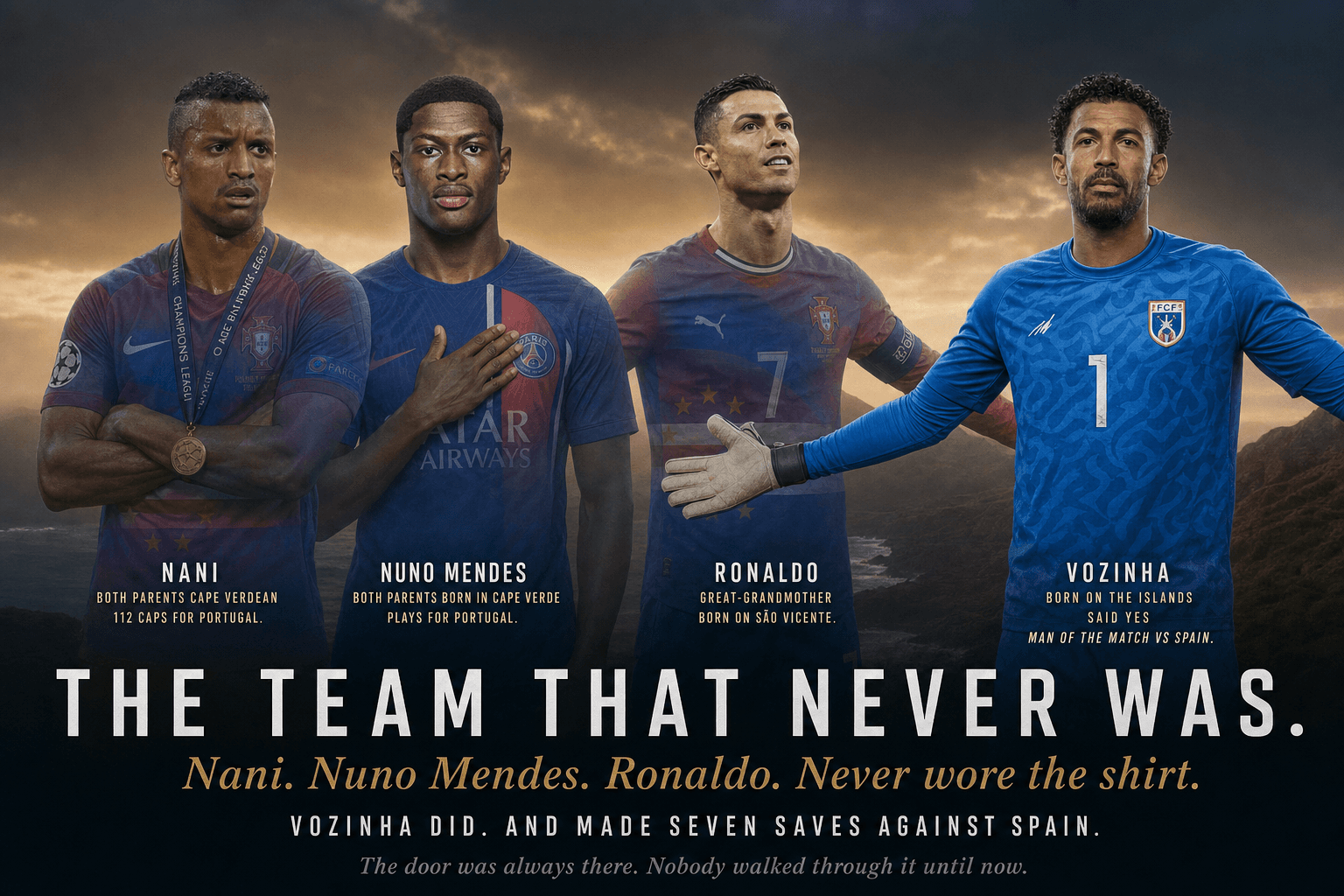
Cape Verde's 2026 World Cup squad, documented in full in our piece on where every player in this year's squad was actually born, is built almost entirely from diaspora talent scattered across the Netherlands, Portugal, France, Ireland and the United States. That model, remarkable as it is, only tells half the story. For every Vozinha or Logan Costa who chose the Blue Sharks, there is a longer and older list of players with genuine Cape Verdean blood who never wore the shirt at all, because by the time they were coming through, Cape Verde simply was not organised, funded or ambitious enough to give them a footballing reason to say yes. Nani won a Champions League. Henrik Larsson became a Celtic icon. Cristiano Ronaldo's own great-grandmother was born on the islands. None of them ever played international football for Cape Verde. The gap between what this nation is producing now and what it let slip through its fingers for decades is the real measure of how far the project has come.
Nani: Abandoned in Amadora, Champion of Europe
Luís Carlos Almeida da Cunha, known to the football world simply as Nani, was born in Amadora on the outskirts of Lisbon to two Cape Verdean parents. His father left for a holiday in Cape Verde when Nani was five and never returned. His mother left for the Netherlands when he was twelve. He was raised by his aunt on the Santa Filomena estate, one of nine siblings on his mother's side and five on his father's. Out of that specific instability came 112 caps for Portugal, four Premier League titles and a Champions League winner's medal with Manchester United, an FA Cup, and a place in Portugal's Euro 2016-winning squad. Nani was, by his own family's origin, entirely eligible for Cape Verde. He never seriously considered it, because the Cape Verde that existed during his rise through Sporting CP's academy in the early 2000s was not a footballing project capable of competing for a player already being watched by Manchester United.
Henrik Larsson: The Celtic Legend Who Called Himself "Foreign"
Henrik Larsson's father, Francisco da Rocha, was from Cape Verde. His mother, Eva Larsson, was Swedish. Larsson went on to score 174 goals in 221 appearances for Celtic, one of the most decorated strikers in the club's history, before spells at Barcelona and Manchester United and 106 caps for Sweden. In 2024, reflecting on his identity, Larsson said: "I see myself as foreign. I don't know what I am, to be honest. I know I have 106 caps for Sweden. I know I'm Swede-ish, yes. But I never felt 100% Swede. I have to respect my father's heritage." Larsson's Cape Verdean father gave him a name that appears throughout the diaspora communities documented in our piece on how Cape Verde's current squad was built from players born abroad. But Larsson came of age in the 1990s, a full three decades before Cape Verde had any credible pathway to major tournament football. Sweden was never in question.
Ronaldo's Great-Grandmother, Nuno Mendes's Parents, and the Current Generation
Cristiano Ronaldo's paternal great-grandmother was born on São Vicente, one of Cape Verde's ten islands, before moving to Madeira at sixteen, where Ronaldo himself was later born. The connection is distant but genuine, and it places football's most decorated individual player of the modern era, at least in theory, inside the same eligibility pool that produced this year's Cape Verde squad. Closer still is Paris Saint-Germain left-back Nuno Mendes, whose parents were both born in Cape Verde. Mendes has spoken about it directly: "My family's roots go back to Cape Verde, and I always carry that heritage with pride." He plays for Portugal. So does Nélson Semedo, who holds Cape Verdean citizenship and has said openly he dreams of a World Cup final between Portugal and Cape Verde. So does Renato Veiga, whose father Nélson Veiga actually won more than ten caps for the Cape Verde national team himself, making Veiga's Portugal selection the single closest near-miss on this entire list. Rolando, born in Cape Verde itself before rising to prominence at Porto, wrapped himself in the Cape Verde flag after winning the Europa League, even as he lifted the trophy for Portugal's biggest club.
A journalist once assembled the Cape Verde team that could have been, using nothing but confirmed heritage: Vozinha in goal, Semedo, Rolando, Veiga and Nuno Mendes across the back four, Gelson Martins, Kevin Pina, Deroy Duarte and Nani in midfield and attack, Ryan Mendes and Cristiano Ronaldo leading the line. It is not a fantasy squad assembled by loose association. Every single name has a genuine, documented Cape Verdean bloodline. None of them ever played together, because for most of their careers, Cape Verde was not yet the nation capable of asking.
Patrick Vieira: The Invincible Captain With Cape Verdean Blood
Patrick Vieira's Cape Verdean heritage runs through his mother's side, reflected in a surname, Vieira, that is common across both Portugal and the Cape Verdean diaspora. Vieira won the World Cup with France in 1998, Euro 2000, and captained Arsenal's Invincibles through their unbeaten 2003-04 Premier League season, one of the most statistically dominant achievements in the competition's history. Born in Senegal before moving to France as a child, Vieira's route into international football ran entirely through the French system that scouted and developed him from adolescence, the same kind of structural pathway that, as we detailed in our piece on Cape Verde's extraordinary World Cup debut, Cape Verde itself has only recently begun to replicate for its own diaspora.
Why This Makes 2026 More Remarkable, Not Less
The specific significance of this entire list is not that Cape Verde missed out on assembling a golden generation decades ahead of schedule. It is that every player named above made their decision, implicitly or explicitly, based on which nation actually offered them a competitive footballing future at the exact moment they were coming through. Nani's rise coincided with a Cape Verde that had no realistic path to a major tournament. Larsson's generation predates any credible Cape Verdean international project entirely. Even Renato Veiga, born to a father who had actually played for Cape Verde, chose Portugal without hesitation, in his own words never doubting it. What changed by 2026 was not the underlying talent pool, which had always been there, scattered across Portugal, France, the Netherlands and beyond. What changed was Cape Verde finally building the federation structure, the diaspora scouting network, and the competitive credibility to make representing the Blue Sharks a genuine footballing choice rather than a sentimental afterthought. The players who said yes this time — Vozinha, Logan Costa, Ryan Mendes, Kevin Pina — are proof the door is now open in a way it never was for Nani, for Larsson, or for the Portugal defence that could have been built entirely from Cape Verdean roots and never was.
Gelson Martins, Jorge Andrade and the Depth of the List
The roll call extends well beyond the headline names. Gelson Martins, a Portugal international with over a decade of top-flight European football at Sporting CP, Monaco and Atlético Madrid, carries Cape Verdean roots. Jorge Andrade, a mainstay of Portugal's defence through the 2004 European Championship on home soil, has the same heritage and played in the exact match where Cristiano Ronaldo made his senior Portugal debut, a small, neat footnote connecting two generations of players who could have shared a Cape Verde dressing room instead. Manuel Fernandes, cousin of Cape Verde international Gelson Fernandes, grew up playing street football in Portugal alongside a young Nani before their paths diverged into separate national teams. Silvestre Varela, part of André Villas-Boas's Porto side, also qualified for Cape Verde and never took it up. Each of these names represents a specific missed connection, a player whose bloodline pointed toward the Blue Sharks at a moment when the Blue Sharks simply were not yet in a position to compete for him.
Eliseu's Patience and Daniel Batista Lima's Greek Detour
Not every story on this list is straightforward reluctance. Eliseu, the Benfica and Lazio left-back, did not debut for Portugal until he was 26 years old, a specific age at which many players in his position might reasonably have turned toward Cape Verde as a more realistic route to senior international football. He held out, and Portugal eventually called. Further from the mainstream, Daniel Batista Lima, a striker of Cape Verdean descent, built his career in Greece instead, nicknamed the poor man's Gullit by Italian journalists after a standout display against Torino, representing a version of the diaspora story that never touched Portugal or Cape Verde at all, but scattered instead into a third footballing culture entirely. The Cape Verdean diaspora, as we explored in our piece on the tourism and economic impact of Cape Verde's World Cup run, was never confined to a single country or a single sport. Its footballing talent simply had nowhere organised to go until very recently.
There is a specific symmetry worth noting between this generation of missed connections and the current one finally choosing differently. Ryan Mendes, Cape Verdes captain and most capped player, was born in France and had every opportunity to follow the same path as Patrick Vieira, representing the country that developed him rather than the islands his family came from. He chose Cape Verde anyway, at a time when the federation had nothing close to Portugals resources or reputation to offer him. That decision, and the parallel ones made by Vozinha, Logan Costa and the rest of the current squad, only carries its full weight once the alternative history is visible. Nani, Larsson, Vieira and the Ronaldo bloodline show what talent Cape Verde has always had access to and never captured. Mendes and his generation show what happens the moment a handful of players finally decide the answer should be yes.
Nani, Larsson, Vieira, Ronaldo's own bloodline. All connected to Cape Verde, none of them ever wearing the shirt. Which player from this list do you most wish had actually played for Cape Verde, and does their absence make this year's World Cup run even more remarkable? Tell us below.