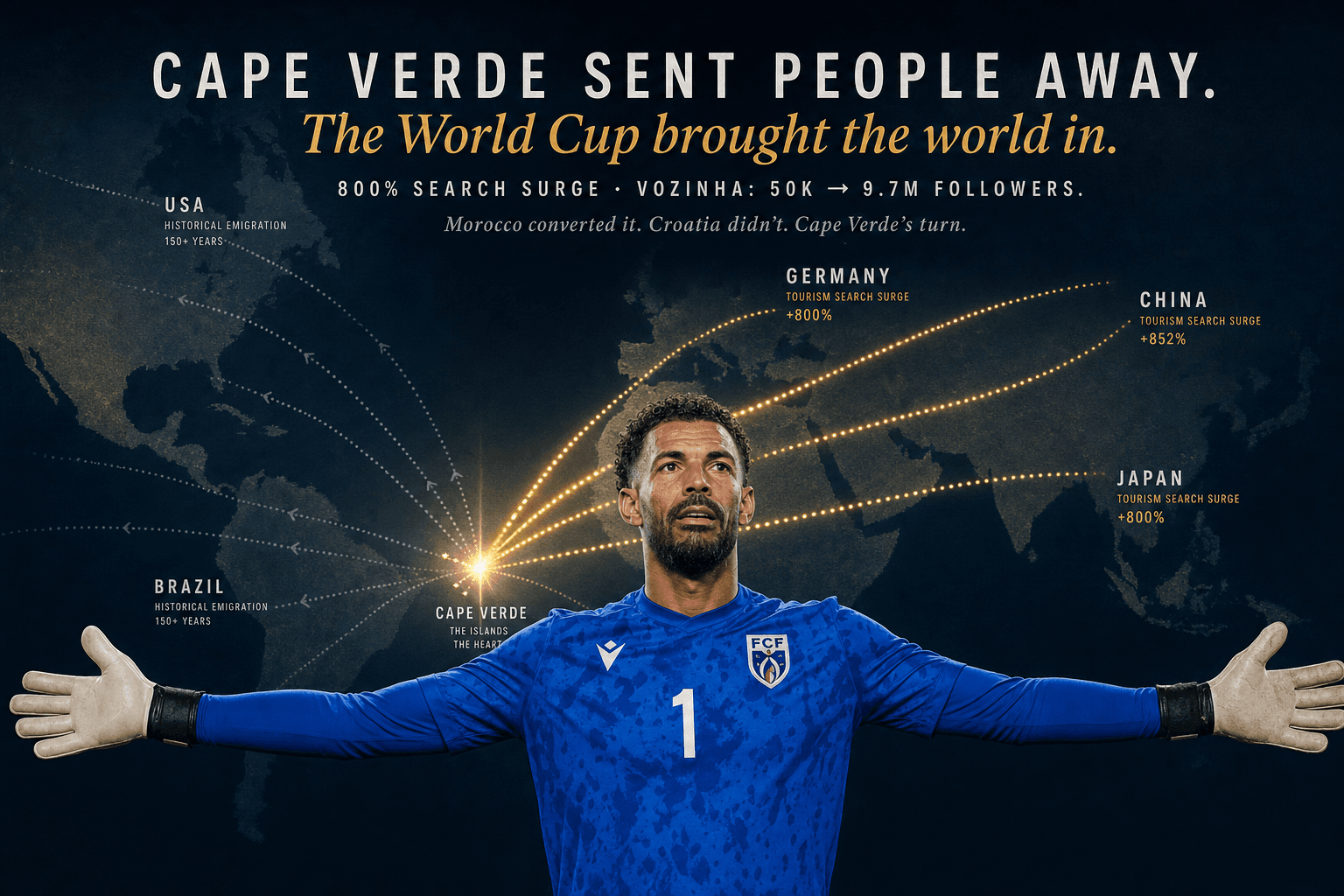
The same word explains both halves of Cape Verde's World Cup story, and it is not a football word. It is emigration. For a hundred and fifty years, Cape Verdeans left the islands — as whalers to New England in the 19th century, as labourers to Portugal and France in the 20th, as footballers' parents to the Netherlands and beyond in the years since independence in 1975. That outward movement is precisely what built the squad we documented in our piece on where Cape Verde's World Cup players were actually born: fifteen of the twenty-six-man squad born outside the islands, six in the Netherlands alone, developed in academies the islands could never have built themselves. Now, in the space of three weeks in June and July 2026, that same emigration story has produced its mirror image. Cape Verde is no longer just sending its people out into the world. The world is searching for Cape Verde, in numbers that tourism boards spend decades trying to manufacture and almost never achieve by accident. Expedia searches from the United States up more than 800%. Chinese travel searches up 852% in a single month. German search interest up 177%, peaking on the exact day of the opening match against Spain. This is the specific, well-documented phenomenon known as the World Cup effect — and Cape Verde is now the smallest nation in the tournament's history to experience it at this scale.
The Morocco Precedent: What a Semi-Final Did to a Nation's Search Traffic
The clearest template for what is happening to Cape Verde right now is Morocco's run to the 2022 World Cup semi-final — the first African and first Arab nation ever to reach that stage. Researchers from New York University found that online mentions of Morocco surged by 4,527% during the tournament, with searches for non-sports topics — travel, food, culture — increasing by 400%. The specific search term "Morocco Travel" remained elevated at 2,356% above pre-tournament levels even after the competition ended, meaning the interest did not simply spike and vanish. It became a new baseline.
The baseline held because Morocco converted it. Marrakech's airport recorded a 12% increase in December 2022 arrivals compared to December 2019 — the pre-pandemic benchmark. Morocco welcomed 11 million tourists in 2022, up from 3.7 million the year before. By 2023, that had grown to 14.5 million visitors — a 34% increase. By 2025, Morocco was welcoming nearly 20 million visitors annually, generating MAD 124 billion in tourism revenue — a sector that now supports roughly 900,000 jobs. In the first four months of 2026 alone, tourism generated MAD 44.39 billion in foreign currency earnings, a 21.2% year-on-year surge. FIFA paid Morocco a $25 million subsidy simply for reaching the semi-final. The tournament run did not end when Morocco lost to France. It began a four-year, and now an eight-year, economic transformation that is still compounding as the country prepares to co-host the 2030 World Cup with Spain and Portugal.
The Croatia Warning: Visibility Is Not the Same as Conversion
Not every deep World Cup run converts into sustained economic benefit, and the counter-example matters as much as the success story. Croatia reached the 2018 World Cup final — the smallest nation by population ever to do so at that point. The word "Croatia" was used in foreign media 118,482 times on the day of the final alone — three times more than the platform's tracked average across the previous three years. The Croatian Tourist Board's website recorded a 200% increase in visits. Chinese flight prices to Zagreb doubled overnight, and hotel searches surged 300% through the Ctrip booking platform.
But a year later, Total Croatia News reported that tourism traffic was, by several measures, down on the previous year — and that the golden opportunity afforded by the World Cup euphoria had not been fully cashed in. The article's specific verdict: Croatia won the world's attention but did not build the sustained infrastructure and marketing strategy to convert that attention into lasting visitor growth at the scale Morocco later achieved. The lesson is specific and important for any small nation experiencing a World Cup surge: the spike in searches is not the achievement. The achievement is what happens in the eighteen months after the spike — whether flight routes are added, whether hotel capacity is expanded, whether the story is told consistently rather than left to fade with the news cycle. Morocco built infrastructure and sustained the narrative for four years. Croatia, by its own tourism board's later admission, largely did not.
Morocco's World Cup search interest for "Morocco Travel" stayed 2,356% elevated even after the tournament ended — a permanent new baseline. Croatia's foreign media mentions spiked 3x on final day but tourism traffic was reportedly down a year later. Two nations, two World Cup runs, two completely different outcomes. Cape Verde's search surge is happening right now. Which pattern it follows depends entirely on what the country does in the next eighteen months — not on what happened at the 2026 World Cup itself.
Cape Verde Right Now: The Fastest, Most Concentrated Version Yet
What is happening to Cape Verde in July 2026 is, by several measures, a more concentrated version of the Morocco effect than Morocco itself experienced — because Cape Verde is a smaller country experiencing it in a shorter window. Skift reported that Expedia recorded searches from the United States up more than 800% following Cape Verde's Round of 32 run against Argentina — documented in our piece on Sidny Lopes Cabral's wonder goal in that match — while TUI, Europe's largest tour operator, saw destination searches and inquiries double.
Trip.com Group confirmed that Chinese travel searches for Cape Verde jumped as much as 852% in late June compared to the previous month, and 388% compared to the same period the year before. Flight bookings to Cape Verde rose 76% year over year. Hotel bookings increased 46%. Tongcheng Travel recorded a 200%-plus surge in destination searches within 24 hours of the Argentina match specifically, with the strongest demand from Shanghai, Guangzhou, Beijing, and Shandong province. This is a country most Chinese travellers — and most American travellers, and most travellers anywhere outside Portugal and the UK — had never previously considered a holiday destination. Japan-based interest in the destination climbed 110% in the same period.
Skyscanner's data showed German searches for Cape Verde trips between June and September rose 177% compared to the same period the previous year, with a distinct peak precisely on June 15 — the day of Cape Verde's opening match against Spain, the 0-0 draw where Vozinha made seven saves and became Man of the Match on his World Cup debut. The Vozinha effect specifically is worth naming in isolation: his Instagram following grew from approximately 50,000 to more than 9.7 million in the days following that performance — a nearly 19,000% increase for one goalkeeper from one match.
Why This Matters More for Cape Verde Than It Did for Morocco
The specific economic vulnerability that makes this surge more consequential for Cape Verde than a comparable surge would be for a larger economy is structural. Tourism already contributes approximately one-quarter of Cape Verde's entire GDP — a proportion far higher than tourism's share of Morocco's considerably larger and more diversified economy. The islands welcomed roughly 1.2 million visitors in 2025, a record figure, but the visitor base has historically been narrowly concentrated: European travellers, largely from the UK and Portugal, mostly booking all-inclusive packages to just two of the nine inhabited islands — Sal and Boa Vista. A $75 million World Bank investment aimed at strengthening and diversifying the tourism sector was already underway before the tournament began — specifically targeting new source markets beyond Europe. The World Cup has arrived at precisely the moment that investment needed a marketing catalyst it could never have purchased at any price. The specific overlap between the World Bank's diversification goal and the specific new markets generating search interest — the United States, China, Japan — is not coincidental in outcome even if it was coincidental in timing. It is the exact market expansion the investment was designed to produce, arriving four years ahead of any conventional marketing timeline.
The Diaspora Circle: What Immigration Built, Tourism Now Repays
The specific irony that connects both halves of this story deserves to be stated plainly. As we explored in our piece on the diaspora model that built Cape Verde's squad, the players who produced this World Cup run exist specifically because Cape Verdean families left the islands across multiple generations — to the Netherlands, to Portugal, to France, to the United States, to Ireland — in search of the economic opportunity the islands could not provide domestically. Ryan Mendes, born in Mindelo, chose Cape Verde over France. Vozinha developed his career in Europe before returning to define his country's tournament. The emigration that the islands' limited economy forced across a century and a half is the specific mechanism that assembled a World Cup squad capable of holding Spain scoreless and pushing Argentina to extra time.
Now the same tournament run is reversing a different kind of flow — not people leaving, but money, attention, and visitors arriving. The diaspora built the team abroad. The team's performance is now pulling international interest back toward the islands the diaspora's ancestors left. It is a specific, complete circle: a small nation whose economic limitations produced an emigration pattern, whose emigration pattern produced a football squad, whose football squad produced a tournament run, whose tournament run is now addressing — even if only partially and only if capitalised on correctly — the very economic limitations that started the cycle. Whether Cape Verde's government and tourism sector can execute the Morocco version of this story, sustaining the surge through infrastructure and consistent marketing, or the Croatia version, where the spike faded because the follow-through did not arrive, is the specific multi-year question the islands now face.
Haiti and Curaçao: The Comparison That Shows What Cape Verde Achieved
The specific scale of Cape Verde's achievement becomes clearer against the two other small-diaspora nations who reached the 2026 World Cup. As we documented in our piece on Haiti's first World Cup appearance in 52 years, Haiti — a nation whose diaspora in the United States, Canada, and France built their qualifying squad in a similar pattern to Cape Verde's — were eliminated in the group stage without the kind of signature knockout-stage moment that generates sustained global search interest. Curaçao, the 156,115-person nation that qualified as the smallest country in World Cup history before Cape Verde arrived to claim the smallest-nation-in-the-knockout-stage distinction, similarly exited at the group stage. Both nations generated genuine attention simply by qualifying — the novelty of their presence was newsworthy in itself. Neither generated the specific kind of sustained, multi-platform search surge that Cape Verde is now experiencing, because neither produced the knockout-stage drama — the penalty shootout against the Netherlands, documented in our piece on Morocco's own knockout run, or the extra-time battle against Argentina — that turns a novelty into a genuine global story with a beginning, middle, and dramatic end. Qualifying generates a headline. Reaching the Round of 32 and taking the reigning champions to extra time generates a four-week global news cycle, a goalkeeper with 9.7 million new Instagram followers, and an 852% search surge from a country on the other side of the planet.
What Happens Next: The Eighteen-Month Window
The academic literature on World Cup economic effects, while often skeptical of host-nation infrastructure spending, is specifically more positive about the effect of tournament performance itself. A 2024 study published in the Oxford Bulletin of Economics and Statistics found that World Cup winners experience a measurable GDP growth bump of at least 0.48 percentage points in the two quarters following the final — driven primarily by stronger exports as the tournament raises a nation's global profile and the perceived quality of its brands. Cape Verde has not won the World Cup and will not generate an effect of that specific magnitude. But the search, flight, and hotel booking data already available in July 2026 — collected before the tournament has even concluded — suggests a comparable mechanism operating at a scale proportional to Cape Verde's economy, where tourism's 25% GDP share means even a modest and temporary visitor increase registers as a significant national economic event.
The next eighteen months determine which template applies. If Cape Verde's tourism authority adds flight connections from the new markets generating interest — the direct US and Chinese routes that do not currently exist at scale — and builds a marketing campaign around Vozinha, Mendes, and the specific underdog narrative the world has already fallen in love with, the Morocco outcome is available: a permanently elevated baseline of visibility and visitor numbers that compounds for years. If the momentum is left to the natural news cycle without strategic reinforcement, the Croatia outcome is the more likely result: a remarkable month, extensively covered, gradually fading from global search interest as the next news cycle replaces it. Cape Verde's World Cup story on the pitch is already permanent — no result in any future tournament changes what the Blue Sharks did in 2026. Whether the tourism story becomes equally permanent is the specific question that Cape Verde's government now has the rare, expensive-to-manufacture, and time-limited opportunity to answer correctly.
Cape Verde's diaspora built the squad. The squad's World Cup run is now pulling global attention back to the islands — an 800% search surge, a goalkeeper with 9.7 million new followers, and a small nation suddenly visible to markets it could never previously reach. Will Cape Verde follow Morocco's path to sustained transformation, or Croatia's path of a spike that faded? Tell us below.