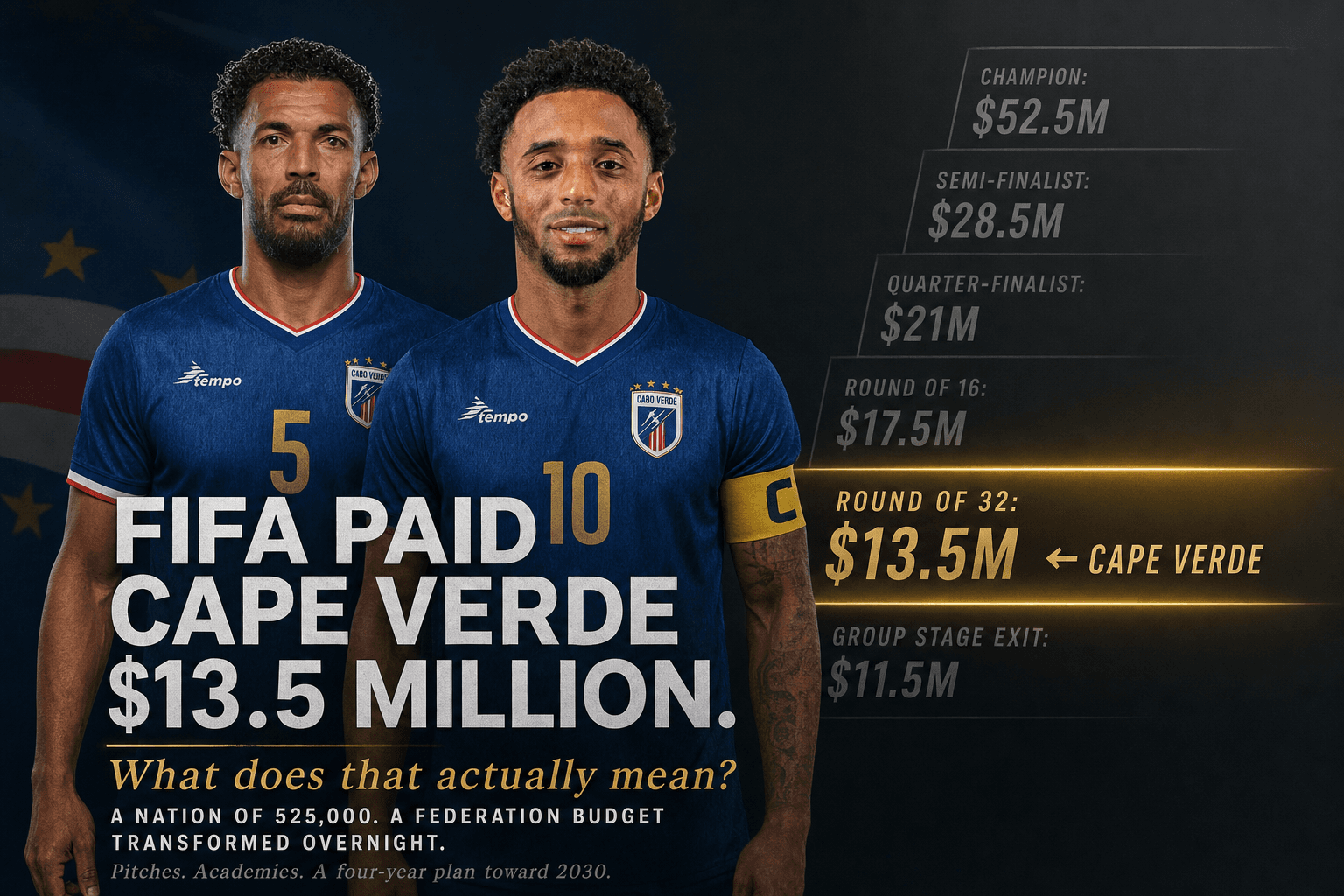
Somewhere in the Cape Verdean Football Federation's accounts, a number has just appeared that did not exist in any previous year of the organisation's history: approximately $13.5 million, wired from FIFA within weeks of Cape Verde's elimination from the World Cup. That figure — the direct financial reward for reaching the Round of 32 at the 2026 tournament — is not a headline number anyone chased deliberately. It is the specific, calculable consequence of the football documented in our piece on Cape Verde's extraordinary World Cup debut: a scoreless draw with Spain, a fighting draw with Uruguay, progression from the group, and a battle to extra time against Argentina. Each of those results moved Cape Verde one payment tier higher in FIFA's prize structure. Understanding exactly what that structure is — and what $13.5 million actually means for a federation representing 525,000 people — requires working through the specific mechanics of how FIFA distributes World Cup prize money in 2026.
The Full 2026 Prize Money Structure
Cape Verde finished second in Group H — behind Spain, ahead of Uruguay and Saudi Arabia — and progressed to the Round of 32, where they lost 3-2 in extra time to Argentina. That result places them precisely in the $11 million performance tier, plus the universal $2.5 million preparation fee, for a total of approximately $13.5 million. FIFA typically distributes this money to national associations within weeks of the tournament concluding — meaning the payment is likely already processed or imminent as Cape Verde's federation moves into its post-tournament planning phase.
What $13.5 Million Actually Means for Cape Verde
The specific scale of this figure only becomes meaningful in context. Cape Verde is a nation of approximately 525,000 people with a GDP considerably smaller than most countries competing at this World Cup — an economy where, as we documented in our piece on the tourism boom Cape Verde's World Cup run has triggered, tourism alone contributes roughly a quarter of total GDP. A national football federation representing a country this size operates on a budget that, in a typical non-World Cup year, would be measured in the low millions of dollars at most — funding domestic league operations, youth development programmes, and the costs of fielding national teams across various age groups and competitions. $13.5 million arriving in a single payment is not an incremental boost to that budget. It is a transformational sum, potentially exceeding several years of the federation's combined normal operating income in one transfer.
For comparison, teams eliminated in the group stage — the outcome Cape Verde beat by advancing — receive $9 million in performance money plus the $2.5 million preparation fee, for $11.5 million total. The report specifically noted that for smaller football nations, even the guaranteed minimum of $11.5 million "matters in ways that go far beyond one summer" — capable of building training facilities, funding youth academies, or supporting a federation's core operations for years, reshaping what qualification itself is worth for a first-time entrant. Cape Verde's additional $2 million for advancing past the group stage — the specific reward for the 0-0 draw with Spain and the fighting 2-2 with Uruguay — is the direct financial dividend of the football itself, separate from the baseline reward simply for qualifying. A full breakdown of what every country actually earned from this tournament is available in our piece on how much every country actually made at the 2026 World Cup.
$13.5 million. That is what FIFA pays a nation for holding Spain scoreless and taking Argentina to extra time. For a federation representing 525,000 people, whose annual budget in a normal year would not approach a fraction of that figure, the number is not incremental. It is the difference between a federation surviving year to year and a federation able to plan a genuine four-year development cycle toward 2030 — the year Morocco, Spain, and Portugal host the next World Cup, and the year Cape Verde will attempt to qualify for a second time.
What the Money Can Realistically Fund
The specific uses that a windfall of this scale typically funds for small football federations are well documented across previous small-nation World Cup breakthroughs. Pitches — Cape Verde's islands have historically lacked the density of quality playing surfaces that larger footballing nations take for granted, meaning investment in artificial or grass pitches across multiple islands would directly expand the talent pool the federation can develop domestically, rather than relying entirely on the diaspora recruitment model documented in our piece on how Cape Verde built this squad from players born abroad. Youth academies — a formal, federation-run development pathway that identifies and trains young Cape Verdean talent domestically could, over a decade, reduce the reliance on discovering diaspora players through the informal channels that produced this squad, including, as we documented in our piece on the transfer market's reaction to Cape Verde's breakout players, a defender recruited via a LinkedIn message.
Federation operating costs — travel, coaching salaries, administrative infrastructure — represent the least glamorous but most immediately necessary application of a windfall like this. A federation that has just proven it can compete with the best nations in the world needs the operational capacity to sustain that level of competition rather than reverting to the resource-constrained infrastructure that predated this World Cup cycle. And stadium infrastructure — Cape Verde's domestic football grounds are not built to the standard that hosting significant continental fixtures, let alone any future World Cup qualifying matches against increasingly attentive opponents, will require as the federation's profile rises.
Beyond the Prize Money: The Sponsorship Multiplier
The $13.5 million FIFA payment is, in one specific sense, the smallest part of Cape Verde's total financial windfall from this World Cup. As we detailed in our piece on the tourism and economic impact of Cape Verde's tournament run, the broader economic effect — tourism searches up 800% in the United States, 852% in China, flight bookings up 76% year over year — represents a potential economic dividend that dwarfs the direct FIFA payment when measured across the national economy rather than just the football federation's accounts. The federation's $13.5 million is a discrete, immediately available sum with a clear source and clear accounting. The tourism dividend is diffuse, uncertain, and dependent on execution — but potentially many multiples larger if converted successfully, following the Morocco template rather than the Croatia one, as we explored in that piece.
There is also a sponsorship dimension specific to the football federation itself that the World Cup run makes newly available. A federation that has just been global news for a month, whose goalkeeper has 25 million new Instagram followers as documented in our piece on Cape Verde's transfer market explosion, has a fundamentally different commercial sponsorship pitch available to it than it did in June 2026. Kit sponsors, broadcast partners, and commercial sponsors who would never previously have considered Cape Verde's federation a viable partner now have a specific, quantifiable reason to reconsider. The $13.5 million from FIFA is guaranteed and immediate. The sponsorship uplift that follows a successful World Cup campaign is the specific opportunity that determines whether this financial moment becomes a permanent step change for Cape Verdean football, or a single good year that fades without lasting structural investment.
Comparing the Windfall to Cape Verde's Economic Baseline
The specific scale becomes even clearer when set against Cape Verde's broader public finances. National football federations in nations of this size typically operate with annual budgets that are a rounding error compared to what a single Premier League club spends on a squad player's wages in a single season — a comparison we explored in our piece on how Premier League financial rules reward commercial revenue over owner wealth. Where a club like Newcastle United must navigate PSR constraints to fund a single transfer, Cape Verde's federation has received, in a single FIFA payment, a sum that most comparably sized national federations across Africa and the Caribbean would need a decade or more of normal federation income to accumulate. The specific opportunity this creates is not comparable to a transfer window decision at elite club level — it is closer to a one-time national infrastructure investment decision, the kind of allocation that shapes a football culture's trajectory for a generation rather than a single season. It is worth noting that prize money is not the only channel through which FIFA moves significant sums to national federations and clubs around a World Cup: as we documented in our piece on FIFA's Club Protection Programme and how it compensated Manchester United for Manuel Ugarte's World Cup injury, the governing body separately distributes hundreds of millions of dollars in club compensation and insurance payments alongside the 71 million team prize pool — a reminder that FIFA's financial footprint around a single tournament extends well beyond the trophy and the federations competing for it.
The comparison to hosting nations is also instructive. Morocco, as we detailed in our piece on the tourism and economic transformation their 2022 World Cup semi-final produced, received a specific FIFA subsidy of 25 million dollars simply for reaching that stage — a figure that then compounded into a multi-year, multi-billion-dirham tourism transformation. Cape Verdes 13.5 million dollar prize money is smaller in absolute terms, appropriate to a Round of 32 finish rather than a semi-final. But relative to the size of Cape Verdes economy and the scale of its football federation, the proportional impact may prove comparable, or even larger. A country of 525,000 people processing a windfall of this size experiences it very differently than a country of 38 million processing a similarly structured reward.
Whichever specific allocation the federation ultimately chooses, the underlying fact is unlikely to change: this is the single largest and most flexible sum of money Cape Verdean football has ever controlled at once, arriving at the exact moment the country has the highest global profile in its sporting history to leverage alongside it. The football produced the moment. The prize money produced the resources. What happens next is entirely a question of execution.
FIFA has paid Cape Verde approximately $13.5 million for their World Cup run — a transformational sum for a federation this size. Should the money go toward pitches and academies to reduce diaspora dependency, or toward sustaining the current diaspora recruitment model that already works? Tell us below.