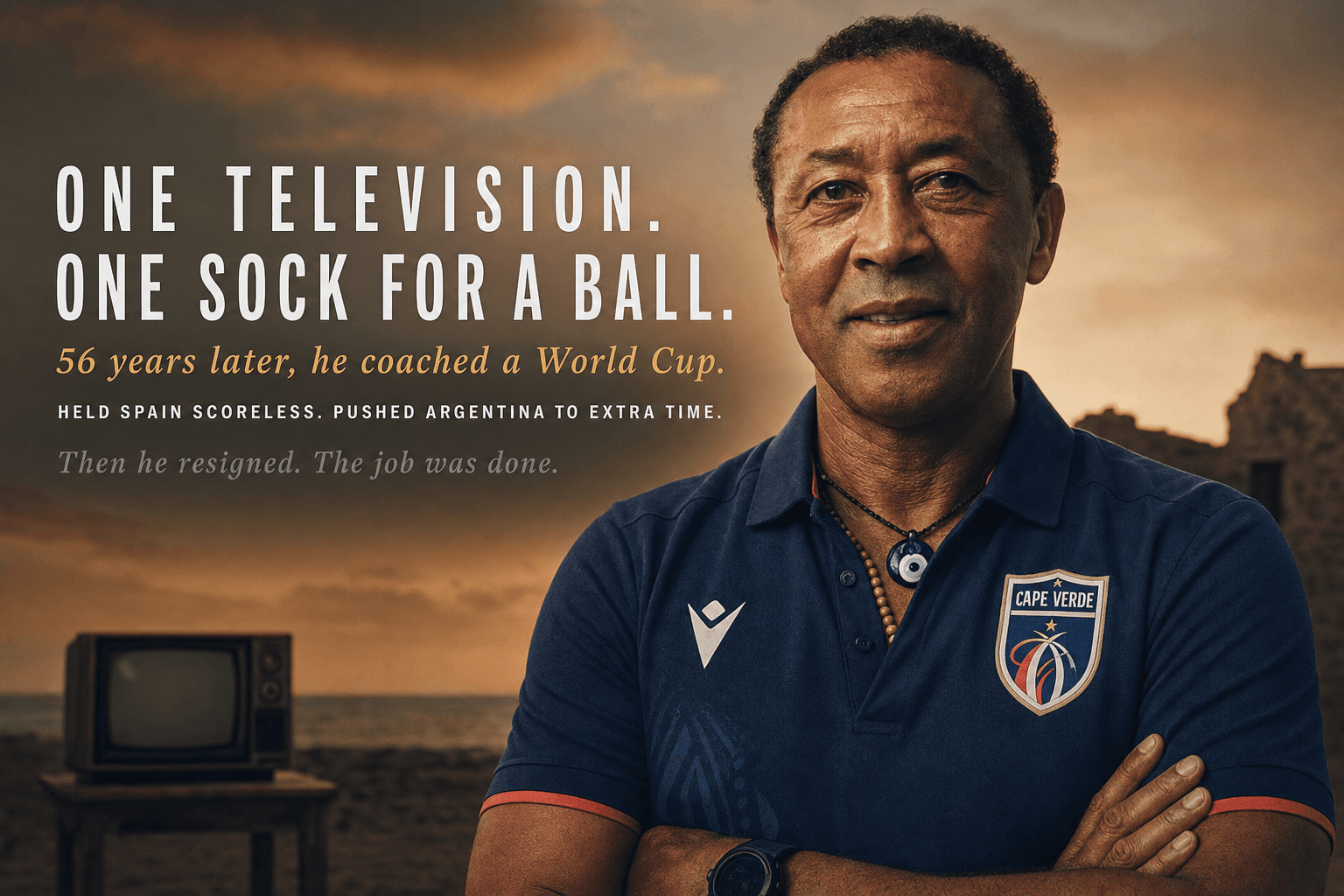
There was one television set in Povoação Velha, a village on the Cape Verdean island of Boa Vista, when Pedro Leitão Brito was a boy. It was not easy to get to. He walked there anyway, with his neighbours, to watch the World Cup — Lothar Matthäus, Éder and Falcão of Brazil, and, above everyone, Diego Maradona. His mother made him footballs out of socks because there was nothing else to make them from. He was inspired by what he saw on that one shared screen to pursue a career in the sport himself, though the specific version of that dream — playing in a World Cup — would not arrive for him for another fifty years. Not as a player. As a coach, at the age of 56, having spent eleven years as Cape Verde's captain and then two decades building toward the exact moment his childhood imagination could not have fully pictured: his own team of players, some of them born thousands of miles from Boa Vista, walking out to face Spain at a World Cup he was coaching them through. Everyone calls him Bubista — the Cape Verdean Creole word for someone from Boa Vista. Nobody in world football has a more specific or more complete underdog story attached to their name.
The Player: 28 Caps, Eleven Years as Captain
Pedro Leitão Brito was born on January 6, 1970, on Boa Vista, then still Portuguese Cape Verde. He made his international debut for Cape Verde in 1991 as a centre-back, going on to earn 28 caps across a fourteen-year international career that ended in 2005. He captained the national team for more than a decade — a role that required leadership as much as football, given Cape Verde's status throughout that era as a footballing afterthought with no realistic World Cup pathway visible on the horizon. His playing career took him briefly into European football — a short spell at Spanish Segunda División club Badajoz in 1995 and 1996, where he made two appearances, including 90 minutes in a 3-0 win over Getafe — before six seasons at Angolan club ASA, the most productive stretch of his playing career, and a return home to Falcões do Norte in 2003 to close out his playing days on the islands where he began.
Former teammates described him as a strong defender who excelled in aerial duels despite not being among the tallest players on the pitch — a specific quality that would later become one of the defining hallmarks of his coaching philosophy: organisation and discipline compensating for whatever individual physical or technical gaps existed in his squads. The defensive principles he embodied as a player became, twenty years later, the exact defensive principles that held Spain scoreless at the 2026 World Cup.
The Coach: From Mindelense to the National Team
Bubista's route into management ran through Cape Verde's domestic clubs — Mindelense, Académica do Mindelo, Sporting Praia, and Batuque — before he was appointed head coach of the national team in January 2020, replacing Janito Carvalho. His tenure began with an immediate milestone: in March 2021, he guided Cape Verde to qualification for the 2021 Africa Cup of Nations after a decisive away win over Mozambique. He went on to reach the quarter-finals of the 2023 Africa Cup of Nations, and steadily transformed the Blue Sharks into one of African football's most tactically disciplined national teams — built specifically on defensive organisation and the systematic integration of Cape Verde's diaspora players across Europe.
The specific coaching identity Bubista built is worth stating precisely because it is unusual for a team assembled from players who, as we documented in our piece on the diaspora model that produced Cape Verde's World Cup squad, mostly meet for international duty and have limited time together compared to club sides. Building a coherent defensive structure with a squad assembled from Rotterdam, Paris, Lisbon, Dublin, and the islands themselves — a squad that, as we explored in our piece on where Cape Verde's players were actually born, includes fifteen of twenty-six players born outside the country — requires a specific kind of coaching that prioritises simplicity and repeatable principles over complex tactical systems that a squad with limited training time together could not reliably execute. Bubista's version of that principle was: be hard to beat first, create moments of quality through individual brilliance second. It won Cape Verde a World Cup place. It then very nearly won them a place in the Round of 16.
Qualification: The Second-Smallest Nation Ever
On October 13, 2025, Bubista led Cape Verde to a 3-0 home win over Eswatini that confirmed their first-ever FIFA World Cup qualification — making Cape Verde the second-smallest nation ever to reach the tournament, after Iceland in 2018. He was subsequently named CAF Coach of the Year for 2025. Bubista explained the change in mindset that had allowed Cape Verde to overcome Cameroon — a nation with vastly more footballing history and resources — in qualifying: once you are on the pitch, he said, a lot of things become equal. As big as the opponent might be on the world stage, national teams become equal once the whistle blows. It was not false modesty. It was the specific coaching philosophy that then produced a 0-0 draw with Spain, ranked 65 places above Cape Verde by FIFA — a result multiple outlets subsequently ranked among the biggest upsets in World Cup history.
Bubista watched the 1990 World Cup on a single shared television set on Boa Vista, playing with a ball his mother made from socks. Fifty-six years later, he coached a World Cup team himself — 28 caps and eleven years as captain behind him, a squad of Rotterdam-born, Paris-born, Dublin-born, and island-born players assembled through diaspora scouting and, in one case, a LinkedIn message. His team held Spain scoreless. They pushed Argentina to extra time. Then he resigned, his job — the only job he had ever wanted — complete.
The Tournament: Held Spain, Fought Uruguay, Pushed Argentina to the Brink
The football itself is documented in full in our piece on Cape Verde's extraordinary World Cup debut against three nations with six combined World Cup titles. What Bubista's specific tactical approach produced across those four matches was consistent: a compact defensive shape that surrendered almost nothing in open play, a goalkeeper in Vozinha whose individual quality Bubista trusted completely, and moments of attacking quality — Kevin Pina's free-kick, Hélio Varela's second-half equaliser, Sidny Lopes Cabral's extra-time wonder goal against Argentina — that came from individual brilliance rather than a sustained attacking system. It was not expansive football. It was never intended to be. Bubista built a team to survive against opposition with vastly superior individual talent, and to strike when the specific moment arrived. That approach delivered a scoreless draw against the pre-tournament unbeaten-record holders, a comeback draw against two-time champions Uruguay, and two second-half equalisers against the reigning champions in the Round of 32.
The Resignation: A Bittersweet Farewell
Shortly after the tournament ended, Bubista resigned as Cape Verde's head coach. He leaves behind the specific legacy that most coaches spend entire careers chasing and never achieve: taking one of the smallest nations on Earth to a World Cup for the first time in history, then taking that same nation to the brink of a result that would have been one of the greatest upsets the tournament has ever produced. His departure was not framed as a crisis or a falling-out. It read as the natural conclusion of a specific chapter — a coach who set out in 2020 with one stated ambition, achieved it and then exceeded it, and chose the moment of maximum achievement to step away rather than attempt to manage the different, harder challenge of sustaining a small nation's World Cup momentum across a full four-year cycle with the pressure of elevated expectations attached.
Whoever succeeds him inherits a specific and unusual set of advantages: a diaspora recruitment pipeline that Bubista built essentially from nothing, a defensive philosophy that has been proven against Spain and Argentina simultaneously, and — as documented in our piece on the transfer market explosion Cape Verde's players are now experiencing — a national team brand that carries genuine commercial and recruitment value for the first time in the country's history. Bubista built that from a single television set on Boa Vista and a ball made from socks. The next coach starts from a considerably higher floor, because of what he did.
The Specific Weight of Coaching a Diaspora Squad
The tactical challenge Bubista solved deserves more specific credit than it typically receives in coverage of Cape Verde's tournament. Managing a squad assembled from players developed in the Netherlands, Portugal, France, Ireland, and the United States — documented in full in our piece on where every Cape Verde player was actually born — is not simply a matter of picking the best available eligible players. It requires building a shared tactical language among players who trained under completely different coaching philosophies at their respective clubs, who speak multiple first languages, and who typically assemble for only a handful of days before international fixtures. Bubista's specific achievement was compressing what would normally take a club manager an entire pre-season to install — defensive shape, pressing triggers, set-piece routines — into the fragmented training windows international football allows. That he did it well enough to hold Spain scoreless and take Argentina to extra time, with a squad that had barely trained together as a full unit before the tournament began, is the specific coaching detail that separates Bubista's achievement from a simple story of overachieving underdogs. The system worked because he built it correctly, not because Cape Verde got lucky four times in a row.
There is also a quieter dimension to Bubista worth noting: he did all of this as a first-time national team manager at the senior level, having never previously coached outside Cape Verde domestic football or held a role at a club playing continental competition. The conventional pathway to managing a World Cup campaign runs through club football at increasingly prestigious levels, or through assistant roles at major federations. Bubista took none of that route. He managed Mindelense. He managed Batuque. He built his entire coaching reputation inside a footballing infrastructure smaller than a single lower-league English club academy, and turned it into a World Cup campaign that held one of the two pre-tournament favourites scoreless. That is the specific detail that separates his achievement from any comparable underdog coaching story in the sport recent history.
Bubista waited 56 years and eleven years as captain for his World Cup moment — then resigned having exceeded every reasonable expectation. Where does his achievement rank among football's great underdog coaching stories, and who do you think should replace him? Tell us below.