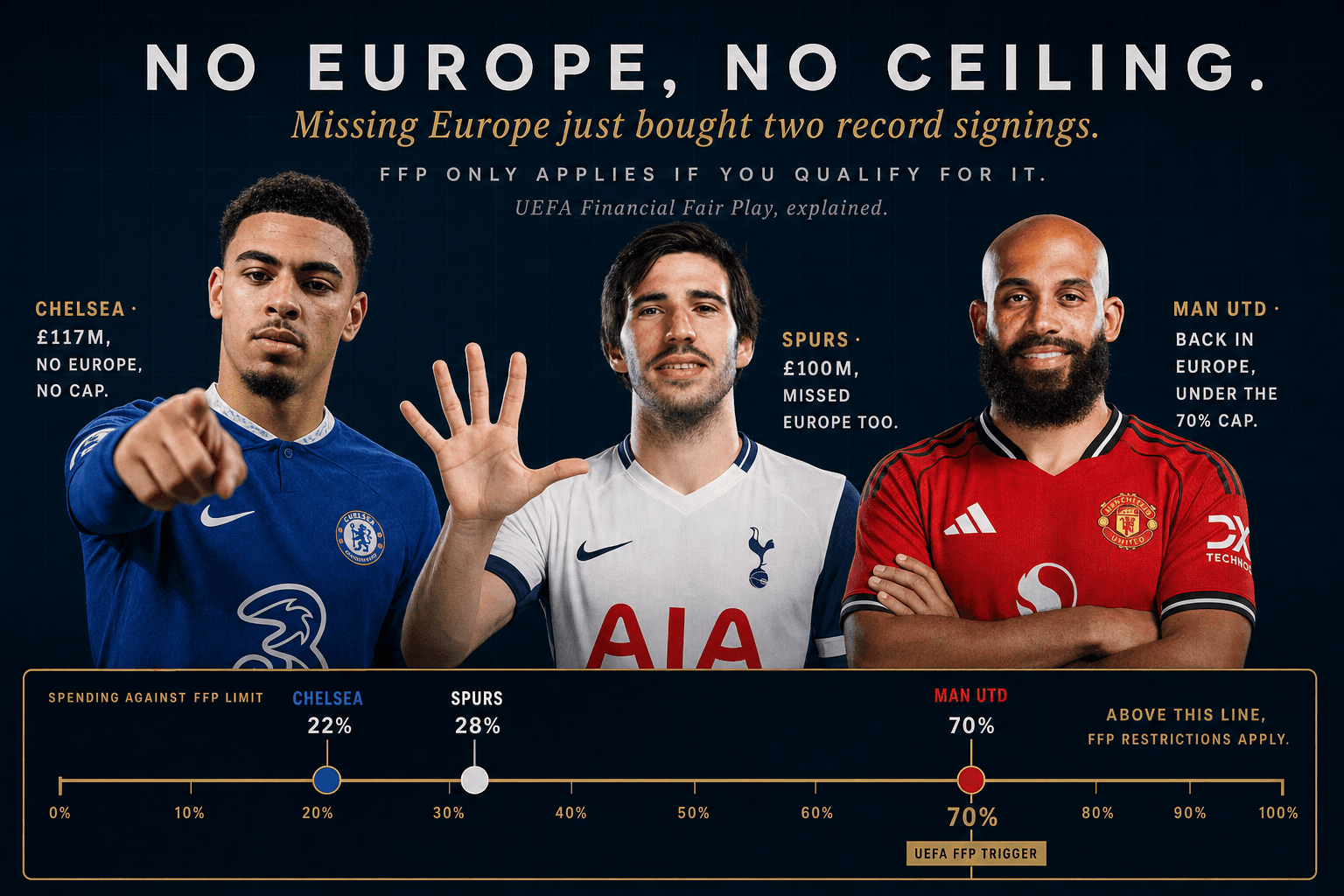
In our piece on how Squad Cost Ratio replaced PSR, we established the domestic picture: 85% of football revenue is the Premier League's new ceiling, Newcastle are forecast at 98.5%, and clubs must now sell before they buy. That explains why Newcastle dismantled their squad. It does not explain the summer's genuine anomaly.
Chelsea finished tenth. They won one of their final nine league matches, lost 2-1 at Sunderland on the last day, and missed the Champions League, Europa League and Conference League entirely. Then they paid Aston Villa a British record £117 million for Morgan Rogers. Tottenham finished seventeenth in a twenty-team league for the second consecutive season, survived on the final day, missed every European competition, and spent up to £100 million on Sandro Tonali, taking their summer outlay past $300 million. Manchester United qualified for the Champions League by finishing in the top five and have spent the window picking carefully through mid-priced deals.
Two clubs failed catastrophically and spent enormously. One succeeded and held back. That is not coincidence, and it is not chance. It is the second financial mechanism, sitting on top of the domestic one we already explained, and once you see it you cannot unsee it.
UEFA Can Only Regulate Its Own Competitions
This is the part that is rarely stated plainly. UEFA is a competition organiser, not a regulator of domestic football. Its financial framework, historically Financial Fair Play and now the Financial Sustainability Regulations, exists as a condition of entry into its own tournaments: the Champions League, Europa League and Conference League. The cost control provisions, the overdue payables rules and the football earnings rule all apply to clubs that qualify for the group or league stage of those competitions. They have never applied to domestic leagues, because UEFA has no jurisdiction there and never claimed any.
The consequence is straightforward and enormous. A club that misses all three European competitions has no UEFA financial rule to answer to at all that season. It still faces its domestic framework, but as we set out in the SCR piece, that domestic ceiling is 85% of football revenue. UEFA's own cost control rule sits at 70%, phased in at 90% in 2023/24, 80% in 2024/25 and 70% from 2025/26.
Missing Europe therefore costs a club prize money, broadcast income and prestige. It also hands that club a fifteen percentage point increase in the share of its revenue it may legally spend on players. The Premier League's own stated reasoning for the more generous domestic threshold is competitive balance: clubs without European income should be able to spend a larger proportion of what they do earn. The intention is defensible. The outcome is that a disastrous season can function as a transfer window advantage.
Chelsea: Breached the Rule, Then Escaped It Entirely
Chelsea's position this summer is the sharpest illustration available, and it connects directly to something we documented in the SCR piece. Chelsea's own June 2026 club statement confirmed they had narrowly exceeded UEFA's 70% squad cost threshold for calendar year 2025 and would pay a fine, ultimately €3 million with €2 million suspended.
Now follow the sequence. Chelsea breached UEFA's cap while still inside UEFA's competitions. They were fined an amount that, against their revenue, barely registers. And then they finished tenth, missed Europe altogether, and the rule they had just breached stopped applying to them for the following season. There was no additional consequence, because there was no competition left to exclude them from.
What followed is the window we covered in our piece on Xabi Alonso tearing up the BlueCo model: the British-record £117 million for Morgan Rogers, Elliot Anderson from Nottingham Forest, Maxence Lacroix from Crystal Palace, and then the genuine philosophical break, Danny Welbeck at 35 and Jordan Henderson at 36, the first players aged 35 or over signed since the 2022 takeover. Rogers, notably, left Champions League football at Villa to join a club with no European fixtures at all.
Read that alongside the amortisation model we explained in our Vision 30 piece and the machine becomes fully visible: long contracts to spread fees thinly across the accounts, related-party asset sales to manufacture profit when needed (now banned), and no UEFA ceiling because the football collapsed. Chelsea's business is tracked on our Chelsea transfer records page.
Chelsea breached UEFA's spending rule, paid a fine of £2.58 million with most of it suspended, then finished tenth and the rule stopped applying to them entirely. Newcastle qualified for Europe, complied with everything, and sold Isak, Gordon and Tonali while their manager resigned. Both of those outcomes are the system functioning exactly as designed.
Tottenham: Seventeenth Twice, £100 Million Anyway
Tottenham's case is arguably starker because the football was worse. Back-to-back seventeenth-place finishes, survival secured on the final day, and no European qualification of any kind. Their response was to break their own transfer record twice within days, culminating in Sandro Tonali from Newcastle in a deal worth up to £100 million: £92.5 million upfront plus £7.5 million in add-ons that are, in a detail worth pausing on, explicitly linked to European qualification.
We covered that rebuild in our piece on Roberto De Zerbi's record-breaking Tottenham window, and the revenue engine funding it in our piece on how the stadium converts into spending power. That stadium revenue, the NFL fixtures, the concerts, the year-round commercial operation, is exactly the denominator advantage that makes an 85% ceiling generous for Spurs and punitive for others. Their full record sits on our Tottenham transfer records page.
Now hold that against the club on the other end of the Tonali transfer. Newcastle qualified for Europe, generated genuine Champions League revenue, ran a 72.6% wage-to-revenue ratio and posted a £34.7 million profit. And as we detailed in our piece on the collapse of their project and our piece on Eddie Howe's resignation, they still sold Tonali, Gordon and potentially Bruno Guimarães, and lost the manager who delivered their first trophy in seventy years.
Newcastle finished above Tottenham. Newcastle qualified for Europe. Newcastle had less financial freedom for it, and Tottenham bought their best midfielder with the proceeds.
Manchester United: Financially Punished for Qualifying
United returned to the Champions League and raised their 2026 revenue forecast to £665 million on the strength of it. That is unambiguously good news. It also means every pound they spend now counts against UEFA's 70% cap rather than the domestic 85%.
Financial analyst Jacobs made the point that genuinely inverts intuition: United's spending budget would actually shrink if they qualified for a lower-tier European competition such as the Conference League, because the 70% cap would still apply while the revenue it is measured against would be dramatically smaller. Qualifying for the wrong European competition is financially worse than missing Europe entirely. There is a real scenario in which a club is better off finishing eighth than seventh.
Watch what United have actually done with that constraint. Andrey Santos from Chelsea for around £50 million. Youri Tielemans from Aston Villa for £35 million, the release clause activation we broke down in our piece on how clubs discover and trigger release clauses, where Villa were reportedly caught off guard by how quickly United moved. Karl Darlow on a free transfer. Tynan Thompson from Tottenham for an initial £4 million.
Former Manchester City financial adviser Stefan Borson believes United are deliberately working through squad needs in stages with affordable deals first, saving room for one large purchase before the deadline. That is not a club without money. It is a club managing a ratio in real time. And in the SCR piece we noted analysis concluding that United's earlier £200 million outlay on Cunha, Mbeumo and Sesko left them compliant but walking a financial tightrope. This summer's restraint is that tightrope being walked. United's history is on our Manchester United transfer records page.
These Rules Absolutely Have Teeth, Once You're Inside Them
It would be easy to read all of this and conclude FFP is decorative. The enforcement record says otherwise, and it becomes severe the moment a club is inside UEFA's competitions.
In 2014, Manchester City and Paris Saint-Germain were each fined €60 million, €40 million of it suspended, had their Champions League squads reduced to 21 players, and faced transfer spending restrictions plus two-year squad salary caps. City's specific sanctions included maximum permitted losses of €20 million in 2014 and €10 million in 2015, with their wage bill frozen at existing levels for two seasons.
In 2019, AC Milan were fined €12 million and banned outright from the following season's Europa League for a break-even breach covering spending up to 2017. In 2022, UEFA fined eight clubs in a single enforcement round: PSG €65 million, Roma €35 million, Inter €26 million, Juventus €23 million, Milan €15 million, Beşiktaş €4 million, and Monaco and Marseille €2 million each. Nineteen other clubs, including Barcelona, Chelsea, Dortmund, Lazio, Leicester, Lyon, Manchester City, Napoli, Rangers, Real Betis, Sevilla, West Ham and Wolfsburg, escaped fines only because of Covid-related exemptions.
And the most recent round produced the Villa and Chelsea penalties we covered in the SCR piece: €22.5 million and €3 million respectively. Banning a club from the Europa League costs more than any fine ever could. But you can only ban a club from a competition it qualified for in the first place.
What This Actually Changes About How You Watch Football
The conclusion is genuinely uncomfortable. European qualification carries a hidden financial cost, and missing out carries a hidden short-term financial benefit. Nobody designed that. UEFA regulates its own competitions because that is its only jurisdiction; the Premier League regulates domestically; and the seam between the two systems creates an arbitrage that a club finishing tenth or seventeenth can exploit for one summer.
None of this makes Chelsea or Tottenham villains. Both followed the rules precisely as written, and Spurs attaching European qualification add-ons to the Tonali fee shows exactly where they would rather be. But the effect compounds in an ugly direction. Chelsea's tenth-place collapse funded a British record. Tottenham's seventeenth-place finish funded a £100 million midfielder bought from a club that qualified for Europe and was forced to sell him. And as we argued in the SCR piece, there is no longer any legal route for a club outside the established revenue elite to invest its way upward, which leaves player trading and contractual protection as the only levers remaining, the model we examined in our piece on Real Madrid's buyback, sell-on and matching rights clauses.
Next time a club has a catastrophic season and immediately spends enormous money, you will know the mechanism nobody puts on the broadcast graphic. And when a club qualifies for Europe and then dismantles itself to comply, you will understand that too. Right now, in English football, sporting success and financial freedom are pulling in opposite directions.
Watch the full breakdown of why FFP only applies to clubs in Europe, and what it meant for Chelsea, Tottenham and Manchester United this summer, on BackPage FC Videos.
Chelsea finished 10th and broke the British record. Spurs finished 17th and spent £100m. United made the Champions League and had to hold back. Should missing Europe really buy a club more spending freedom? Tell us below.