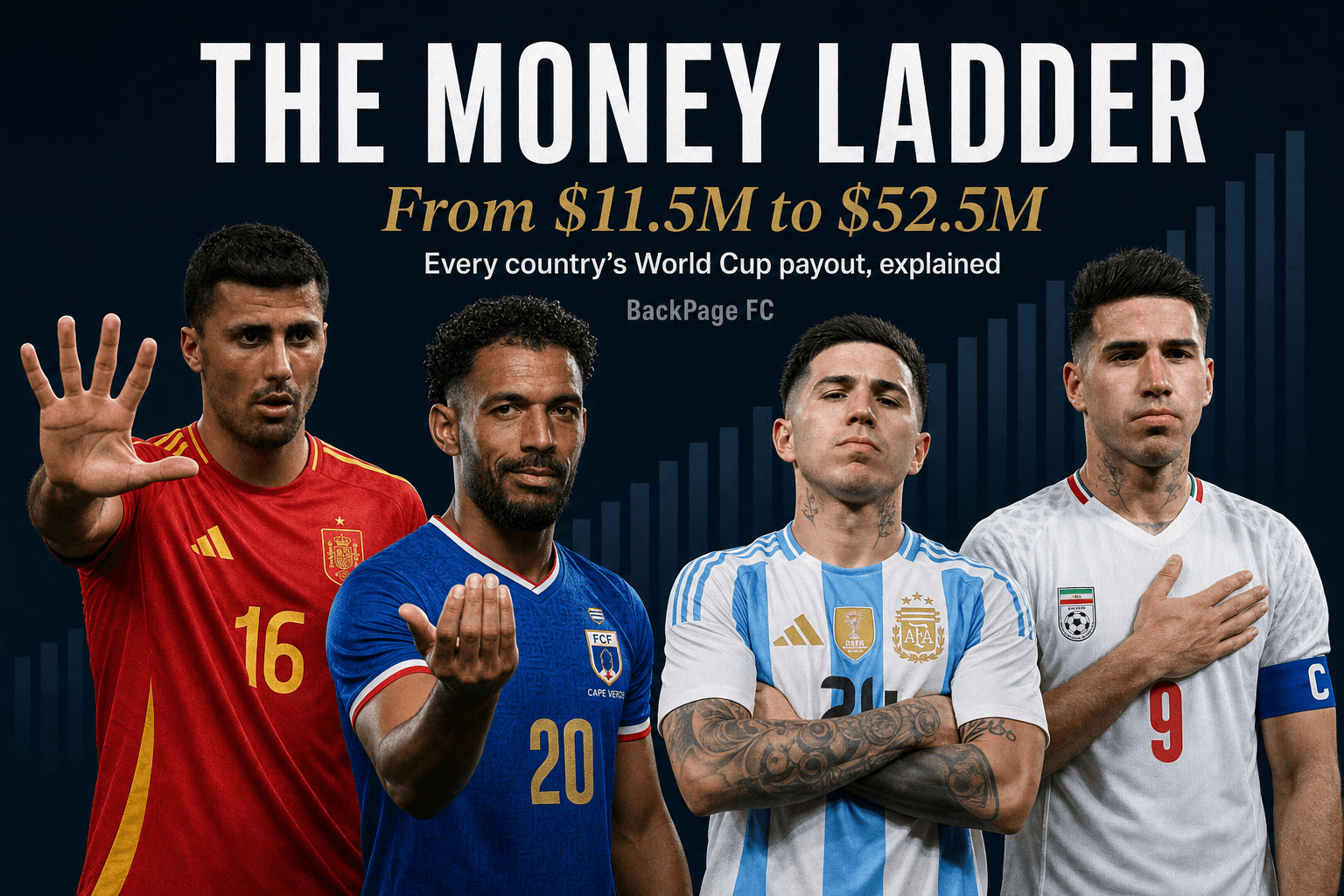
Spain lifted the World Cup on July 19 and, alongside the trophy, collected a prize cheque of roughly $52.5 million from FIFA. Cape Verde, a nation of 525,000 people making their World Cup debut, collected $13.5 million simply for reaching the Round of 32, a sum we detailed in full in our piece on Cape Verde's FIFA prize money windfall. Both figures come from the exact same $871 million pool, distributed according to the exact same round-by-round structure, and every one of the 48 nations that competed this summer, from Argentina to Uzbekistan, fits somewhere on that ladder. Understanding exactly how FIFA works out the number, and what every single competing country actually took home, is the specific breakdown BackPage FC exists to give you.
How FIFA Actually Calculates the Number
FIFA's official prize money structure for 2026 is built on two separate layers. The first is a flat $2.5 million preparation grant, paid to all 48 qualified nations regardless of how they perform, intended specifically to cover pre-tournament training camps, travel and logistics. The second layer is performance-based, paid out according to the single furthest stage a team reaches: $9 million for a group-stage exit, $11 million for elimination in the newly created Round of 32, $15 million for a Round of 16 exit, $19 million for the quarter-finals, $27 million for fourth place, $29 million for third, $33 million for the runner-up, and $50 million for the champion. A team's total payout is always the preparation grant plus whichever single performance tier applies to their final result; the tiers do not stack cumulatively as a team advances. FIFA calculates the total pool first, working backwards from broadcast rights, sponsorship and ticketing revenue for the specific edition, then divides it across these fixed tiers before the tournament even begins, meaning every nation knows its minimum guaranteed payout the moment it qualifies.
The Champion and Runner-Up: Spain and Argentina
Spain's $52.5 million total, documented in full in our piece on their semi-final win over France, is the largest single payout any nation has ever received from FIFA for a World Cup, a direct consequence of the $50 million champion's tier combined with the $2.5 million preparation grant. Argentina, beaten 1-0 in extra time in the final, collected $35.5 million, the $33 million runner-up tier plus their own preparation grant. Al Jazeera confirmed the final scoreline and Ferran Torres's 106th-minute winner that decided which of those two figures each federation actually banked.
The Semi-Finalists: France and England
France and England, both eliminated at the semi-final stage, contested the third-place play-off for the difference between the $27 million and $29 million tiers. England's own semi-final defeat to Argentina, documented in our piece on Tuchel's costly late substitution, and France's defeat to Spain both guaranteed a minimum of $29.5 million once the preparation grant is included, with the actual finishing position worth an additional $2 million on top for whichever of the two nations won the play-off.
The Quarter-Finalists: Morocco, Belgium, Norway and Switzerland
Four nations exited at the quarter-final stage, each collecting $21.5 million: Morocco, beaten by France in a match we previewed in our piece on the Olise-Diaz subplot; Belgium, beaten by Spain; Norway, whose run ended against England after their own historic elimination of Brazil, documented in our piece on Norway's squad stories; and Switzerland, whose exit against Argentina was defined by the mistaken identity controversy we detailed in full in our piece on Breel Embolo's red card.
The Round of 16: Mexico, Brazil, Portugal and Others
Mexico's exit to England at the Azteca, covered in our piece on England's ten-man win, earned Mexico $17.5 million, the same $15 million Round of 16 tier plus preparation grant collected by Brazil, whose own elimination by Norway ended Carlo Ancelotti's chase for football's rarest managerial double, a story we told in full in our piece on Brazil's European curse continuing. Portugal, beaten by Spain in the same round, collected the identical $17.5 million.
The Round of 32: Cape Verde, Ecuador and Austria
Thirteen and a half million dollars was the specific figure collected by every nation eliminated in the newly introduced Round of 32, the tier that gave Cape Verde their transformational windfall after extra time against Argentina, and the same figure collected by Ecuador, whose defensive qualifying campaign we documented in our piece on their elimination by Mexico, and by Austria, beaten by Spain in the same round.
The Group Stage: Iran's Heartbreak, Curaçao and Haiti's History
Iran's elimination was among the most dramatic of the entire group stage. Undefeated across three matches, drawing with Belgium, New Zealand and Egypt, Iran finished third in Group G on three points and needed a specific set of results elsewhere on the final matchday to advance as one of the eight best third-placed teams. None of them arrived: Croatia beat Ghana, Congo beat Uzbekistan, and Austria drew 3-3 with Algeria, eliminating Iran without them losing a single match. Iran's players had left a letter in their Seattle dressing room before the tournament began, reading: "Fair play is not only a rule of football, it is the soul of the game." That specific gesture makes the eventual destination of the tournament's actual Fair Play Award a pointed footnote: it went not to Iran but to the Netherlands, documented separately below, based on FIFA's technical disciplinary criteria rather than the sentiment Iran's own dressing room expressed before a ball was kicked. Iran's $11.5 million group-stage payout, the $9 million tier plus preparation grant, was earned entirely without a single defeat.
Curaçao and Haiti, both making history simply by qualifying, documented in full in our pieces on Curaçao becoming the smallest nation ever to reach a World Cup and Haiti qualifying without playing a single home game, both exited at the group stage and collected the identical $11.5 million payout. For federations of that size, the sum represents a genuinely transformational injection of funds regardless of the early elimination.
The Netherlands: Winning an Award Without Winning a Match at That Stage
The Netherlands were confirmed as winners of the 2026 FIFA Fair Play Award, their first, making them the eleventh nation to receive the honour since it was first introduced in 1970. FIFA's own data showed the Netherlands were not statistically the tournament's cleanest side by raw numbers, committing 44 fouls across the competition and receiving three yellow cards, the same tally as Algeria, Germany and Senegal, all eliminated earlier than the Dutch. FIFA's criteria explicitly extends beyond card counts to include respect for opponents and overall sportsmanship, and only nations that reach the knockout stage are eligible to receive the award at all. The Netherlands were eliminated by Morocco on penalties in the Round of 32, a match previewed in our piece on Morocco's tournament threat, meaning their $13.5 million prize money payout and their Fair Play Award both arrived from the same specific stage of the competition.
Why the Tournament Expanded to 48 Teams
FIFA's total distribution for 2026 reached $871 million, nearly double the $440 million paid out at Qatar 2022. The driver of that growth is the expanded format itself: 48 teams instead of 32, spread across the United States, Canada and Mexico, produced 104 matches instead of 64 and a vastly larger commercial footprint across three host nations simultaneously.
Infantino's Proposed 64-Team Format for 2030
FIFA president Gianni Infantino has publicly floated an even larger 64-team format for the 2030 World Cup, co-hosted across Spain, Portugal and Morocco, with additional centenary matches in Argentina, Paraguay and Uruguay. Critics warn a format nearly double the pre-2026 size risks diluting group-stage quality and further congesting an already strained football calendar. Proponents point directly to the 2026 expansion's financial precedent as the case for going further.
The Balogun Controversy and What Expansion Actually Produces
The specific kind of storyline a larger, US-co-hosted tournament generates was visible in Folarin Balogun's tournament. Born in Brooklyn to Nigerian parents, raised almost entirely in England, and eligible for Nigeria too, Balogun chose the United States in 2023 after representing England through Under-21 level. He became the USMNT's breakout star this summer before a red card against Bosnia and Herzegovina in the Round of 32. FIFA's Disciplinary Committee suspended his automatic match ban for a one-year probationary period rather than ruling him out of the Round of 16. The specific controversy, a naturalised co-host nation's biggest attacking talent receiving a disciplinary reprieve at the exact moment his suspension would have hurt the host federation most, is precisely the kind of storyline critics of further expansion point to.
Spain earned $52.5 million for winning it all. Cape Verde earned $13.5 million just for reaching the Round of 32. Iran left with nothing but an undefeated record and a letter about fair play. Should FIFA expand to 64 teams by 2030, or has the format already grown too large? Tell us below.