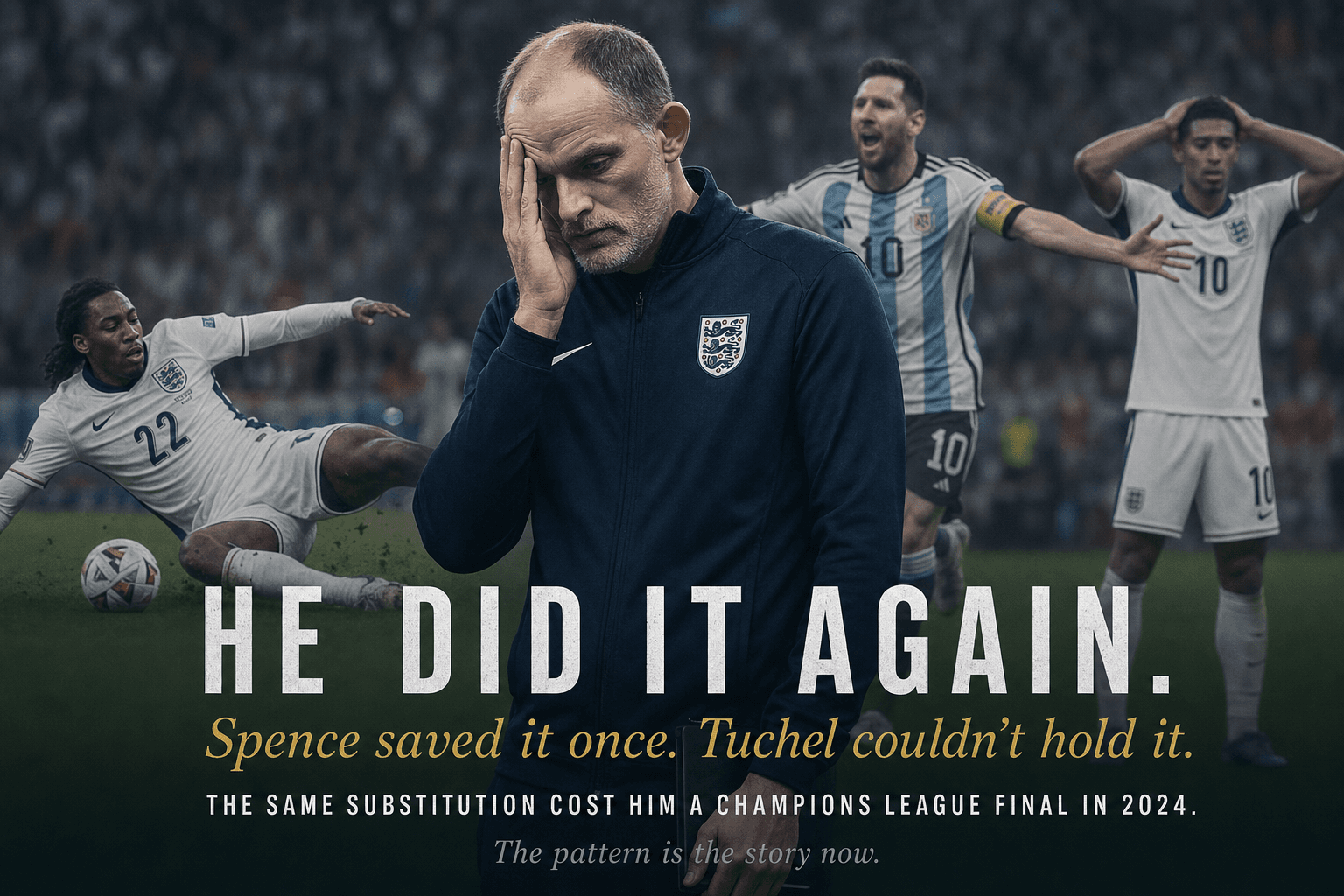
England were the better team for fifty-five minutes against Argentina at Mercedes-Benz Stadium in Atlanta. Anthony Gordon's 55th-minute opener had put genuine belief into a fiery, foul-filled World Cup semi-final, and for the first time all tournament, Lionel Messi's Argentina looked rattled. Then England scored, and immediately stopped playing like a team that believed they could be dominating the World Champions with that scoreline. Three minutes later, Argentina carved a clean chance through the middle, and only a genuinely world-class sliding tackle from Djed Spence, timed to perfection to deny Giuliano Simeone one-on-one in the box, prevented an instant equaliser. BBC pundit Paul Robinson called it the tackle of the tournament. England never recovered their nerve after that moment. As we documented in our piece on how Tuchel built the best version of Bellingham this tournament, England's semi-final run was built on courage and knockout-stage nerve. Against Argentina, in the moment that actually mattered most, that courage evaporated, and the manager who is supposed to be the one instilling it is the specific reason why. Argentina won 2-1, through Enzo Fernández's 85th-minute strike from twenty yards and Lautaro Martínez's stoppage-time header, both created by Messi, and England's World Cup was over.
Twelve Per Cent Possession: What Happened After the Goal
The numbers from Atlanta are genuinely damning, and they are not an exaggeration. ESPN's post-match data showed that from the moment Gordon's goal went in to Martínez's stoppage-time winner, England had just twelve per cent possession. Across the full match they managed 35 per cent of the ball and five shots in total. That is not a defensive gameplan. That is a team that has stopped trying to play football, sitting so deep and so passively that Messi, Julián Álvarez and Argentina's midfield were simply allowed to camp in England's half for the better part of thirty-five minutes, probing for the moment England's low block would eventually crack. Jordan Pickford kept England alive with saves from Nico González and Alexis Mac Allister, but Argentina's equaliser, when it came through Fernández in the 85th minute, felt less like a breakthrough and more like an inevitability that had been building since the fifty-fifth minute, the specific consequence of a team that decided defending a one-goal lead meant abandoning every attacking principle that had carried England through Mexico and Norway, matches documented in our pieces on the ten-man win at the Azteca and the Norway quarter-final. England had shown throughout this tournament that they could defend with genuine conviction when required. What happened against Argentina was not conviction. It was retreat.
The Substitutions That Killed the Momentum
The specific decisions this piece exists to interrogate came in two waves, and ESPN's breakdown of the substitutions laid them out precisely. In the 72nd minute, with England still leading, Thomas Tuchel withdrew Anthony Gordon, his goalscorer and most direct attacking outlet, and sent on centre-back Ezri Konsa, shifting England into a 5-3-1-1. Ten minutes later he doubled down, taking off Reece James and Declan Rice for Dan Burn and Nico O'Reilly. By the closing stages England had six defenders on the pitch and almost no pace left for the counter-attack. It was the passive option. It was the safe option. It was, in the specific context of a World Cup semi-final his side were winning, the cowardly option, and Argentina's two goals arrived after it. Instead of asking his team to see out a lead by continuing to attack, Tuchel effectively told his players the lead was something to be protected rather than extended, and a team of Bellingham, Kane, and Rice's calibre visibly lost belief in the same passage of play the substitutions were supposed to stabilise. Alan Shearer put it bluntly on BBC coverage: England had six defenders on the pitch, and Tuchel had played his hand and wanted to hang on. Wayne Rooney went further, arguing the players themselves will have lost belief the moment they saw those changes being made.
England led. England dominated. Then one Argentina chance, the Simeone run that Spence's heroics erased, instilled fear into them, and that was the moment England decided to sit back. Instead of reversing the retreat, Tuchel took off his own goalscorer for a centre-back, followed it with two more defensive changes, and finished a World Cup semi-final with six defenders on the pitch. Argentina scored twice. This was not the first time. It happened at Bayern Munich against Real Madrid too, and the result was identical: a lead protected into nothing, then lost entirely.
Bayern, Kim Min-jae, and the Pattern Nobody Learned From
Tuchel's specific tactical instinct in these exact moments has a documented history, and it did not begin against Argentina. On May 8, 2024, Tuchel's Bayern Munich led Real Madrid 1-0 on the night through an Alphonso Davies goal in the Champions League semi-final second leg, needing only to hold that lead to reach the final. In the seventy-sixth minute, with Bayern still ahead and the tie still very much alive, Tuchel withdrew Leroy Sané, an attacking outlet, and introduced Kim Min-jae, a central defender, shifting Bayern to five at the back. He followed it by removing Harry Kane and Jamal Musiala in the closing stages too, later explaining that fitness concerns across his front four had forced his hand. Former Bayern midfielder Owen Hargreaves, as Sky Sports reported at the time, called the Kane change the biggest substitution he had ever seen in a game of that magnitude. Whatever the justification, the practical effect was the same one that occurred against Argentina: Bayern stopped pushing forward, Real Madrid grew into the game, and substitute Joselu scored twice in the final minutes to send Carlo Ancelotti's side through to the final at Bayern's expense. As we detailed in our piece on the complete Tuchel vs Ancelotti head-to-head record, that specific 2024 semi-final is precisely the kind of match that keeps Tuchel's record against elite opposition looking worse than his overall reputation suggests. The Argentina semi-final was not an isolated lapse in judgement. It was the same pattern, in a different shirt, against a different opponent, with the same outcome.
Tuchel's Own Words Made It Worse
Tuchel's post-match explanation deserves to be quoted precisely, because it concedes the core of the criticism while trying to deflect its target. He admitted England "got too passive" after scoring, and insisted the retreat began before his changes: "We sat deep straight away after our goal, not after the substitutions." He added that "it's not a matter of structure, you can defend actively in any formation," and that it is "easy to say that it was wrong" in hindsight. But that defence collapses under its own logic. If Tuchel could see his team sitting too deep from the fifty-fifth minute onwards, the manager's job in that moment is to reverse it, with fresh attacking legs, with a substitution that signals intent, with anything other than confirmation. Instead, every change he made deepened the exact passivity he now says he had already identified. A manager who diagnoses the illness in real time and then prescribes more of it has not been unlucky. He has made a choice.
What Tuchel Was Actually Brought In to Do
England hired Tuchel with one explicit brief: win the World Cup, and in doing so, join the exclusive list of managers who have won both the Champions League and the World Cup, a list we detailed in full in our piece on the managers who have achieved football's rarest double. He arrived with a Champions League title already on his CV from Chelsea in 2021, an 18-month contract running specifically to the end of this tournament, and the historical opportunity to join Marcello Lippi and Vicente del Bosque as only the third man to complete both parts of that equation. Instead, England's tournament ends at the semi-final stage, the exact same position reached by managers with considerably less individual pedigree and considerably smaller salaries than the reported £5 million a year the FA committed to Tuchel. Reaching a World Cup semi-final is not, by itself, evidence of elite management. The specific question England's federation now has to answer is whether a manager hired explicitly to clear the bar that lesser managers have already cleared has actually delivered value proportionate to that investment, or whether the same specific in-game passivity that cost him a Champions League final appearance with Bayern has simply followed him to international football and cost England a World Cup final appearance too.
What Comes Next for Tuchel and England
The specific conversation English football now has to have is uncomfortable but necessary, and the calendar forces it quickly: Tuchel's contract was structured to expire after this World Cup, meaning the FA's decision is not whether to sack him but whether to actively renew him. England still have a third-place playoff against France to play before the tournament ends, while Argentina advance to face Spain in Sunday's final at MetLife Stadium, a meeting we previewed in our piece on Messi, the Ballon d'Or, and the teacher-student final. Tuchel built genuine improvement in this England side across the tournament, documented in detail in our piece on Bellingham's transformation under his management. But the specific moments that decide World Cup semi-finals, the ones requiring courage rather than caution, are precisely the moments in which Tuchel has now twice, at the highest level available to him, chosen the passive option and watched his team pay for it immediately afterward. Whether the FA views the Argentina defeat as an aberration or as confirmation of a deeper pattern will determine whether Tuchel remains in position for the next cycle. The Bayern precedent suggests it is not an aberration. It is exactly who he is when the stakes are highest and the safe decision is available.
What the Dressing Room Actually Needed in That Moment
The specific football logic Tuchel's substitutions ignored is worth stating plainly. Argentina, chasing the game, were always going to commit numbers forward as the clock ran down regardless of what England did. The specific space that creates, in behind a high defensive line pushing bodies into England's box, is exactly the space a fresh, direct attacker exploits on the counter. Taking off Gordon removed England's single best tool for punishing that exact space, at the exact moment it was about to open up most, with Bukayo Saka, Marcus Rashford and Ollie Watkins all available on the bench and none of them used until the game had already turned. A fresh runner in behind Kane would have kept Argentina honest, forced Scaloni to hold defenders back, and made the equalising push considerably more difficult to construct. Instead, Tuchel's changes told Argentina's back line they had nothing to fear in behind, freeing every outfield player to commit to the search for an equaliser without consequence. Rice's withdrawal compounded it, removing England's best outlet for relieving pressure just as the pressure peaked. Bellingham and Foden were left isolated, chasing a game England were still nominally winning, with no outlet and no reinforcements coming.
The Specific Psychology of a Passive Substitution
Beyond the pure tactics, there is a psychological dimension to this specific kind of change that deserves attention. A team leading a World Cup semi-final, watching their own manager withdraw the goalscorer in favour of extra defensive cover, receives an unmistakable message: the manager does not trust this lead to hold through continued attacking pressure, and believes the safer path is retreat. That message filters through a squad instantly, whatever the players say publicly afterward, and Rooney's post-match assessment named it directly. England's collapse into a twelve per cent possession shell immediately following the substitutions was not simply the tactical consequence of one fewer attacker on the pitch. It was the psychological consequence of watching their own manager blink first, in the exact moment a World Cup final was within reach, with Messi on the opposite side waiting to punish exactly that hesitation.
Tuchel took off attackers for defenders while leading 1-0, twice, in two of the biggest matches of his career, and lost both times. Should England move on from Tuchel after this World Cup? Tell us below.