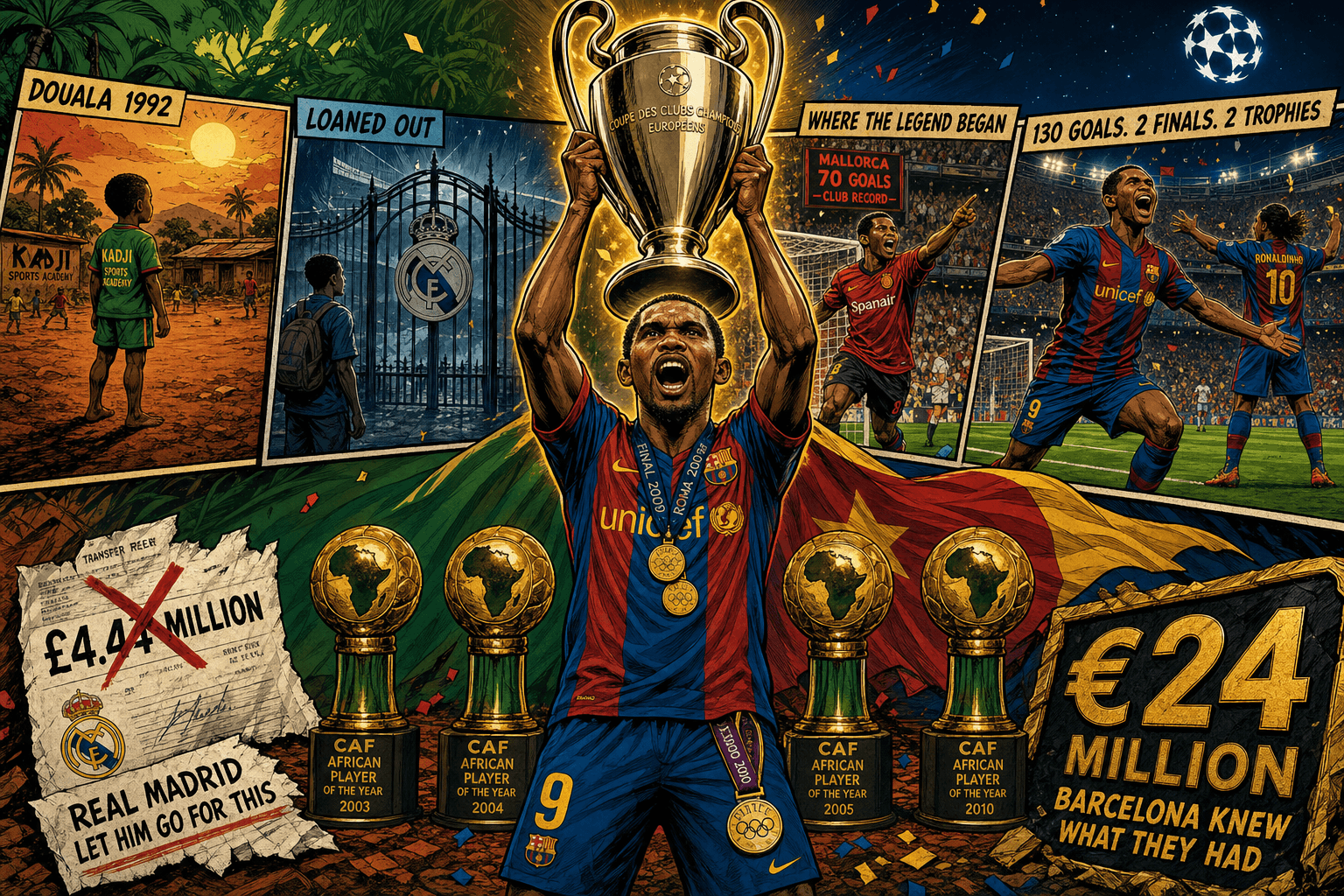
There is a version of this story where Samuel Eto'o never makes it. Where the boy from Douala gets lost in the system — loaned to clubs that don't want him, blocked by regulations he didn't write, discarded by a club that didn't understand what they had. Where the greatest African footballer of his generation disappears into the lower divisions of Spanish football and nobody notices. That version came close. But it didn't happen — because no bureaucratic obstacle ever moved faster than the talent trying to get past it.
Douala, 1992: The Beginning at Kadji
Samuel Eto'o Fils was born on 10 March 1981 in Douala, Cameroon. In 1992, at the age of eleven, he enrolled at the Kadji Sports Academy in Douala — the most prestigious sporting institution in the country, a production line of Indomitable Lions that had sent players across continents for decades. He trained there for four years. By 1996, at fifteen, he was playing for UCB Douala in the second division of Cameroonian football, and in the 1996 Cup of Cameroon, he was making opponents uncomfortable in ways that fifteen-year-olds rarely do.
Real Madrid were watching. On 9 March 1997 — one day before his sixteenth birthday — Eto'o made his senior international debut for Cameroon in a friendly against Costa Rica. Hours before that match, he was already contracted to one of the biggest clubs on the planet.
Madrid, 1997: The Boy and the Bureaucracy
In 1997, sixteen-year-old Samuel Eto'o flew to Spain. Real Madrid had signed him into their famous La Fábrica youth system — alongside teenagers who would become household names across European football. The problem appeared almost immediately. He could only train with Real Madrid B, as he was still a minor. Real Madrid B were relegated to the Segunda División B — the third tier of Spanish football — where non-European Union players were not permitted to play under Spanish regulations. Eto'o had made it to Real Madrid. He could not play for Real Madrid.
The solution was a loan. For the 1997-98 season, while still in the tenth grade, Eto'o was sent to CD Leganés — a second-division club — where he made 30 appearances and scored four goals. It was not the platform anyone had imagined. He returned to Madrid. In January 1999, he was loaned again, this time to Espanyol, where he made a single Copa del Rey appearance. One game in eighteen months.
The system was stacked against him. The talent was growing faster than the obstacles.
Real Madrid signed Eto'o at sixteen. They loaned him to three clubs. They sold him permanently for £4.4 million. Four years later, Barcelona paid €24 million for the same player. The gap between those two numbers is the gap between seeing something and understanding it.
Mallorca, 2000: Where the Legend Was Actually Born
In January 2000, Real Madrid loaned Eto'o to RCD Mallorca. The island club — not a powerhouse of European football, not a club on any teenager's dream list — gave him a pitch, a shirt, and consistent minutes. He scored six goals in 19 games. At the end of the season, Mallorca signed him permanently from Real Madrid for a club record £4.4 million. That figure — the most Mallorca had ever spent on a single player — tells you exactly what they had seen. Real Madrid, meanwhile, let him go without hesitation.
What followed across the next four seasons was relentless. In his second permanent season he scored 11 goals and began attracting attention across La Liga. By 2002-03 he had scored 14 goals in the league and 19 across all competitions — and in the Copa del Rey final against Recreativo de Huelva, he scored twice as Mallorca won 3-0 to claim the first major trophy in the club's history. A seven-metre mural of Eto'o still stands on the outside wall of their stadium today. He reportedly paid for supporters to travel to the final out of his own pocket.
By 2003-04 he had scored 17 La Liga goals. He departed Mallorca as their all-time leading scorer with 70 goals in 165 appearances — including 54 in the domestic league, a club record that still stands. He had transformed a club-record loan fee into a club-record signing, and then into one of the most productive striker spells any mid-table Spanish club had ever seen.
Between 2003 and 2005, simultaneously, Samuel Eto'o won the African Player of the Year award three consecutive times. He would win it again in 2010. Four wins. Still the joint record alongside Didier Drogba.
Barcelona, 2004: Madrid's Mistake Becomes Barça's Masterpiece
In the summer of 2004, Barcelona signed Samuel Eto'o for €24 million after lengthy three-way negotiations involving Mallorca, Barcelona, and Real Madrid. Florentino Pérez initially wanted to buy back the full transfer rights and loan Eto'o out again — but the Barcelona offer was too substantial, and Real Madrid's squad was already at its quota of three non-EU players. Madrid stepped aside. Barcelona signed one of the finest strikers in the world at a market rate that, four years earlier, had seemed generous at £4.4 million.
At the Camp Nou, alongside Ronaldinho — the best player on the planet at that moment — Eto'o became something beyond a goalscorer. He became the engine of the most entertaining attacking unit in world football. La Liga title in 2005. Champions League in 2006 — Eto'o scored in the final. La Liga title again in 2006. Then in 2008-09, part of the front three of Messi, Eto'o, and Thierry Henry that scored exactly 100 goals between them in a historic treble season — La Liga, Copa del Rey, and Champions League. In the final against Manchester United, Eto'o scored the opening goal. Barcelona won 2-0.
Five seasons. 130 goals. Three La Liga titles. Two Champions Leagues. The record for the most appearances by an African player in La Liga history. And the distinction, confirmed by UEFA, of being the second player in Champions League history to score in two different finals.
After the 2004-05 title win, Eto'o led the Camp Nou in chanting something unprintable in the direction of Real Madrid. The Spanish Football Federation fined him €12,000. He apologised. The sentiment, from a man who remembered exactly what it felt like to be a teenager sitting on Real Madrid's bench with nowhere to play, was entirely understandable.
Inter Milan, 2009-10: The Record Nobody Else Has Touched
In the summer of 2009, Barcelona sold Eto'o to Internazionale in a swap deal that brought Zlatan Ibrahimović to the Camp Nou. At Inter, under José Mourinho, Eto'o entered the most improbable chapter of a career already full of them. In 2009-10, Inter won Serie A, the Coppa Italia, and the Champions League — the European treble. Eto'o made 44 appearances across all competitions, the joint-most of any Inter player that season. He had won the treble with Barcelona the season before. He had won it again with Inter the season after.
He became the first player in football history to win two European trebles in consecutive seasons with two different clubs. That record has never been equalled. Nobody has come close.
The Numbers That Do Not Lie
The statistical summary of Samuel Eto'o's career does not require embellishment. 118 caps for Cameroon. 56 international goals — his country's all-time leading scorer. 18 goals in the Africa Cup of Nations — the competition's all-time record, a mark that still stands. AFCON winner in 2000 and 2002. Olympic gold medallist in 2000, when Cameroon became the first African team to win Olympic football gold. African Player of the Year four times. Two Champions League winner's medals. Three La Liga titles. One Serie A. The first player to win two European trebles.
After retiring, he returned home. In December 2021, Samuel Eto'o was elected president of the Cameroonian Football Federation. The boy from Douala who was too young to play for Real Madrid B went home to run football across his entire continent.
The Real Story
The version that nearly happened — the one where the system wins and the loaned teenager fades into the lower divisions — never came close to what actually did. Because Eto'o was not a player who waited for the right conditions. He was a player who made the conditions right wherever he found himself. Leganés. Espanyol. Mallorca. Barcelona. Inter Milan. He gave everything, completely, to every club that gave him a pitch and a shirt.
Real Madrid let him go for £4.4 million. Barcelona won the Champions League with him for €24 million. The gap between those two numbers is the gap between seeing something and understanding it. Eto'o always understood. He was just waiting for everyone else to catch up.
Samuel Eto'o is the greatest African footballer of his generation — but where does he rank among the all-time great strikers? And who do you think is the best African player in the world right now? Let us know in the comments. 👇