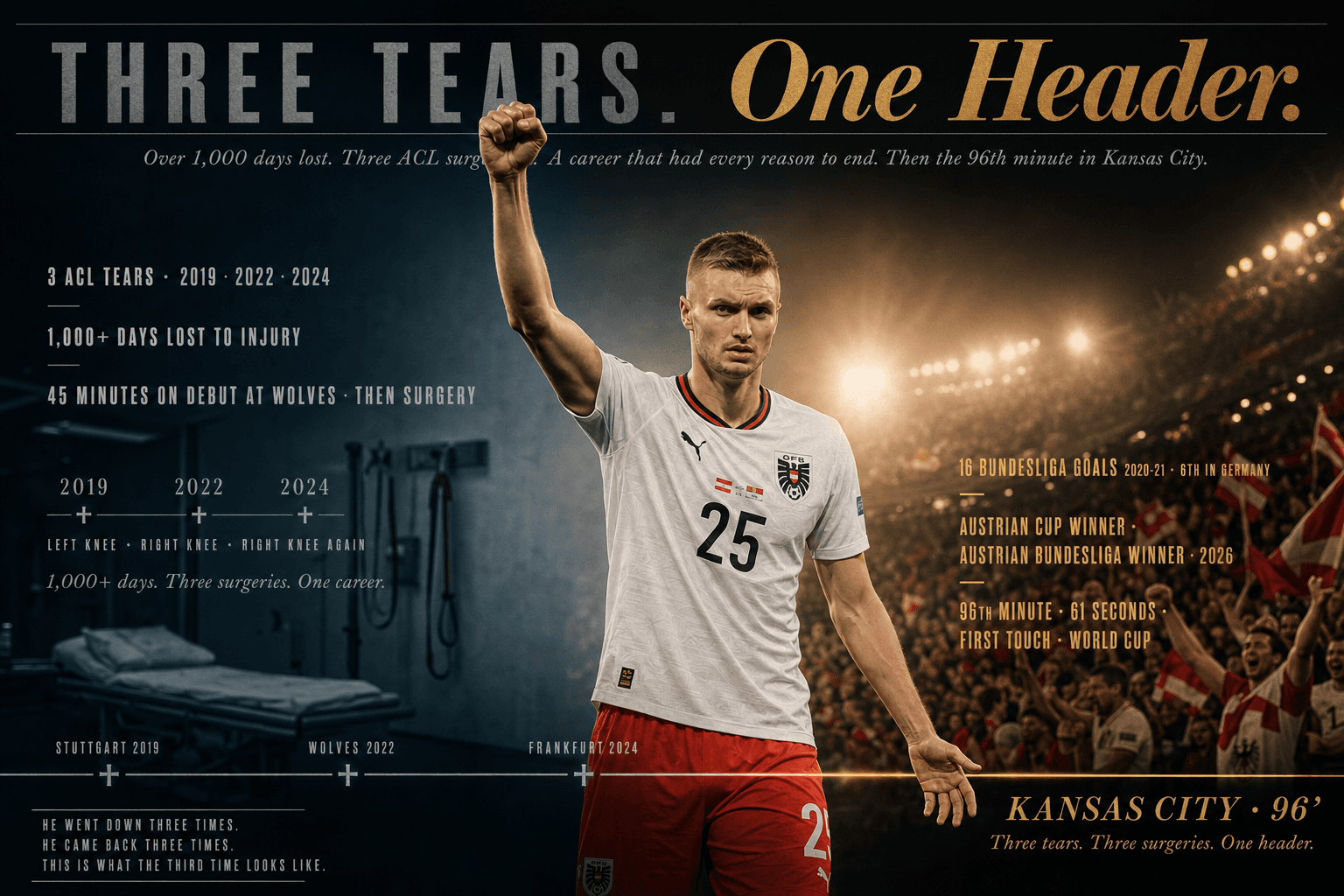
The 96th-minute header is told in full in our piece on Kalajdžić's World Cup miracle and what it means for Austria. This piece is different. This piece is the story that makes the header possible — three anterior cruciate ligament tears in five years, over one thousand days lost to injury, a career that had every reason to be over before the World Cup began. Sasha Kalajdžić is 28 years old. He is currently preparing to face European champions Spain in the World Cup Round of 32. He should, statistically, not be here at all.
The Beginning: Donaufeld, Admira, and the Foundation Nobody Saw
Saša Kalajdžić was born on 7 July 1997 in Vienna, to a family with Austrian and Serbian heritage that shaped both his nationality choices and the cultural identity he carries into every squad he joins. He began in the lower tiers of Austrian football at SR Donaufeld Wien — the kind of starting point that produces almost no one who ends up playing in the Bundesliga, let alone the Premier League. His progress through the Austrian pyramid was rapid enough to earn a move to Admira Wacker Mödling, where he scored 12 goals and registered 12 assists over his time in Austria's top division. The combination of aerial dominance and technical quality — two good feet, intelligent link-up play, a natural ability to bring teammates into dangerous areas — was evident from the start. The Bundesliga article that ran on him at the height of his Stuttgart fame quoted Borussia Dortmund coach Edin Terzic: "It feels like he reaches four or five metres in the air. He rises above the opposition like they're not even there."
The move to VfB Stuttgart in July 2019 was the next step. It began immediately with the first disaster. Within weeks of signing, during pre-season training, Kalajdžić suffered a cruciate ligament tear in his left knee. Surgery. Rehabilitation. He did not make his Stuttgart debut until May 2020 — almost a year after he had signed for the club. At that point, a less resilient player's career at Stuttgart might have stalled into peripheral roles and gradual irrelevance. Kalajdžić went the other way.
Stuttgart 2020-21: The Season That Made the World Notice
The 2020-21 Bundesliga season was Kalajdžić's announcement. He finished the season as the sixth-highest scorer in the Bundesliga with 16 goals — helping Stuttgart, a side fighting relegation for much of the campaign, finish ninth in the table. The context of those 16 goals matters enormously: in a team that was struggling, without the supporting cast or tactical sophistication of the sides above them, Kalajdžić was outscoring almost every striker in Germany's top flight.
The company he kept in that scoring table puts his numbers in precise perspective. The players who scored more than Kalajdžić's 16 Bundesliga goals that season were Robert Lewandowski, André Silva, Thomas Müller, Wout Weghorst, Erling Haaland, and Andrej Kramaric. Every single one of those players was valued at over €19 million at the time. Kalajdžić was valued at €8.6 million — a bargain-basement price for a striker who was performing at the level of the most expensive forwards in European football. The arbitrage between his output and his valuation was the specific signal that made Premier League and top European clubs take notice.
For comparison: Wout Weghorst was in that scoring company while at Wolfsburg, before his own complicated journey to Burnley and Manchester United. We documented Weghorst's story in our piece on how Burnley turned his loan into profit through intelligent player trading. The Bundesliga striker who moves to England and faces identity questions about whether the Premier League environment suits their specific profile — Kalajdžić and Weghorst are different players with a shared experience of that specific scrutiny. The difference is that Kalajdžić's Premier League story began with a different kind of obstacle entirely.
The Wolves Move: The Day Everything Changed
By the summer of 2022, interest in Kalajdžić was substantial. Wolverhampton Wanderers moved fastest and most decisively, signing him on August 31, 2022 on a five-year contract for a reported £15 million — a fee that felt like a bargain given what he had produced at Stuttgart. He was 25, he had just helped Stuttgart survive relegation with crucial goals across two difficult seasons, and he was ready to prove that his Bundesliga output was genuinely reproducible at a higher level.
His debut at Molineux was against Southampton. He played the first half — approximately 45 minutes. He felt something in his knee. He was substituted. The initial hope was that it was minor. It was not. The diagnosis came back: an anterior cruciate ligament tear, this time in his right knee. His second ACL injury in three years. The £15 million signing was unavailable for the rest of the 2022-23 season. Over 600 days of absence lay ahead. Surgery, recovery, the long months of rehabilitation that every athlete who has suffered an ACL tear describes as more psychologically taxing than anything the physical recovery demands — the constant management of expectations, the setbacks in the recovery timeline, the slow return of confidence in a joint that has been surgically reconstructed twice in five years.
The Wolves fanbase never fully got to judge him. He was a name on a shirt, a statistic in a squad list, and a presence in the treatment room for the better part of a year before anyone at Molineux had seen enough of him to form a view. By the time he came back, the context around the club had changed, the squad dynamics had shifted, and the player returning from a long ACL rehabilitation is never quite the same player who left.
The Return, the Frankfurt Loan, and the Third ACL
Kalajdžić returned to action in August 2023. He scored for Wolves against Everton in a Premier League win — a late winning goal that earned Gary O'Neil's side their first three points of the season. He followed it with two more goals in 13 appearances. Three goals, limited minutes, the sense of a player trying to rebuild form and rhythm in an environment that could not give him the consistency of starts he needed to genuinely rediscover his Stuttgart level.
In January 2024, Wolves sent him to Eintracht Frankfurt on loan for the remainder of the season. He scored for Frankfurt in the Conference League on February 15 against Union Saint-Gilloise. Three days later — February 18, 2024, in a Bundesliga match against SC Freiburg — he went down again. A third ACL tear, this time in his right knee alongside a lateral collateral ligament tear. Over one thousand days total across his three injuries. The longest consecutive spell of uninterrupted fitness he had managed at a top club was measured in months rather than years.
The accumulation of three ACL injuries across five seasons of professional football at the highest level is not merely an unfortunate sequence of bad luck. It represents a fundamental challenge to the physical architecture of a career. Scouts who might have signed him after the Stuttgart season began to factor in the injury risk. Clubs that had been interested revised their assessments. The player who was valued at €8.6 million despite outscoring almost everyone in the Bundesliga had become a player whose medical file was as long as his highlights reel.
Three anterior cruciate ligament tears. Over one thousand days lost. A career that should have been built on Stuttgart's 16-goal season and instead became a story of surgical reconstruction and slow return. And then, in the 96th minute of a World Cup group stage match with Austria 3-2 down and heading out, he came on and headed them through with his first touch 61 seconds later. This is what a thousand days of recovery looks like when it finally arrives.
LASK, Austria, and the Season That Rebuilt Everything
The 2025-26 season before the World Cup was the final chapter of the recovery. Wolves sent Kalajdžić on loan to LASK — an Austrian Bundesliga club, a level below where his Stuttgart season had placed him in conversations about European strikers, but the exact environment he needed to rebuild match fitness, confidence, and the kind of sustained run of games that three ACL tears had made impossible.
At LASK he scored 6 goals and provided 5 assists across 1,323 minutes in the Austrian Bundesliga — an average rating of 7.2 across the season. More significantly, he won both the Austrian Cup and the Austrian Bundesliga title with LASK in 2025-26. Two pieces of silverware. The first major trophies of his club career. In a season where his primary objective was to prove his body could handle the demands of consistent professional football — to log enough minutes without a fourth injury that Austria's World Cup selection became a realistic conversation — he not only stayed fit but won things.
He scored in the Austrian Cup in January 2026. He scored a brace against TSV Hartberg in April 2026 — one from his own half, a 50-yard strike that the Austrian football media circulated for weeks — and provided an assist in a 5-1 win. Ralf Rangnick watched the season. He saw a player who had physically returned. He selected him for the World Cup squad. And when Austria needed a miracle in the 96th minute against Algeria in Kansas City, he knew exactly who to send on.
The National Team Thread: From Romania to Italy to Kansas City
The club career does not tell the complete story of who Kalajdžić is as a footballer. His international career runs parallel to the injury timeline — a separate thread where the peaks have consistently come in the highest-pressure moments. His senior debut came in October 2020 against Romania in the Nations League, as a substitute in a 1-0 win. He scored twice on only his second Austria start, in a 2022 World Cup qualification match against Scotland. He scored at Euro 2020 against Italy in the Round of 16 — a goal that came in extra time of a 2-1 defeat to the eventual tournament winners, a significant goal in an important match against a top opponent. The pattern of Kalajdžić delivering in moments that matter is not new. Kansas City was the most extreme version of a capability that has been evident across his entire international career.
The career path — from SR Donaufeld to Admira Wacker to Stuttgart to Wolves to Frankfurt to LASK to a World Cup Round of 32 against Spain — is not the path anyone designing a striker's career would have drawn. Three ACL tears should not produce a World Cup hero. A £15 million transfer that began with a 45-minute debut and ended in a surgical suite should not produce a player with the confidence to score a headed equaliser in the 96th minute of the most important match of his country's football year in over four decades. It did. That is the specific, irreducible quality of Saša Kalajdžić. He went down three times. He came back three times. And the third time he came back, he was ready for this.
The full tactical breakdown of what Austria need to do against Spain on 2 July is covered in our Austria vs Spain Round of 32 preview at SoFi Stadium. The short version relevant to Kalajdžić specifically: set pieces are Austria's most realistic route to a goal, Kalajdžić's aerial threat against Spain's high defensive line is the specific weapon Rangnick will be planning around, and the script of the tournament says you do not write off a player who scored in the 96th minute the last time you expected him to come on and do nothing.
Kalajdžić suffered three ACL tears and missed over 1,000 days of football before heading Austria's World Cup equaliser in the 96th minute. Who is the most remarkable comeback story at the 2026 World Cup — and can Kalajdžić add another chapter against Spain on July 2? 👇