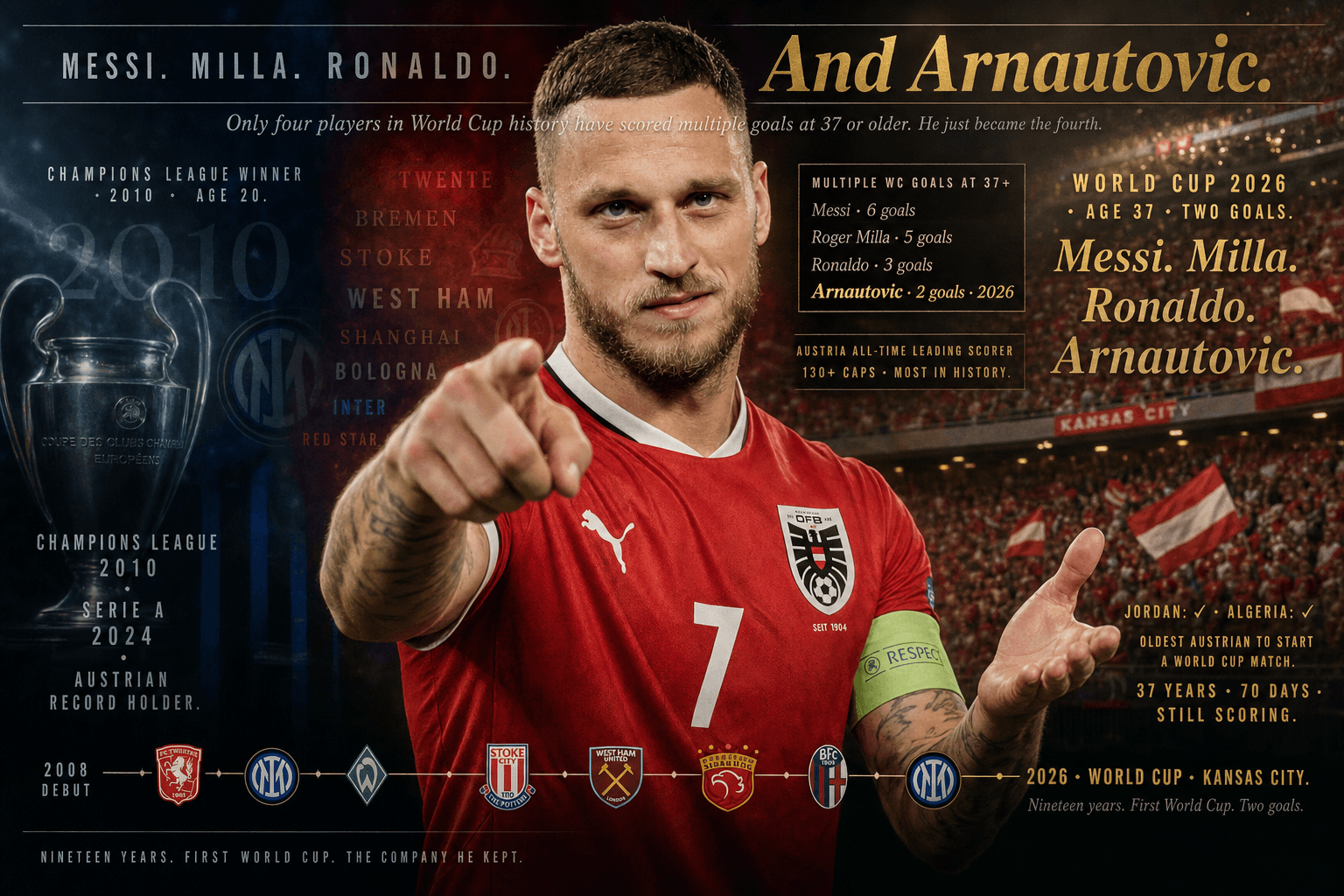
The list reads like a hallucination. The players who have scored more than one World Cup goal at the age of 37 or older, across the entire history of the tournament: Lionel Messi, with six. Roger Milla, the Cameroonian legend who came out of retirement at 38 to score at the 1990 and 1994 World Cups, with five. Cristiano Ronaldo, with three. And now Marko Arnautovic, the Austrian striker who was born in Vienna in 1989, won the Champions League under José Mourinho at 20, spent his career travelling between the Netherlands, Italy, Germany, England, China, Italy again, and Serbia — and arrived at his first World Cup at the age of 37 to score two goals in two different group stage matches and confirm his place in the most exclusive company the tournament can offer.
The Messi-Milla-Ronaldo Stat: Why It Matters
The specific Opta statistic — only Messi, Roger Milla, and Ronaldo have scored multiple World Cup goals at 37 or older; Arnautovic became the fourth player in history to do so in June 2026 — deserves to sit alone for a moment before the career around it is explained. Roger Milla scored five goals across 1990 and 1994 in some of the World Cup's most celebrated individual performances of the modern era. Ronaldo scored three at the 2022 World Cup in Qatar. Messi has scored six. These are not comparable players. They are, collectively, the most decorated forwards the sport has ever produced. And Arnautovic's name is now in the same sentence.
His first goal came on June 17 against Jordan — a stoppage-time penalty that confirmed Austria's 3-1 win in their group opener. His second came on June 28 against Algeria, in the 28th minute, from David Alaba's perfectly weighted lofted pass over the top of the Algerian defensive line. Arnautovic ran in behind, controlled, and finished with the clinical confidence of a striker who has been scoring goals in professional football for nearly two decades. He was 37 years and 70 days old when he started against Algeria — the oldest Austrian ever to start a World Cup match, breaking a record previously held by Michael Konsel from 1998.
The Career Nobody Could Have Predicted
Marko Arnautovic's career resists simple categorisation. He has been, at various points: one of the most exciting young strikers in Europe; a frustrating talent who failed to match his ability with consistency; a Premier League cult figure; a Chinese Super League exile; a Serie A veteran; and now a World Cup scorer at 37 with the weight of Austrian football history on his back. The journey between those descriptions contains almost everything that makes football worth writing about.
He joined FC Twente from Vienna as a teenager and won the Dutch Eredivisie title in 2009-10 — the last time a club other than Ajax or PSV won the Dutch title for years. From there he moved to Inter Milan, where José Mourinho's side was completing the most dominant season in Italian and European football — Serie A champions, Coppa Italia winners, and the Champions League, beating Bayern Munich in the final in Madrid. Arnautovic was 20 years old and had a Champions League winner's medal before most of his contemporaries had established themselves in their domestic leagues.
Werder Bremen followed, then Stoke City in the Premier League, then West Ham. At West Ham, where he arrived for £20 million in 2017, Arnautovic won the Hammer of the Year award in his debut season — the supporter-voted prize for the club's best player — and scored 22 goals in 65 appearances across two seasons. The West Ham period was the clearest evidence of the specific player Arnautovic is: physically imposing, technically capable, able to dominate games in a way that relied on neither pace nor relentless pressing but rather an intelligent use of his 6ft 4in frame and the sheer quality of his touch. When his motivation was high and the club structure around him was functional, he was outstanding. When it was not, he could seem peripheral.
Shanghai, Bologna, Inter — and the Promise to Mihajlović
The move to Shanghai SIPG for £22.4 million in 2019 drew predictable criticism from those who measure career ambition by the league name rather than the financial decision. Arnautovic scored on his debut in China and continued scoring throughout a spell that was more successful on its own terms than the commentary around it suggested. He returned to Europe and signed for Bologna in August 2021 — a move that, in retrospect, was the turning point in the final chapter of his career.
At Bologna, under Siniša Mihajlović, Arnautovic found the environment he had been searching for. Mihajlović — the former Red Star Belgrade and Serbia midfielder who had been managing through leukaemia with extraordinary public courage — built a relationship with Arnautovic that went beyond football. Their connection was personal, shared, and defined by the kind of trust that produces the best performances from a player of Arnautovic's specific character. Mihajlović died in December 2022, having fought his illness publicly and with remarkable dignity. When Arnautovic signed for Red Star Belgrade in July 2025, he revealed in the press conference that the transfer fulfilled a promise he had made to Mihajlović — who had won the 1991 European Cup at Red Star and wanted his friend to experience the club. The emotional weight of that commitment is not a footnote. It is the explanation for a career decision that no straightforward financial or sporting logic could fully account for.
At Inter Milan — first on loan in 2023-24, then permanently — Arnautovic contributed to another Serie A title, playing as a rotational forward in a squad that contained Lautaro Martínez and Marcus Thuram as the primary attacking pair. He scored his first Champions League goal with Inter in a 3-3 draw at Benfica in November 2023. He was 34 years old and scoring in the Champions League. Man United, who had bid £7.6 million for him at Bologna the previous summer only to be rejected by the Italian club, were watching a player whose European calendar had been richer than anything that particular offer reflected.
Arnautovic won the Champions League at 20. Scored on his debut at West Ham at 28. Scored in the Champions League at 34. Became Austria's all-time leading scorer at 36. Scored two World Cup goals at 37. The career arc that could only belong to him — and the place it has finally arrived.
Austria's All-Time Record: The Number He Finally Reached
The Austrian record that Arnautovic broke in October 2025 deserves its own paragraph. On 9 October 2025, in a 2026 World Cup qualifying match against San Marino, Arnautovic scored four goals in a 10-0 Austrian victory. The fourth goal took him past Toni Polster's long-standing record as Austria's all-time leading scorer. He was 36 years and 173 days old. He had waited nearly eighteen years of international football — 130-plus caps, every major European Championship since 2016, the full weight of Austrian expectations — to stand alone at the top of his country's goalscoring history. The record came against San Marino, in a 10-0 win, with all the anti-climactic practicality of record-breaking in qualification football. He did not care. He celebrated as if it were the World Cup final.
His most-capped record had come three years earlier — September 2022, against Croatia, his 104th appearance breaking Andreas Herzog's previous mark. Arnautovic became the first player in Austrian history to hold both records simultaneously: most caps and most goals. The combination is not common among international footballers. It requires not merely talent but the specific durability and consistency to maintain an international place across nearly two decades of squad competition, injury, form fluctuation, and the natural rotation that happens as younger players emerge. He has maintained it throughout.
The Two Different Heroes of Kansas City
Against Algeria, the match that confirmed Austria's knockout stage qualification — told in full in our piece on Kalajdžić's 96th-minute miracle — the two moments that defined Austria's campaign were provided by players at opposite ends of their careers. Arnautovic, 37, started and scored in the 28th minute. Kalajdžić, 28, came on in the 90th minute and scored 61 seconds later. One man near the end of a career that has encompassed Champions Leagues, Premier League cult status, a promise to a dead friend, and the rewriting of his country's records. One man in the middle of a career that three ACL tears could not end, returning from Austrian Bundesliga football to score a World Cup header. Different stories, same result. Austria through. Austria history made.
The Round of 32 against Spain — covered in full in our Austria vs Spain tactical preview at SoFi Stadium — is Arnautovic's final opportunity to add to the Messi-Milla-Ronaldo scoring company he has joined. Spain have not conceded a World Cup goal in this tournament. Arnautovic has scored in both of the matches he has contributed to. At 37, playing at his first World Cup in his nineteenth year of international football, the question of what is possible for him this summer has become genuinely interesting.
Roger Milla, for context, scored his most celebrated World Cup goal — his dance by the corner flag after scoring against Colombia — at the age of 38. If Arnautovic needs a precedent for continuing this run against Spain, the list he has just joined contains exactly the kind of player who shows it is possible.
What He Means to Austrian Football: Beyond the Numbers
The conversation about Arnautovic in Austria has never been simple. He is simultaneously the greatest player the country has produced in the modern era and the most frustrating — a player whose talent was consistently evident and whose consistency was consistently questioned. The Premier League period generated the clearest version of that tension: moments of genuine brilliance at Stoke and West Ham alternating with periods where his application appeared to wane, where his body language suggested he was somewhere other than the pitch mentally.
What the final chapters of his career have produced — the Bologna relationship with Mihajlović, the Inter Serie A title at 34, the broken records, and now the World Cup goals at 37 — is a correction of the narrative that the inconsistency years threatened to write permanently. The player who might have been defined by what he did not achieve relative to his talent is instead being defined by what he has achieved past the age when most players of his profile have retired or declined into bit-part roles.
Rangnick, who manages with extreme precision around player motivation and squad culture, has found in Arnautovic a veteran who provides both goalscoring output and the kind of experienced leadership that Austria's young squad requires around it. His combination of Premier League experience, Champions League pedigree, and the emotional investment of representing the country whose all-time record he holds makes him a different kind of presence in a dressing room from any younger player. At 37, he is not the player he was at 27. He is something more specific and, in this context, more valuable: the player who has seen everything, done almost everything, and arrived at his first World Cup with nothing to prove and everything to enjoy.
Red Star, a Promise and the Season Before the World Cup
The 2025-26 season before the World Cup was not spent at a Champions League club. It was spent at Red Star Belgrade, in the Serbian SuperLiga, because of a promise Arnautovic had made to Siniša Mihajlović before his friend died of leukaemia in December 2022. FotMob records 7 goals and 8 assists across 994 minutes at Red Star in 2025-26 — a rating of 7.65 across the season. He won the Serbian Cup and the Super Liga title. He arrived at the World Cup with two trophies won in the six months preceding it, a fitness level that his 37-year-old body had maintained through consistent match minutes, and the emotional weight of the promise finally fulfilled. Whether that specific combination — the trophies, the promise delivered, the first World Cup in his nineteenth year of senior football — contributed to the form he has shown against Jordan and Algeria is something only he can know.
Arnautovic has scored twice at the World Cup at 37, joining Messi, Roger Milla and Ronaldo in unique scoring company. Can he add a third against Spain on July 2 — and where does he rank in the conversation about Austrian football's greatest-ever player? 👇