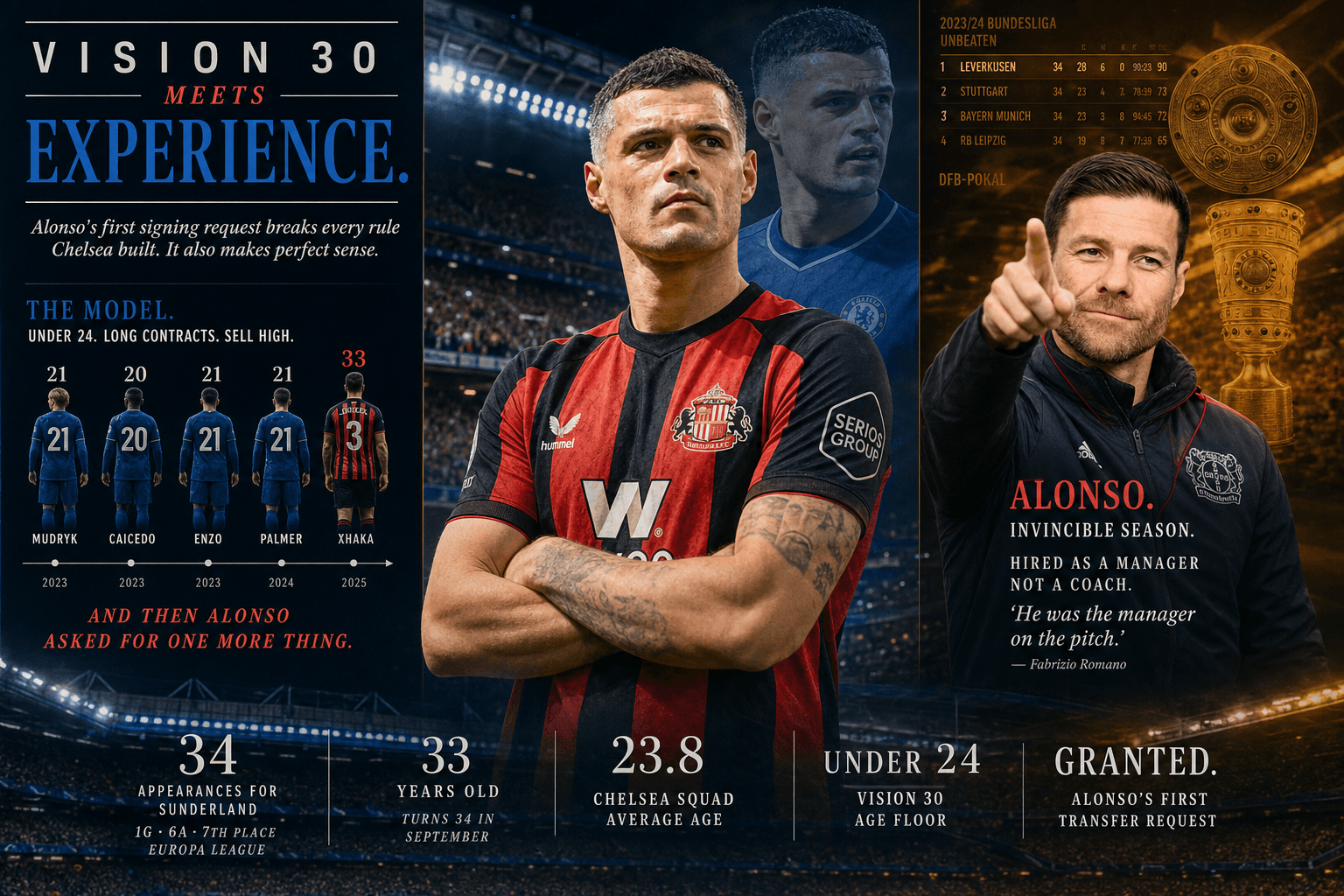
On the final day of the 2025-26 Premier League season, Sunderland beat Chelsea 1-0 at the Stadium of Light to confirm their Europa League qualification. The goal that sealed it was engineered by Granit Xhaka — the 33-year-old Swiss midfielder who had captained, organised, and in every meaningful sense defined the Black Cats' extraordinary debut top-flight campaign. Three weeks later, Chelsea's new manager Xabi Alonso has reportedly made signing that same player his first significant transfer request of the summer. The man whose last act was eliminating Chelsea from Europa League contention on the final day is now the player Chelsea's manager most wants in his squad. Football, occasionally, has a sense of humour.
What This Means for the Vision 30 Model
To understand why this transfer matters beyond its surface narrative, you need to understand the system it potentially disrupts. Chelsea's Vision 30 transfer model — documented in full in our piece on how BlueCo used PSR amortisation and long contracts to build a player factory — is built on a single non-negotiable premise: sign players under 24, tie them to contracts of seven to nine years, keep wages lean, and sell when the market values peak. Mykhailo Mudryk at 21. Moisés Caicedo at 20. Enzo Fernández at 21. Cole Palmer at 21. The model has a floor and that floor is youth. The same PSR rules produced a starkly different outcome up the road at Newcastle, where the club lacked Chelsea's amortisation flexibility — a contrast detailed in full in our pieces on how PSR collapsed Newcastle's project and Eddie Howe's resignation.
Granit Xhaka turns 34 in September. Chelsea's current squad average age is 23.8 — the youngest of any Premier League top-half club. Xhaka would walk into a dressing room where he is a decade older than the average player. That is not a minor administrative detail. It is a structural departure from the philosophy that Chelsea's sporting directors have operated since 2022. Signing Xhaka does not merely add an experienced player. It signals that the model has a second phase — that Xabi Alonso's arrival has introduced a different set of priorities to the recruitment conversation at Stamford Bridge.
As we explored in our analysis of Chelsea's three-manager Vision 30 era, the fundamental tension of the post-Abramovich period has been the conflict between the sporting directors' recruitment model and the needs of individual managers. Potter wanted different players. Pochettino wanted more control. Maresca was sacked after reportedly growing frustrated with the same limits. Alonso, who officially takes charge on July 1, appears to be operating differently from day one: his express request for Xhaka — confirmed by Fabrizio Romano — was reportedly actioned by BlueCo rather than deflected. That distinction matters. It is the first evidence that Alonso has been hired as a manager with genuine authority over recruitment, not merely as the latest technician in a system designed by others.
The Invincible Season: What Xhaka Did Under Alonso
Fabrizio Romano's framing of the Xhaka-Alonso relationship is the most illuminating detail in the entire story. Romano described Xhaka as the manager on the pitch for Xabi Alonso during their time together at Bayer Leverkusen — a phrase that captures a specific, irreplaceable role that no tactical system can replace. The 2023-24 Bayer Leverkusen season — the one the football world called the invincible season — was built on Alonso's tactical vision and Xhaka's ability to implement it in real time, across 34 Bundesliga games without a single defeat. Leverkusen went unbeaten across the entire Bundesliga season. They won the DFB-Pokal. They reached the Europa League final. They did it without losing in Germany once. Xhaka made 99 appearances for Leverkusen and won everything available. When Alonso speaks about Xhaka, he is not describing a player he admires. He is describing the player through whom his entire tactical system was communicated on the pitch.
Xhaka himself, speaking about Alonso previously, gave a specific description that goes beyond conventional manager praise. Xhaka described Alonso as someone who arrived without big-stage managerial experience but possessed instant authority — authentic, focused, caring only about what he saw on the pitch. That mutual That mutual understanding — Alonso's clarity and Xhaka's capacity to translate it — is the foundation of what Alonso wants to rebuild at Stamford Bridge.
Sunderland's Season: The Numbers That Convinced Chelsea
Xhaka joined Sunderland from Leverkusen in the summer of 2025 for £13 million — an eyebrow-raising destination for a player coming off the greatest season in Bundesliga history. He was reportedly keen on a return to London at that stage, with West Ham having shown interest, but chose Sunderland partly for the project, partly because the fee and terms suited all parties, and partly because — in a sentence that will be repeated for years — a 33-year-old former Arsenal midfielder chose to come and prove himself in the Premier League one more time.
He made 34 appearances in the Premier League, scoring once and registering six assists, as Sunderland finished seventh — their best top-flight position since 2016-17 — and qualified for the Europa League, their first European competition in their history. He was voted Sunderland's Player of the Season. Peter Schmeichel, assessing the transfer market in May, said Xhaka is the reason Sunderland are where they are. Football commentators who watched his performances week by week described a player who made Sunderland's midfield function in a way it simply could not without him — the tempo control, the defensive cover, the distribution, the leadership under pressure. His unbeaten home record at the Stadium of Light across the season was one of the Premier League's most talked-about domestic statistics.
Xhaka was the manager on the pitch for Alonso at the invincible Leverkusen. He was the heartbeat of a Sunderland side that had never played European football. He is 33, turns 34 in September, and Chelsea's new manager has made him a personal priority. Vision 30 signs players under 24. But it's about to make an exception. And the exception makes perfect sense.
Why 33 Is Not What It Used to Be — The Chelsea Precedent
The concern about Xhaka's age is understandable in the context of Chelsea's stated strategy. But Chelsea's own history contains the most compelling counter-arguments to the idea that signing a player in their mid-30s represents a departure from intelligent management. The club's most decorated periods have repeatedly included older players bought specifically for their experience, leadership, and ability to transmit winning standards to younger dressing rooms.
Michael Ballack joined Chelsea from Bayern Munich in 2006 at 29 — older than the stated cut-off of the current model — and became one of the most influential players in the club's early Roman Abramovich era. Mark Hughes, at 31, was a key figure in the Ruud Gullit-era Chelsea of the late 1990s, providing the physical and mental standard that the club's younger players did not yet possess. And the most direct precedent of all: Thiago Silva, who arrived at Chelsea aged 35 in the summer of 2020, became one of the most dependable and authoritative defenders in the club's history — a 35-year-old who made Chelsea a better team for three years through sheer quality and leadership. The fear about age at Chelsea has historically been less about what the player can do and more about whether the club's leadership can identify the right veteran at the right moment. Alonso has identified one. He has worked with him. He knows exactly what he gets.
The analogy that applies most precisely to Xhaka is Thiago Silva: a player in the latter stage of a decorated career, arriving at Chelsea when his football understanding is at its most complete even if his physical peak has passed. Xhaka at 33 can press harder than most 25-year-olds, because pressing is not about pace — it is about positioning, anticipation, and the intelligence to be in the right place before the ball arrives. He has spent two years at the highest level of German football and one season proving himself in the Premier League. He arrives at Stamford Bridge knowing exactly who he is and what he needs to do.
Why Alonso Was Hired as a Manager, Not a Coach
The Xhaka story illuminates something about the Alonso appointment that the club has not stated explicitly but that the transfer activity is making clear. The distinction between a manager and a coach in the modern football lexicon is specifically about authority over personnel decisions. Coaches implement systems with the players they are given. Managers shape the squad that plays those systems. As we documented in the Chelsea manager revolution piece, the fundamental tension of the Vision 30 era was precisely this: Potter, Pochettino, and Maresca were all, to varying degrees, coaches rather than managers — given a system built by sporting directors and asked to operate within it rather than shape it.
Alonso's first act of substance is an express request to the owners for a specific player. The owners actioned that request rather than deflected it. That dynamic — a manager who asks for something and gets it — is structurally different from anything Chelsea have operated with since Boehly took over. It suggests that Alonso's contract with BlueCo carries genuine recruitment authority, not just tactical responsibility. The invincible Leverkusen season was built on Alonso having control over the environment he created. If Chelsea have given him comparable control, the Xhaka signing is not a departure from Chelsea's model. It is the model under new management: still buying smart, still buying for specific purposes — but now buying what the manager needs rather than what the spreadsheet recommends.
The wider transfer context confirms this reading. Chelsea have also completed Marco Palestra's move from Atalanta for £43 million — a 21-year-old right-sided defender. The young asset for the model, and the experienced leader for the manager. Both simultaneously. That is not a contradiction of Vision 30. That is Vision 30 with an asterisk: the youth factory continues, but the factory now has a foreman who knows what he needs to make it run.
The Alonso Factor: What Chelsea Fans Need to Understand
Alonso inherits a Chelsea squad that finished 10th last season — the worst league finish of the Boehly era. He inherits a dressing room with an average age of 23.8 whose extraordinary talent has been consistently unable to convert individual quality into collective results. He inherits Cole Palmer, who may be the most gifted player at the club, operating without the kind of midfield platform that a Granit Xhaka provides. Palmer thrived in his debut season, scored his way to player of the year discussions, and then watched Chelsea finish 10th in his second. The youth model produced the talent. The youth model could not, by itself, produce the structure that talent needs to express itself in consistent winning.
That is the gap Xhaka fills. Not goals. Not assists. Not dribbles per 90 minutes. The ability to stand in a dressing room at 33 years old, having won a Bundesliga title without losing, having captained Switzerland at a World Cup, having dragged a newly promoted Sunderland side to European football in their first top-flight season in years — and tell 22-year-olds who have never won anything what winning actually requires. That knowledge is not available in the transfer market at age 22. It cannot be amortised across an eight-year contract. It arrives with the grey hairs, the tournament appearances, and the relationship with the manager who most needs it.
Whether Chelsea complete this deal depends on Sunderland's willingness to sell a player under contract until 2028 who they signed specifically to build their club around. The fee will not be small. Sunderland would not welcome the disruption. But Xhaka has reportedly already told Chelsea's people that he wants to return to London. He wants to work with Alonso again. He wants Stamford Bridge. The Premier League's most intelligent 33-year-old knows exactly what he is doing. So does his former manager. The pursuit ultimately fell through — Xhaka chose to stay and lead Sunderland into Europe instead — the twist that sent Alonso toward two very different veteran additions, covered in our piece on why Chelsea signed Welbeck and Henderson instead.
Xhaka to Chelsea — is this the transfer that signals the end of the youth-only Vision 30 era, or is it the smartest evolution of it? And should Chelsea break the model to get the deal done? Tell us what you think below. 👇