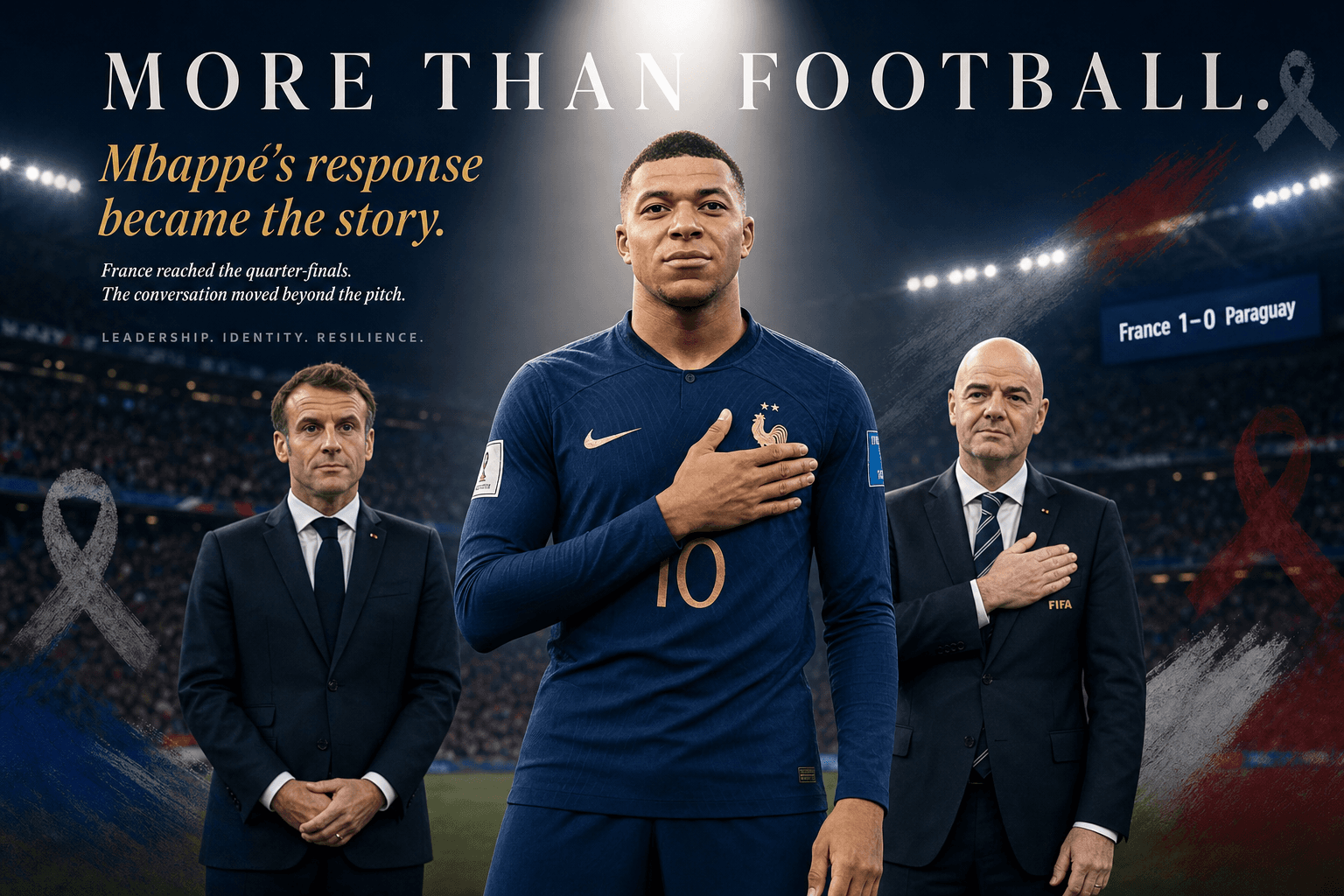
France beat Paraguay 1-0 to reach the World Cup quarter-finals, but the story that followed the final whistle had nothing to do with Kylian Mbappé's penalty. A Paraguayan senator's racist attack on Mbappé, and a separate remark from a former Paraguay goalkeeper describing France as "a squad from Africa," pulled the French captain, President Emmanuel Macron and FIFA itself into a controversy that has overshadowed one of the best wins of France's tournament.
A Bruising, Ugly Win in Philadelphia
On the pitch, France had to work far harder than the scoreline suggests. Paraguay, who had already knocked out Germany on penalties, set up to frustrate from the first whistle, sitting deep and committing bodies behind the ball in Philadelphia's extreme heat. France dominated possession at 76 percent but could not find a way through until the 70th minute, when substitute Désiré Doué was brought down in the box by Diego Gómez. Mbappé sent goalkeeper Orlando Gill the wrong way from the spot, his 19th World Cup goal in 19 appearances and his 11th in the competition's knockout stages, three more than anyone else in tournament history.
Gill was the best player on the pitch by some distance, twice denying Mbappé in stoppage time after already thwarting Manu Koné earlier in the second half. Remarkably, not a single Paraguayan player picked up a yellow card despite a physical approach that repeatedly halted the game's rhythm, including a shoving match between Andrés Cubas and Mbappé that summed up the tenor of the afternoon. Extreme heat, with temperatures hovering around 100 degrees Fahrenheit in Philadelphia, added another layer of difficulty, with hydration breaks and pitch-side sprinklers doing little to make the conditions comfortable for either side. France now face Morocco in the quarter-final in Foxborough on July 9, a repeat of their 2022 semi-final meeting in Qatar, which France won 2-0.
For Paraguay, elimination brought an end to a run that had already exceeded most expectations. La Albirroja reached the knockout stages for the first time in over a decade by eliminating Germany on penalties in the Round of 32, and their run to a World Cup quarter-final berth had been built almost entirely on defensive resilience rather than attacking quality, a template that worked right up until Mbappé's penalty. That defensive identity, and the intensity with which Paraguay's players and now some of its politicians have defended it, is central to understanding why the aftermath escalated the way it did.
The Comments That Overshadowed the Result
The controversy began before kickoff, when former Paraguay goalkeeper José Luis Chilavert referred to France as a squad representing Africa rather than France, comments that were swiftly condemned by French Football Federation president Philippe Diallo. It escalated dramatically after the final whistle, when Paraguayan senator Celeste Amarilla posted a series of racist remarks about Mbappé on social media, mocking his heritage and accusing France of only winning through luck.
Mbappé did not stay quiet. He responded directly on X, calling Amarilla unworthy of her position and accusing her of the "brazen racism" that had eclipsed the achievements of her own country's players at this World Cup. The French Football Federation released its own statement branding the senator's comments abject and demanding legal consequences. Sports minister Marina Ferrari called the remarks disgraceful, and President Macron posted his support for Mbappé directly, describing the moment as another goal for his captain, this time scored against racism.
"Through your recklessness and your brazen racism, the entire world has already forgotten the journey and the historic effort that your players accomplished during this World Cup." — Kylian Mbappé
Paraguay's Government Distances Itself
To Paraguay's credit, its government moved quickly to separate itself from Amarilla's comments, releasing a statement calling them contrary to the values of peaceful coexistence the country promotes, and stressing that a single senator's opinions do not represent the Paraguayan government or its people. FIFA president Gianni Infantino weighed in as well, condemning the remarks unequivocally and reaffirming football's stated commitment to fighting racism, a message he shared publicly rather than leaving to statements from national federations alone.
Amarilla, for her part, later published an open letter to Mbappé in French and Spanish saying her issue was with the player rather than the country, while also demanding an apology from him over his own choice of words and threatening legal action if he did not retract his comments — a response that did little to cool the story down heading into France's quarter-final week.
Mbappé's Growing Influence Off the Pitch
The episode has only reinforced Mbappé's standing as the dominant figure of this France squad, on the pitch and away from it. He is level with Lionel Messi on seven goals in the race for the Golden Boot, one behind Messi's all-time World Cup scoring record, and has captained France a tenth time at a major tournament — only the fourth player in the competition's history to do so.
That authority is starting to show up in the transfer market too. Mbappé is reported to be personally driving Real Madrid's interest in Michael Olise, a pursuit BackPage FC broke down in detail in our piece on Olise's rumoured Real Madrid move. The idea of Mbappé recruiting his France teammate to Madrid dovetails with the growing on-pitch partnership between the two at this World Cup, something we covered separately in our look at the Mbappé-Olise partnership powering France's run. A World Cup win, combined with Mbappé's clear influence in the Madrid dressing room, would only strengthen his hand in that pursuit.
What Comes Next for France
France will want the story to move on quickly. Morocco await in the quarter-final, a side that eliminated co-host Canada 3-0 and whose own French-born and France-connected players, including Ayyoub Bouaddi's high-profile international switch, add another political undertone to a tie that was always going to carry extra weight. For a squad that has now won its first four matches, scored three or more goals in five consecutive World Cup games — a tournament record — and beaten South American opposition with total consistency, the Paraguay aftermath is a reminder that football's biggest stage still can't fully insulate its biggest stars from the ugliest parts of the sport's audience.
A Pattern That Started Before Kickoff
What made the Amarilla controversy land so hard is that it did not come out of nowhere. Chilavert's "squad from Africa" remark in the buildup had already put the same theme — questioning the Frenchness of a diverse France squad built in part on players with roots across the African continent — into the pre-match conversation. Diallo's public rebuke of Chilavert, calling the comments a disgrace to the values of respect and diversity in football, should in theory have closed the subject before a ball was even kicked. Instead, Amarilla's post-match comments repeated a near-identical framing, this time aimed directly at Mbappé's Cameroonian heritage and his upbringing in the Paris suburbs, describing him in openly derogatory terms and claiming the France captain had been fearful throughout the match.
The senator, a member of Paraguay's opposition Liberal Radical Authentic Party who has sat in the country's Congress since 2023 and built a reputation for combative social media posts, later tried to reframe the dispute as a personal disagreement with Mbappé rather than a comment on France or its players more broadly. She also claimed to have faced similar insults herself as a mixed-race woman, while still refusing to fully retract her original remarks and instead demanding an apology of her own. That response satisfied almost nobody following the story, and did little to quiet a controversy that had already reached the desks of two heads of state.
Mbappé's Growing Influence Off the Pitch
The episode has only reinforced Mbappé's standing as the dominant figure of this France squad, on the pitch and away from it. He is level with Lionel Messi on seven goals in the race for the Golden Boot, one behind Messi's all-time World Cup scoring record, and has captained France a tenth time at a major tournament — only the fourth player in the competition's history to do so. His penalty against Paraguay was also France's 150th World Cup goal in the competition's history, a tally bettered only by Brazil, Germany and Argentina.
That authority is starting to show up in the transfer market too. Mbappé is reported to be personally driving Real Madrid's interest in Michael Olise, a pursuit BackPage FC broke down in detail in our piece on Olise's rumoured Real Madrid move. The idea of Mbappé recruiting his France teammate to Madrid dovetails with the growing on-pitch partnership between the two at this World Cup, something we covered separately in our look at the Mbappé-Olise partnership powering France's run. A World Cup win, combined with Mbappé's clear influence in the Madrid dressing room and his willingness now to speak publicly and forcefully on issues well beyond football, would only strengthen his hand in that pursuit and in his broader standing as the leader of this generation of France players.
The Morocco Test Looming Large
None of this changes the football problem directly ahead of France. Morocco have been one of the form teams of the tournament's knockout stages, physical and well-organised in the same way Paraguay were, but with considerably more attacking quality in behind their front line. France beat Morocco 2-0 in the 2022 semi-final in Qatar, and this quarter-final in Foxborough on July 9 carries echoes of that occasion, right down to the broader cultural conversations that have followed both fixtures involving players of North and West African descent representing European nations.
Didier Deschamps will be desperate for his players' attention to return fully to the football rather than the noise around it, particularly with Ousmane Dembélé, Doue and Olise all continuing to rotate through France's front line and Mbappé still searching for the extra goal that would take him level with Messi's all-time record. If France's dominant statistical tournament — four wins from four, three-plus goals in five straight matches, a genuine title-favourite tag — is going to continue, it will need to happen with the same composure Mbappé showed from the penalty spot against Paraguay, on and off the pitch alike.
For BackPage FC readers tracking the bigger picture of this tournament, the pattern is becoming familiar: football's biggest moments keep colliding with politics, identity and heritage, whether it is a French captain of Cameroonian descent facing racist abuse from a South American senator, or a Moroccan wonderkid choosing his mother's country over the France squad he once captained at youth level. Both stories will follow France into their quarter-final week, whether the team wants them to or not.
Do you think FIFA and Paraguay's federation have done enough in response to the racist comments directed at Mbappé?