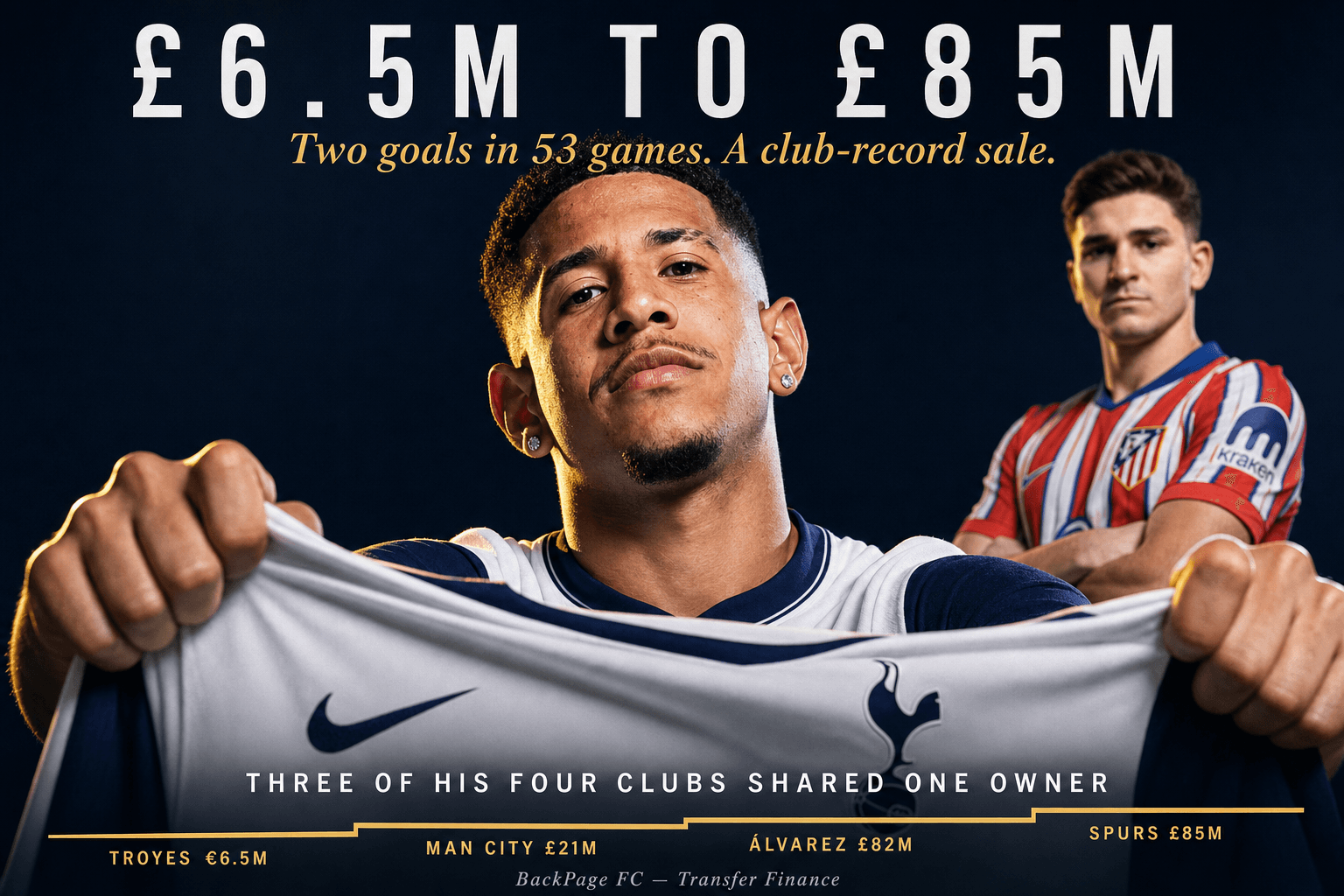
On 20 August 2026, Manchester City agreed terms with Tottenham for Savinho. Seventy-five million pounds guaranteed, plus £10 million in add-ons of which £5 million is near-certain. A package worth £85 million, and a club-record sale for Manchester City.
Now the numbers that make it strange. Savinho started five Premier League matches in 2025-26. He came off the bench eleven times. He finished the season with no goals and one assist from twelve shots. Across his entire Manchester City career he scored twice in 53 Premier League appearances. He was left out of Brazil's squad for the 2026 World Cup.
And £85 million is £3 million more than Atlético Madrid paid City for Julián Álvarez, who left after 36 goals in 103 games and a treble.
This is not a story about a winger's valuation. It is a story about what a multi-club structure can do to a number, and it starts in Ligue 2 with a player who never got on the pitch.
The Chain: €6.5m, Zero Minutes, Two Loans, One Internal Sale
Follow it in order, because the order is the point.
July 2022: Troyes sign Savinho from Atlético Mineiro for €6.5 million. Troyes are a City Football Group club. They never play him. Not one minute.
He is loaned to PSV, then to Girona, also a City Football Group club, where he finally performs. July 2024: City buy him from Troyes for an initial £21 million, rising to a maximum £33.6 million with add-ons. Not the flat £30 million widely quoted, which matters, because it puts the guaranteed profit on this sale above £50 million.
Both selling clubs in that chain were City Football Group entities. Savinho became the first player to have played at every level of the group, and the 2024 transfer drew protests from Troyes supporters over CFG moving value upward through its own network.
So: a €6.5 million Ligue 2 registration who never played for the club that bought him has become an £85 million Premier League sale, and every step until the last one happened inside the same ownership structure. City's business is tracked on our Manchester City transfer records page, Tottenham's on our Tottenham transfer records page.
Troyes paid €6.5 million for Savinho and never played him. Girona developed him. City bought him internally for £21 million. Tottenham are now paying £85 million. Three of the four clubs in that sentence are owned by the same group, and the one that is not is the one writing the cheque.
The Álvarez Comparison Is Brutal
Atlético Madrid paid £64 million up front plus up to £17 million in add-ons for Julián Álvarez in August 2024, an £82 million package. Savinho's is £75 million guaranteed and £85 million maximum. It beats the Álvarez sale on both measures, not just the headline.
Álvarez cost City £14 million from River Plate in January 2022 and left having scored 36 goals in 103 games with a treble on his record. Savinho cost £21 million and leaves with two Premier League goals in 53 appearances.
City's leverage was never sporting. It was contractual. After rejecting Tottenham's approach in summer 2025, City tied Savinho to a new deal running to 2031, leaving six years on the contract when Spurs came back this window. A player with six years remaining has no natural exit price, and the selling club sets whatever number it likes.
If you read our piece on how release clauses work and how clubs discover them, this is the mirror image of everything in it. There we covered Youri Tielemans leaving Villa for £35 million because a clause existed and Manchester United knew about it, and Matheus Cunha's exit on Wolves' instalment terms. Here there is no clause at all, so there is no ceiling. Six years of contract is the most powerful pricing instrument in football, and it is the one nobody writes about.
The Buyback Theory, and Why It Doesn't Hold
One explanation doing the rounds is that the £85 million includes a premium for City not inserting a buyback clause. It is an intuitive theory. It does not survive contact with the facts.
No reported version of the Savinho deal contains a buyback clause or matching rights. And City's clause architecture, which we documented in detail in our piece on buybacks, sell-ons and matching rights, applies specifically to academy graduates rather than acquisitions.
The pattern is genuinely consistent. City wrote a £40 million buyback plus a matching clause into James Trafford's 2023 sale to Burnley, then triggered it an hour before the 2025 deadline to beat Newcastle's £27 million offer. James McAtee's £30 million move to Nottingham Forest carried the same architecture. Oscar Bobb's £27 million sale to Fulham in January 2026 included a 20% sell-on and matching rights. In that article we traced this behaviour directly to City's Cole Palmer mistake, when they sold him to Chelsea for £40 million with no buyback, no sell-on and nothing else, and did not even haggle.
Savinho is not an academy player. He is a City Football Group acquisition. The clause premium theory is paying for the absence of something no source reports was ever on the table.
The Marmoush Theory, Which Is at Least Arithmetically Coherent
The more interesting explanation is a linked-deal price shift, and while it is explicitly a rumour rather than reporting, the arithmetic behind it uses independently confirmed numbers.
Savinho was reported all summer at around £65 million. The jump to £85 million coincides with Tottenham also agreeing a deal for Omar Marmoush, and Eintracht Frankfurt hold a sell-on share of City's profit on Marmoush. City paid Frankfurt €70 million, roughly £59 million, for him in January 2025.
Now do the maths. If Tottenham pay over the odds for Savinho and under the odds for Marmoush, City's recorded profit on Marmoush shrinks toward zero, and Frankfurt's sell-on percentage applies to a much smaller number. The total Tottenham pay stays broadly the same. The share leaving City's building falls.
Whether or not that is what happened, the mechanism is real and it is exactly what we explained in the buyback and sell-on piece: a sell-on clause is only as good as the profit it is calculated against. We showed there how City's own Ferran Torres sell-on never triggered because Barcelona sold him to PSG for under €50 million, just below the €55 million threshold City had written, which we covered in full in our piece on how Barcelona funded the Rodri transfer.
City know precisely how these clauses fail, because they have been on the wrong end of one this same summer.
In Fairness to Savinho: The Collapse Was One Season, Not Two
The "never proved anything" framing needs qualifying, because 2024-25 was genuinely good.
Savinho made 48 appearances under Pep Guardiola that season, and no City player matched his eight Premier League assists. Five of them were finished by Erling Haaland, whose contract situation we covered in our piece on the longest deal in Premier League history. Being the primary supply line to the most lethal striker in the division is not nothing.
The collapse was the second season. Five starts, no goals, one assist, and a World Cup squad omission for a Brazil side that has no shortage of wingers. Tottenham are betting the 2024-25 version returns. City are cashing in on the possibility it does not.
Why This Fits City's Whole Summer, and Tottenham's
The Savinho sale is not an isolated piece of business. It sits inside a full balance-sheet reset in Enzo Maresca's first summer at the Etihad. City have already sold Rodri to Barcelona for €76.5 million, along with Tijjani Reijnders and Nathan Aké, released John Stones and Bernardo Silva, and bought Elliot Anderson for a reported £116 million.
That is the mechanic we have described all summer. Under the financial rules we explained in our piece on how Squad Cost Ratio replaced PSR, clubs must sell before they buy, because spending is tied in real time to revenue rather than measured against a multi-year loss cushion. City are not selling Savinho because they must. They are selling him because a squad reset requires funding, and he is the asset with the widest gap between market price and current output.
For Tottenham, the context is the one we set out in our piece on why FFP only applies to clubs who qualify for Europe. Spurs missed European football entirely, which means they answer only to the Premier League's 85% domestic threshold rather than UEFA's stricter 70% cap. That freedom already funded the £100 million Sandro Tonali deal and the £85 million Mateus Fernandes signing we covered in our piece on the De Zerbi rebuild. Savinho is the same freedom spent again.
Note the symmetry with what we found in our piece on Manchester United signing Carlos Baleba for £50 million less than his 2025 valuation. United, back in the Champions League and constrained by the 70% cap, are hunting discounts on players whose price fell. Tottenham, with no European football and a softer domestic ceiling, are paying premiums on players whose price rose. Same window, opposite strategies, both dictated by which competition each club qualified for.
What This Actually Tells You
The multi-club model is usually discussed as a talent pipeline, and it is one. But the Savinho chain shows the second function, which is rarely stated plainly: value can be created by moving a registration between entities you already own, and then realised in full by selling to someone you do not.
Troyes bought a €6.5 million player and never used him. Girona developed him. City bought him internally at £21 million, gave him one excellent season and one poor one, extended him to 2031 to remove any exit leverage, and are now selling him for £85 million to a club whose lack of European football gives it more spending room than they have.
Every step of that is legal, and most of it is smart. But the next time a fee looks detached from a player's output, the useful question is not what he is worth. It is who owned him before, and what the paperwork was designed to do.
The opposite version of this story is playing out in Spain right now, where Levante wrote a €25 million release clause into Carlos Espí's contract and capped their own payday before an auction could ever start. We cover that in our piece on how Levante priced away their own windfall. One club engineered a ceiling out of existence. The other wrote one into their own contract.
Watch our full breakdown of the Savinho deal and the City Football Group chain behind it on BackPage FC Videos.
Savinho scored twice in 53 Premier League games and is leaving for £3m more than Julián Álvarez after a treble. Masterclass in asset management, or the clearest sign yet that multi-club ownership breaks transfer pricing? Tell us below.