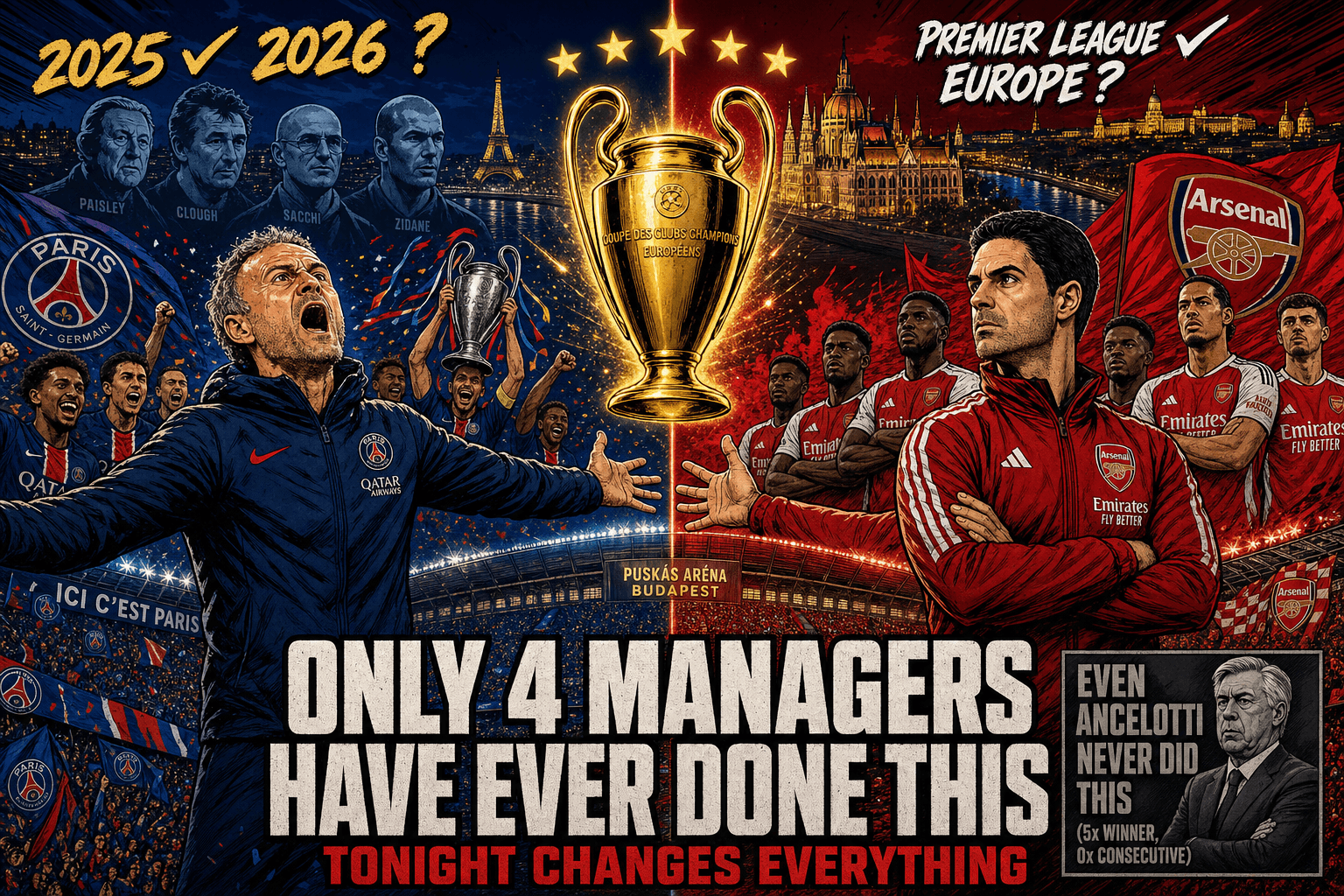
Budapest. 30 May 2026. The Puskás Aréna. Paris Saint-Germain against Arsenal. At 6pm CET, the most anticipated Champions League final in a decade kicks off — and on the PSG touchline stands a Spanish manager with the chance to do something that only one man has managed in the past 34 years. Win the Champions League. Then win it again.
What Is Actually at Stake Tonight
Luis Enrique has already won the Champions League twice — with Barcelona in 2015, when Messi, Suárez, and Neymar formed the most feared attacking trio in the world, and then with PSG in 2025, when a rebuilt, Mbappé-free squad dismantled Internazionale 5-0 in Munich in the most one-sided final of the modern era. Two titles. Two different clubs. Two completely different football philosophies made to work by the same obsessive, uncompromising coach.
Tonight, a third Champions League winner's medal would place him alongside Pep Guardiola, Bob Paisley, and Zinedine Zidane as the only managers in European Cup and Champions League history to win it three times. But that is not even the record that most defines what this evening means. The record that matters is the one nobody in the Champions League era has touched since Zidane at Real Madrid in 2018 — winning it back to back as a head coach.
In the 34 seasons since the European Cup was rebranded as the Champions League in 1992, one manager won it in consecutive years. One. Zinedine Zidane, with Real Madrid across 2017 and 2018 — part of a three-peat that remains the most dominant managerial sequence in the competition's modern history. Before the Champions League era, several coaches managed it across the broader European Cup history. But in the competition as the world now watches it, no one has repeated the feat since Zidane lifted the trophy in Kyiv eight years ago. Tonight, Luis Enrique has the chance to change that.
In 34 seasons of the Champions League era, one manager has ever won it back to back: Zinedine Zidane in 2017 and 2018. No one has come close since. Tonight, Luis Enrique is 90 minutes away from changing that entirely.
What PSG Have Done to Get Here
The route PSG have taken to this final deserves to be stated plainly before anyone discusses what Arsenal might do to stop them. PSG are holders and have been the most complete attacking side in this season's competition — 44 goals scored in the Champions League, one short of the all-time record for a single campaign. Chelsea were beaten 8-2 on aggregate. Liverpool were beaten 4-0. Bayern Munich were taken to a 6-5 aggregate semi-final that will be replayed and analysed for years. Luis Enrique finished 11th in the league phase. Nobody at PSG panicked. He had a plan, and by the knockouts, the timing was exactly right.
The attacking spine of Ousmane Dembélé, Khvicha Kvaratskhelia, and Désiré Doué is as dynamic as anything in European football. Kvaratskhelia alone has recorded the most goal involvements of any player in this season's knockout rounds with 10 — the first player to score or assist in seven consecutive Champions League knockout appearances in a single campaign. This is a team built for transition, improvisation, and speed. Luis Enrique did not just assemble talent. He built a system that gets the best from that talent at the precise moments the competition demands it most.
What Arsenal Have to Stop It
And yet. Arsenal are not here by accident. Mikel Arteta's side are Premier League champions — the fourth time the club has won the English top-flight title, and their first in 22 years. They have been unbeaten throughout the entire Champions League campaign. They have conceded just four goals in eight European matches this season. They conceded fewer Premier League goals than any other team in England this season, with goalkeeper David Raya equalling the club record for clean sheets with 19 across the league campaign.
The centre-back partnership of William Saliba — who signed a five-year contract extension in September having rebuffed Real Madrid's interest — and Gabriel Magalhães is, statistically and visually, the best defensive duo in European football right now. Bukayo Saka, Eberechi Eze, and Viktor Gyökeres offer the attacking threat. But it is the defensive structure that defines what Arteta has built: a refusal to concede the space PSG thrive in, a pressing system designed to make transition football impossible, and an intolerance for defensive error that has characterised every result across this run.
This is the unstoppable force meeting the immovable object. Luis Enrique put it plainly this week — he said Arsenal are, without the ball, the best team in the world. He was not flattering them. He was thinking, publicly, about the problem he has to solve.
The History of Back-to-Back: Why It Is So Hard
To understand what Luis Enrique is attempting tonight, it helps to look at who has done it and when. In the full history of European Cup and Champions League football going back to 1956, back-to-back wins have been achieved multiple times — Real Madrid's dynasties of the 1950s and 60s, Ajax in the early 1970s, Bayern Munich in the mid-70s, Liverpool at the end of the 70s, Nottingham Forest under Brian Clough in 1979 and 1980, and AC Milan under Arrigo Sacchi in 1989 and 1990.
But since the rebrand to the Champions League in 1992, the format changed. The competition became harder, deeper, more commercially driven, and more tactically diverse. Squads that dominate one year face a fully reorganised opposition the next. Injuries, form, and the sheer unpredictability of a knockout tournament conspire against repetition. Between 1992 and 2016, nobody managed consecutive wins as a head coach. Then Zidane and Real Madrid went on their three-peat — 2016, 2017, 2018 — and stood alone.
Even Carlo Ancelotti, the most decorated manager in Champions League history with five titles, never won it in back-to-back seasons as a head coach. He won it with AC Milan in 2003 and again in 2007. With Real Madrid in 2014, 2022, and 2024. Five titles — no other manager comes close. And yet consecutive wins eluded him every time. The footnote that exists — that as a player under Arrigo Sacchi, Ancelotti won the European Cup in 1989 and 1990 while playing in that Milan midfield — only underlines the point. Even the greatest manager the competition has ever produced could not replicate, from the dugout, what his own playing career had delivered as a twenty-something midfielder. That is how rare this particular feat is.
What Makes This PSG Different From Every Other Galáctico Project
The irony running through tonight's final is that Paris Saint-Germain spent most of the last decade chasing Champions League glory by assembling the most expensive squad in football history. Ibrahimović, Neymar, Cavani, and eventually Mbappé — generation after generation of superstars, season after season of early exits. The project looked, on multiple occasions, structurally incapable of winning the thing it existed to win.
Luis Enrique arrived in 2023 and spent the first year dismantling the superstar model. Neymar was moved on. Mbappé left on a free transfer to Real Madrid in 2024. The identity of the club shifted. Instead of building around individual brilliance, Luis Enrique built a collective — a pressing system, positional discipline, and a group of technically gifted players who operate within a clear structure rather than around a single untouchable star. The result was a 5-0 final demolition of Inter Milan in 2025 and a Champions League title that the club had chased for thirty years.
He has now built arguably the most entertaining attacking unit in European football without a single galáctico. Without Mbappé. Without Messi. Without Neymar. And tonight he is 90 minutes away from becoming only the fifth person in Champions League era history to win it back to back as a head coach — and the first to do so since Zidane's Madrid in 2018.
Arsenal's Own History Tonight
It would be wrong to frame this final purely through what Luis Enrique is chasing, because Arsenal are chasing something equally historic. Arsenal have never won the Champions League in their 140-year history. Their only previous final was in 2006 in Paris — a 2-1 defeat to Barcelona at the Stade de France, where a Thierry Henry-led squad led for most of the match before Robert Pires's replacement and ten men couldn't hold on. This is Arteta's side's chance to close a gap that has lasted two decades.
If Arsenal win, they become only the fourth English club to complete a domestic league and European Cup double, after Liverpool, Manchester United, and Manchester City. They become the 25th club to lift the Champions League trophy. And Mikel Arteta, who arrived at Arsenal in 2019 with a club in chaos and rebuilt it from the foundations up, would have the defining result of an already extraordinary managerial career.
History is available for both clubs tonight. That is what makes this particular final — PSG versus Arsenal, Budapest, 30 May 2026 — one of the most loaded ninety minutes European club football has produced in years.
Who do you think wins it tonight — and if PSG do it, where does Luis Enrique rank among the all-time great Champions League managers? Drop your take in the comments before kick-off. 👇