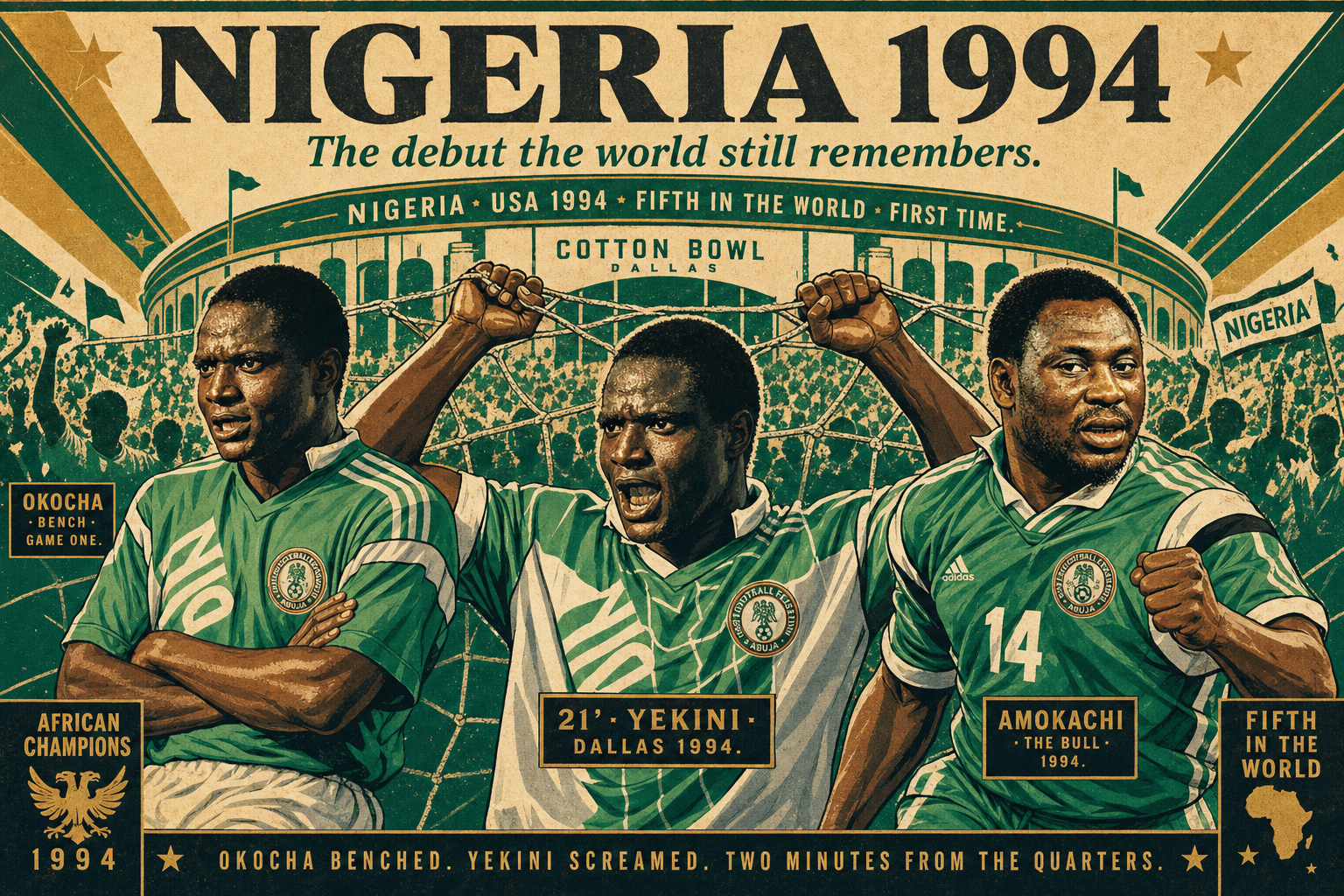
In April 1994, two months before a ball was kicked at the World Cup in the United States, Nigeria became the highest-ranked African team in the history of international football. Fifth in the FIFA rankings. They arrived as African Cup of Nations champions, having won the tournament in Tunisia in February — and the FIFA ranking has never been matched, or exceeded, by any African nation in the three decades since. That number — fifth in the world, February to June of 1994, the summer they debuted at a World Cup for the very first time — sits in a specific place in African football history that no subsequent achievement has displaced. Not Cameroon's quarter-final in 1990. Not Morocco's semi-final in 2022. Not Cape Verde's extraordinary debut in 2026, when they faced Spain, Uruguay and Argentina in four matches and never lost in 90 minutes against any of them, as we documented in our piece on Cape Verde's greatest debut in World Cup history. Fifth in the world. First time in the tournament. Nigeria arrived at USA 1994 with a squad and a moment that the rest of African football had been building toward for sixty years of the sport's existence.
The Coach Who Made a Promise in 1989
The Nigeria 1994 story begins not in Dallas or at the Cotton Bowl stadium but in 1989, when Dutch coach Clemens Westerhof took charge of the Super Eagles after Nigeria failed to reach the 1990 World Cup in Italy. Daniel Amokachi, a key member of the 1994 squad, recalled what Westerhof said to the players at his very first session: "I will make you the first to play at the World Cup." He had made it clear, from the opening conversation, that the goal of his tenure was the thing Nigerian football had never yet achieved. Westerhof spent five years building toward that promise. He identified the players, developed the system — a free-flowing 4-4-2 with attacking width and technical ambition — and, crucially, established the specific psychological environment that Amokachi later described as "we became more than a football team. We became a strong family." The promise made in 1989 was fulfilled in Pasadena in 1994 when Nigeria drew the qualifying lot that put them in USA alongside Argentina, Bulgaria, and Greece. The promise was completed in Dallas when Finidi George fed the ball across goal and Rashidi Yekini tapped it in.
The squad Westerhof assembled for that tournament is the gold standard of Nigerian football — the specific generation that every subsequent Super Eagles coach has been compared against and found wanting. Stephen Keshi was captain. Peter Rufai — "The Cat" — was in goal. The backline of Austin Eguavoen, Uche Okechukwu, Chidi Nwanu, and Ben Iroha gave the team its defensive structure. Sunday Oliseh was the midfielder whose technical quality connected defence and attack. Emmanuel Amuneke and Finidi George provided the width. And then there were the two forwards whose names are inseparable from the tournament: Rashidi Yekini, the man they called "The Goalsfather," and Daniel Amokachi, who became known as "The Bull."
The Benching of Jay-Jay Okocha
The story of Nigeria's opening game against Bulgaria begins with the most remarkable omission from the starting lineup. Jay-Jay Okocha — the player who many Nigerians consider the greatest ever to wear the Super Eagles shirt, whose specific technical quality and irreverence for the conventional moved crowds in a way that connected football to joy rather than simply to competition — started on the bench. Westerhof's reasoning, as reported at the time, was that the urgency of the first match did not need the "showboating" of Okocha. The debut game required discipline and organisation, not improvisation. Samson Siasia took the creative midfield role instead. Nigeria's greatest entertainer watched from the bench as his team performed one of African football's greatest opening performances.
The specific detail is that Nigeria won 3-0 without him. Yekini, Amokachi, Amuneke — all scored. Okocha's contribution to the debut was zero in statistical terms, and Nigeria did not need it. The coaching question of whether Okocha's specific genius would have made the 3-0 become 5-0, or whether his instinct for improvisation would have disrupted the tactical structure that made the victory possible, is the unanswerable question of the match. What is answerable is that Westerhof was right in at least one sense: Nigeria produced the most controlled and dominant performance of their international history without their most naturally gifted player, and the result stood. The 1994 World Cup gave African football Jay-Jay Okocha on the bench, and a 3-0 win. Both halves of that sentence are remarkable.
Rashidi Yekini's Goal and the Words Nobody Could Decode
In the 21st minute at the Cotton Bowl in Dallas, Finidi George received the ball down the right flank, turned away from the Nigerian goal, and delivered a low cross into the box. Rashidi Yekini arrived at the near post, tapped the ball into the Bulgarian net, and then ran directly to the goal, grasped the netting with both hands, and screamed words that nobody present, and nobody watching on television, has been able to decode in the thirty years since. His exact words — delivered in what appeared to be a mixture of English and something else, something private, something that belonged to a moment too large for conventional language — have never been definitively identified. The clips have been slowed down, the audio cleaned, the lip-reading experts consulted. The consensus is that he said something resembling "It's me, it's me" — but the specific meaning behind the repetition, the specific prayer or declaration or release that the goal represented for the man who had spent years being the best striker on the African continent without a World Cup to show it, remains Yekini's alone.
Rashidi Yekini died in May 2012, aged 48. Nigeria's all-time leading scorer — 37 goals in 58 international appearances — left the specific image of that celebration as the defining image of his life's greatest moment. FIFA listed it among the most iconic goal celebrations in World Cup history. The goal itself was nominated for the FIFA World Cup Greatest Goal Award in 2018, twenty-four years after it was scored. The player who scored it was not alive to receive that nomination. But the image of his hands on the net, and the words nobody could decode, is permanent in a way that decoded words often are not.
Nigeria were fifth in the world. African champions. Debuting at a World Cup for the first time. Jay-Jay Okocha watched from the bench. Rashidi Yekini scored and screamed words nobody has decoded in thirty years. They topped a group with Maradona's Argentina. And then, one man up, leading Italy with two minutes remaining, Roberto Baggio equalized and won it in extra time. This is the story of one of football's greatest ever weeks.
Maradona's Last World Cup Game Was Against Nigeria
The specific historical footnote that links Nigeria 1994 to the broader story of football's greatest figure is almost too poignant to be coincidental. Group D's second match, on June 25 at Foxboro Stadium, was Nigeria versus Argentina. Diego Maradona was on the pitch — still performing at the level that made Argentina credible contenders for the tournament. He scored against Greece. He made the pass that led to Caniggia's goals. He was there. The Nigeria match ended 2-1 to Argentina — Samson Siasia scoring to give Nigeria an early lead, before Claudio Caniggia scored twice to win it. After the match, Maradona's drug test came back positive for ephedrine. He was immediately excluded from the tournament. The Argentina vs Nigeria match was the last World Cup match Diego Maradona ever played. Siasia, who scored Nigeria's goal in that game, was the last man to score against Maradona at a World Cup. Nigeria, making their debut, was the opponent in the final chapter of the greatest individual story in the tournament's history.
The irony is that Caniggia — described in the match reports as someone who could run 100 metres in 10.79 seconds, reputedly the fastest footballer before the era of Usain Bolt — decided the match with two goals from his specific physical qualities. Maradona's genius created the platform. Caniggia's pace finished Nigeria. The Super Eagles could not overcome that combination. But they qualified from the group anyway — as group leaders.
Topping the Group: Above Argentina, Above Bulgaria
This is the part of the Nigeria 1994 story that is consistently underreported. Nigeria topped Group D. They finished above Argentina. They finished above Bulgaria — who went on, later in the tournament, to beat Germany in the quarter-finals and reach the semi-finals, where they lost to Italy. The group that Nigeria topped included Diego Maradona's Argentina and Hristo Stoichkov's Bulgaria. Nigeria's final group record: 3-0 win over Bulgaria, 1-2 defeat to Argentina, 2-0 win over Greece. Six points, group winners. The team that had never played at a World Cup before arrived, won the group, and faced Italy in the Round of 16.
The win over Greece in the final group match produced another moment for the permanent record. Yekini scored again. Amuneke scored. The performance was described by FIFA's technical observers as the most free-flowing and creative football Nigeria produced in the tournament — more assured than the Bulgaria opener, more controlled than the Argentina defeat. They had grown. One game into the knockout stage, against the eventual finalists, they were ready for their greatest test.
Two Minutes From the Quarter-Finals: The Baggio Injustice
Nigeria's Round of 16 match against Italy on June 30 is the most painful entry in African World Cup history. Emmanuel Amuneke scored in the 25th minute to give Nigeria the lead. They defended it. They defended the one-goal advantage for sixty minutes. Italy had a man sent off, leaving Nigeria playing against ten men for the final quarter of the match. Nigeria were one man up, 1-0 ahead, with approximately two minutes remaining. A slip from Sunday Oliseh — a moment that Eguavoen later described as simply inexperience, the tournament's new pressure finding its way into a single defensive moment — gave Roberto Baggio space. He took it, he scored, and the match went to extra time at 1-1. In extra time, Italy were awarded a penalty. Baggio converted. Nigeria lost 2-1 after extra time. A man up. Ahead for sixty minutes. Gone in two.
The word Roberto Baggio's equalizer sent Nigeria home with was "experience" — or rather the absence of it. Eguavoen's reflection thirty years later is the specific retrospective verdict: "We could have gone to the semis but we'd already punched above our weight." The Nigeria that lost to Baggio on that afternoon in Foxboro was not a bad team that got lucky and then exposed. It was a team of genuine quality that ran out of experience in the specific moment that the tournament required the most of it. Two minutes. One defensive slip. The difference between the quarter-finals and the flight home. As we explored in our piece on Samuel Eto'o and the trajectory of African football's greatest players, the 1994 Nigeria team was the specific generation that opened the doors — Amokachi's quote that they "opened the doors to other African teams" — through which Eto'o, Drogba, and Salah later walked.
What Happened Next: The 1994 Generation's Legacy
The players of Nigeria's 1994 World Cup squad went on to careers that reflected the specific quality of that tournament generation. Finidi George — who set up Yekini's first goal with that cross from the right — was part of the Ajax side that won the Champions League in 1994-95, the season immediately after the World Cup. He won Europe's greatest club prize months after Africa's greatest international tournament debut. Daniel Amokachi joined Everton in 1994 and famously substituted himself into an FA Cup semi-final without the manager's permission, scoring twice. Jay-Jay Okocha — the man on the bench for the Bulgaria opener — went on to PSG, Bolton Wanderers, and a career that generated the specific reverence expressed in the phrase "Jay-Jay Okocha, so good they named him twice." Sunday Oliseh, whose slip gave Baggio the equalizer, later managed Nigeria. Samson Siasia, who scored against Argentina, later managed Nigeria. Stephen Keshi, the captain, managed Nigeria to the Round of 16 at the 2014 World Cup in Brazil — completing a specific circle in which the man who captained Nigeria's debut thirty years earlier also coached the team's most recent World Cup run, a story as circular and poignant as any in African football.
The Italy connection cuts one more way. Brazil won the 1994 World Cup — beating Italy on penalties after a 0-0 draw in the final. Nigeria lost to Italy in the Round of 16. The team that eliminated Nigeria won the tournament — which is at least some comfort, and which connects Nigeria's 1994 story to the Brazilian World Cup journey documented in our piece on Brazil's European problem and why Ancelotti was hired to solve it. Brazil have not won the World Cup since 1994. Their relationship with that tournament and its specific European-tournament-defeat pattern began in the years following the tournament where Nigeria's story also ended. The threads connect in the way football's history always does — through specific results on specific days, thirty years ago, that carry their weight into the present.
Why 1994 Still Matters: Africa's Unbroken Benchmark
In 2026, Morocco reached the Round of 16 — as we covered in our piece on Morocco's threat at this tournament and the Bouaddi generation carrying the continent's ambitions. Cape Verde made the most extraordinary debut in World Cup history by any nation's measurement, facing Spain, Uruguay, and Argentina across four matches without losing in 90 minutes against any of them. The African teams at the 2026 World Cup are the heirs of a tradition that Nigeria's 1994 squad established in the most dramatic possible way. Fifth in the world. AFCON champions. Okocha on the bench for the opener and 3-0 anyway. Yekini's words that nobody could decode. Maradona's final World Cup game. Two minutes from the quarter-final. Roberto Baggio's equalizer. And a squad of players who went home, went to their clubs, won Champions Leagues and FA Cups and became coaches who returned to the same tournament with the same badge, trying to finish what that summer began.
The fifth-place FIFA ranking has never been equalled by any African nation. It may never be. The memory of that ranking, and the team that produced it, is the specific benchmark against which every African World Cup campaign is measured. Not only Nigeria's. All of them. The 1994 Super Eagles were the moment African football proved it could be great on the world's largest stage. Everything that has followed is the continuation of that proof.
Nigeria's 1994 World Cup debut remains the most complete single-tournament achievement in African football history — fifth in the world, AFCON champions, group winners above Argentina, two minutes from a quarter-final. Which player from that squad do you think was the most important to the story — and where does 1994 rank in African football history's greatest moments? Tell us below.